









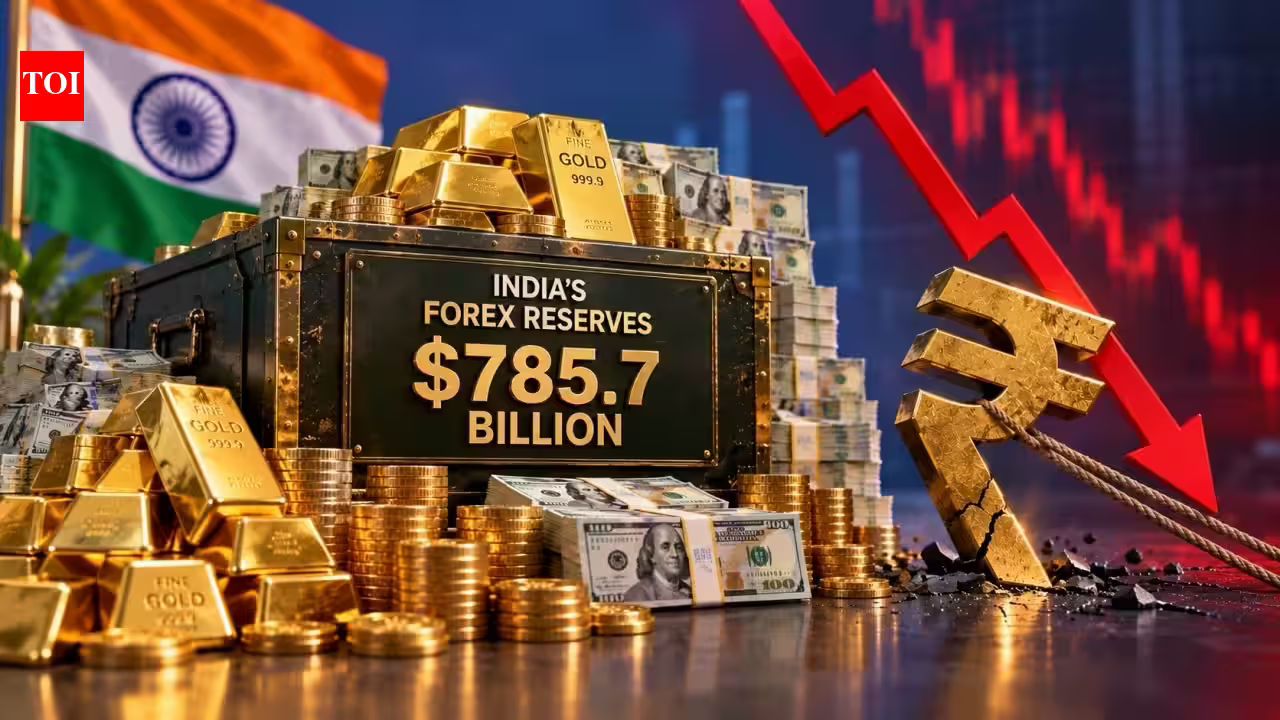
The landscape of Indian macroeconomics is currently defined by a notable paradox: the nation’s foreign exchange reserves have surged to record-breaking levels, yet the Indian rupee remains entrenched in a cycle of weakness. As of September 2026, India’s reserves hit an unprecedented $785.71 billion, bolstered significantly by the Reserve Bank of India’s (RBI) Foreign Currency Non-Resident (FCNR-B) deposit scheme. Despite this massive capital accumulation, the rupee continues to hover near the 95.7–96 per dollar range, leaving market participants and policymakers to grapple with the divergence between balance sheet strength and currency performance.
The Illusion of Reserves as Direct Market Support
The primary reason for the mismatch between record reserves and a struggling currency lies in the mechanics of how these reserves are accumulated. A substantial portion of the recent inflow—$136.38 billion—originated from the RBI’s special dollar swap scheme. Under this framework, banks swap dollars directly with the central bank rather than injecting them into the open market. Consequently, while the headline figure for forex reserves swells on the RBI’s ledger, these dollars remain parked, failing to enter the broader financial system as circulating liquidity that could otherwise support the rupee’s value.
This situation underscores a critical lesson in monetary policy: reserves reflect the capacity to intervene rather than the intent to manipulate market prices. While the RBI has utilized these reserves in the past—most notably during the mid-2026 oil price shocks—the impact of such intervention is often limited to managing volatility rather than shifting the fundamental trajectory of the currency. History has shown that selling reserves can slow a sharp devaluation, but it rarely acts as a permanent floor against sustained macroeconomic pressures.
Macroeconomic Drag: Trade Deficits and FII Outflows
Beyond the mechanics of reserve accumulation, the rupee is weighed down by persistent structural headwinds. The Indian economy remains vulnerable to a widening merchandise trade deficit, driven by the high cost of importing crude oil and gold. When oil prices climb—as witnessed with Brent crude breaching $109 per barrel amid regional geopolitical tensions—the demand for dollars to settle import bills spikes instantly, exerting continuous downward pressure on the rupee.
Compounding this is the behavior of Foreign Institutional Investors (FIIs). After a brief period of optimism in mid-2026, global investors have resumed a defensive stance, pulling billions out of Indian equities. This trend is exacerbated by the narrowing yield differential between India and the United States. With US Treasury yields reaching 19-year highs, the risk-adjusted returns of investing in emerging markets like India have become less attractive. When institutional investors can secure stable, safe returns in US-denominated assets, the incentive to allocate capital to rupee-denominated instruments diminishes, fueling further dollar demand and currency depreciation.
The Global Dollar Dominance
The strength of the US dollar index, currently oscillating near multi-week highs, acts as a primary benchmark for the global currency environment. The US Federal Reserve’s hawkish stance, driven by persistent domestic inflation and the necessity of high interest rates, has effectively turned the dollar into a vacuum for global capital. As the Fed signals potential further rate hikes, the “flight to quality” phenomenon intensifies, forcing emerging economies to face liquidity tightening.
Furthermore, economists point to the long-term implications of rising US government debt. While this might eventually lead nations to reduce their reliance on US Treasuries, the immediate effect is a perceived scarcity of dollars. For major trading partners like India, this transition period creates a difficult environment where the cost of capital remains high, and the domestic currency struggles to find equilibrium against a globally dominant greenback.
The Crude Oil Vulnerability and Geopolitical Risk
India’s reliance on imported oil, which accounts for roughly 85% of its total consumption, remains the country’s most significant economic vulnerability. This reliance creates a direct transmission channel between global energy markets and domestic currency stability. When crude prices rise, the rupee falls; when the rupee falls, imports become even more expensive, creating an inflationary feedback loop.
Geopolitical factors, such as the potential for US tariffs on nations purchasing Russian crude, add a layer of complexity to India’s trade policy. While India has navigated these waters by prioritizing energy security, any move to impose tariffs would likely reduce the trade surplus India enjoys with the US. To mitigate these risks, policymakers are considering strategies to de-dollarize parts of their trade, such as settling transactions in national currencies with major partners like Russia and China. However, such shifts require a massive overhaul of existing trade infrastructure and, until they gain traction, the rupee will remain tethered to dollar-denominated trade volatility.
Strategic Outlook: Reserves as a Safety Net
The RBI has maintained a consistent stance: it does not target specific levels for the rupee, but rather intervenes to curb excessive volatility and ensure the orderly functioning of the market. This policy is prudent, as using reserves to defend a currency against market forces is rarely a sustainable strategy. Instead, the current level of reserves—which covers approximately 11 months of imports—should be viewed as a vital “firewall” that provides macro-fiscal stability and credibility to international investors.
The road ahead necessitates a shift in focus from short-term intervention to medium-term structural adjustments. Strengthening domestic manufacturing to boost exports, managing inter-country trade imbalances, and fostering an environment where foreign investment is attracted by domestic growth rather than just yield differentials will be crucial. As the central bank continues to balance these competing pressures, it must rely on its massive reserves as a buffer for genuine crises rather than a tool for short-term price management. Ultimately, while the reserves offer significant protection against systemic collapse, the rupee’s value will continue to be dictated by the fundamental balance of trade, inflation differentials, and the shifting tides of global capital flows.
Disclaimer: This content is auto-generated for informational purposes only.
Source: Read Original News