





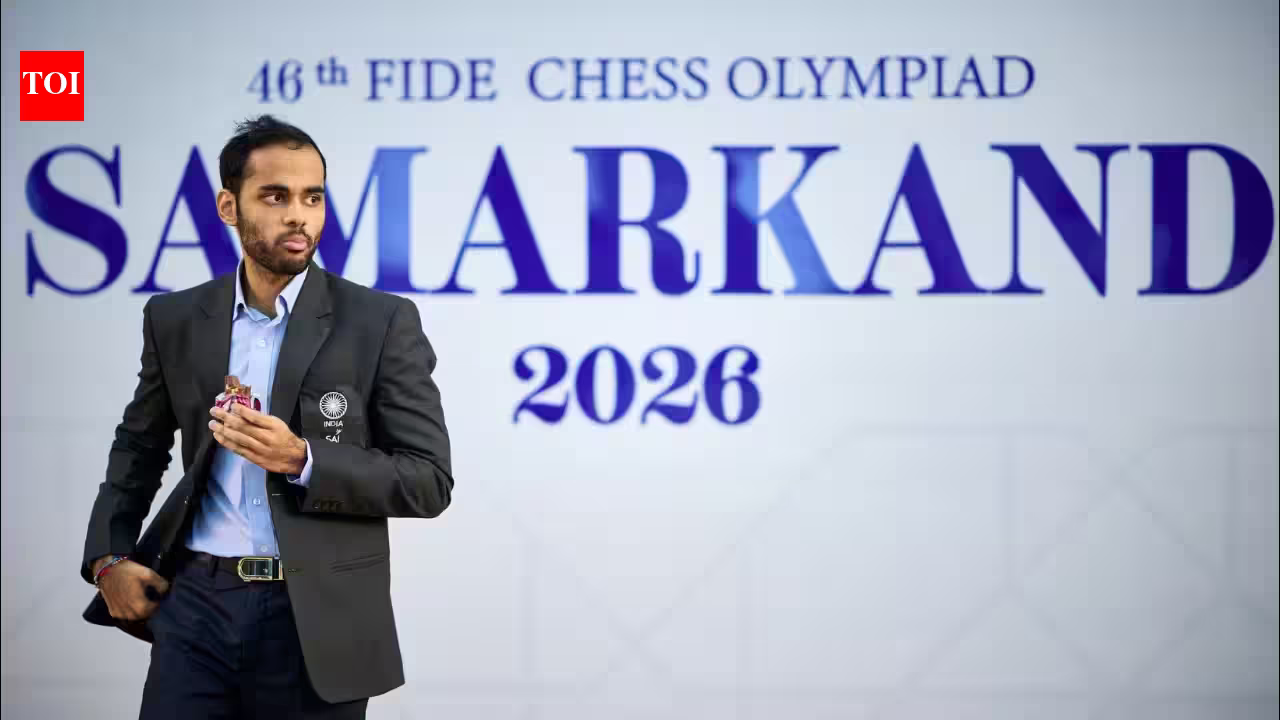
SAMARKAND — The 46th Chess Olympiad has been anything but a smooth sailing for the world’s elite, with organizational hiccups turning the arrival process into a test of patience for the sport’s biggest stars. Yet, for India’s formidable contingent, the turbulence of the opening days has officially been left in the rearview mirror. As the tournament shifts into its high-stakes phase, the Indian open and women’s squads are signaling to the rest of the world that their quest for gold remains very much on track.
The narrative of the tournament’s first few days was defined largely by the logistical nightmare in Samarkand. Reports of missing room allotments and exhausted players arriving straight from the grueling Global Chess League (GCL) in Bengaluru painted a grim picture for the favorites. Among those most affected was India’s No. 2, Arjun Erigaisi, who found himself thrust into the hot seat of Board 1 following Rameshbabu Praggnanandhaa’s decision to rest during the opening fixture.
The results were jarring: a surprising loss to Thailand’s 2363-rated International Master, Prin Laohawirapap. However, the world champion, Gukesh Dommaraju—who has navigated the chaos with a stellar 3.5/4 score—offered a sobering perspective on his teammate’s initial struggle.
“Arjun’s first game was very unfortunate, but it’s worth mentioning the hectic travel and organizational issues,” Gukesh noted in an interview with FIDE. “We all waited for like six hours to get a room. Arjun got his room just a few hours before the game. He was simply exhausted, and that led to the blunder.”
The Resurgence of Arjun Erigaisi
Gukesh’s assessment that the team was simply in a “wait-and-see” phase proved accurate by Saturday. With the rest of the squad having shaken off the jet lag and the initial logistical malaise, the Indian juggernaut began to fire on all cylinders. Arjun Erigaisi, looking refreshed and focused, delivered a masterclass against Spain’s Maksim Chigaev, securing a clinical victory that anchored India’s 3-1 team triumph.
Erigaisi’s win was a triumph of strategic patience. Opting for a flexible Réti/English setup, he methodically squeezed his opponent. By executing a space-gaining plan on the kingside—highlighted by an aggressive 12.h4 and 13.h5 sequence—he forced Chigaev into a defensive shell. The strategic inflection point arrived when Erigaisi executed the 17.Nh2 and 18.Bh3 maneuver, successfully exchanging bishops and clearing the path for a decisive kingside onslaught.
The endgame was surgical. After the 28th move, the transition into a queen-and-knight endgame left the Spanish king critically exposed. Erigaisi’s coordination of his pieces in the final phase, capped by an unstoppable 36.Qf7+, demonstrated exactly why he is considered one of the most dangerous attackers in the modern game. For Erigaisi, this victory was more than just a point; it was a psychological milestone, proving that his transition from the GCL to the Olympiad is complete.
Solidifying the Foundation
While Erigaisi grabbed headlines for his bounce-back performance, Gukesh continues to justify his world championship pedigree. His win against the seasoned Alexei Shirov was a masterclass, pushing his individual score to an impressive 4.5/5. This victory holds extra weight as it follows a minor dip in form for Gukesh earlier in the week, signaling that he has regained his impenetrable form. With Praggnanandhaa and Nihal Sarin stabilizing the board with disciplined draws, the open team is functioning like a well-oiled machine.
The women’s side of the tournament has mirrored this consistency. Despite lower-rated opposition in the fourth round, the Indian women’s team handled the pressure against Mongolia with professional maturity. While veterans Koneru Humpy and Vaishali Rameshbabu secured steady draws, the team’s depth was on full display as Divya Deshmukh and Savitha Shri delivered the necessary wins to secure a comfortable 3-1 match victory.
The Road Ahead: A Crucible of Tests
As the Indian teams remain unbeaten through the first four rounds, the competition is set to tighten significantly. The coming days will be defined by the “strength of schedule,” as the tournament organizers pit the most consistent performers against one another.
For the women, a high-stakes clash against Poland awaits on Sunday—a test that will require the same tactical versatility displayed against Mongolia. Meanwhile, the open team faces what many are calling their most significant challenge of the tournament thus far: a showdown against the Dutch squad led by the formidable Anish Giri.
Having navigated the initial chaos of Samarkand, the Indian teams appear to have found their rhythm. Whether they can maintain this momentum against the cream of the European field remains the central question of the Olympiad. However, based on the clinical dismantling of Spain and the resilience shown by Erigaisi and Gukesh, the defending champions are proving that they have the mental fortitude to handle both the administrative challenges off the board and the grandmasters across from them.
Disclaimer: This content is auto-generated for informational purposes only.
Source: Read Original News