








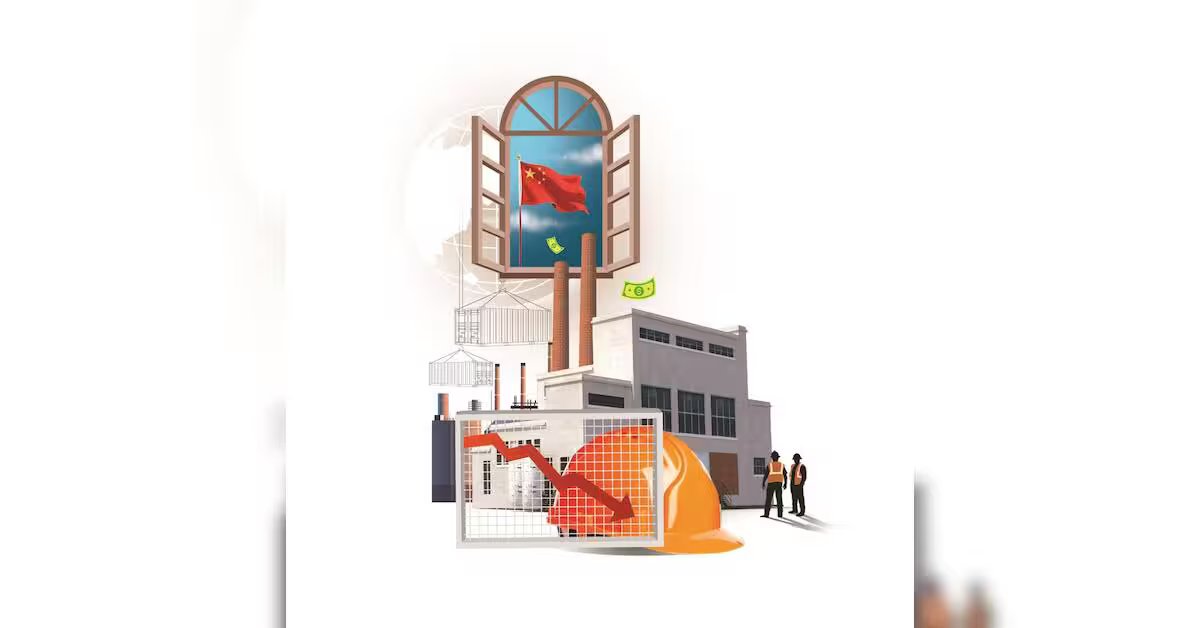
Why India is Lagging in the Global ‘China + 1’ Pivot
As global corporations scramble to de-risk their supply chains by moving manufacturing units out of China—a phenomenon widely known as the ‘China + 1’ strategy—India remains a peripheral player. Despite concerted efforts by New Delhi to court foreign capital through production-linked incentives and infrastructure overhaul, the country has struggled to translate this geopolitical shift into a surge of foreign direct investment (FDI).
While multinational enterprises (MNEs) are eager to diversify, they are increasingly choosing Southeast Asian neighbors such as Vietnam, Thailand, and Malaysia as their preferred landing spots. The data paints a sobering picture: while India has seen pockets of success, the bulk of the manufacturing exodus from China has bypassed its borders, finding more fertile ground in the ASEAN bloc.
The Competitive Edge of Southeast Asia
The disparity in success stems from a complex mix of logistics, regulatory hurdles, and trade integration. Southeast Asian nations have spent decades cultivating deeply integrated ecosystems that cater to high-volume exports. Vietnam, for instance, has effectively positioned itself as a hub for electronics assembly, benefiting from streamlined customs procedures and robust free trade agreements with major global economies.
In contrast, India continues to grapple with the “last-mile” challenges of doing business. While India offers a vast domestic market, MNEs looking for a ‘China + 1’ base are typically seeking an export-oriented manufacturing hub. These companies prioritize ease of cross-border trade, land acquisition stability, and predictable bureaucratic processes—areas where India still lags behind its Southeast Asian rivals. The “cost of compliance” remains high in India, often offsetting the advantages gained from low labor costs.
Structural Bottlenecks and Policy Implementation
Economists point to structural rigidities as a primary reason for the investment gap. Although the Indian government has launched ambitious initiatives to boost the manufacturing sector, these programs often face slow implementation cycles. Land acquisition remains a perennial pain point for large-scale industrial projects, and the complexity of state-level regulations adds layers of uncertainty for international investors.
Furthermore, the scale of integration into global value chains is vastly different. Southeast Asian countries have effectively specialized in specific niches—such as textiles, mid-level electronics, and automotive components—allowing them to act as plug-and-play hubs for global manufacturers. India, meanwhile, is still navigating a transition from a service-oriented growth model to a manufacturing-led one, which requires massive scaling of infrastructure that is currently underway but yet to reach maturity.
A Crucial Window for Reform
The ‘China + 1’ opportunity is not infinite. As global manufacturing priorities shift toward automation and proximity to end-markets, India has a shrinking window to position itself as a viable, large-scale alternative to China. The country’s strength lies in its demographic dividend and a growing technical talent pool; however, these assets require a corresponding improvement in the “ease of doing business” index to become a magnet for capital.
To catch up, India must shift its focus from attracting investment through incentives alone to removing the friction that deters long-term commitment. This includes strengthening regional logistics connectivity, simplifying labor laws, and ensuring that the shift from domestic consumption to export-oriented manufacturing is supported by competitive trade policies. Without a significant acceleration in these areas, India risks remaining a promising market for consumption rather than a powerhouse for global production, leaving the economic dividends of the global supply chain reshuffle to its neighbors.
Disclaimer: This content is auto-generated for informational purposes only.
Source: Read Original News