





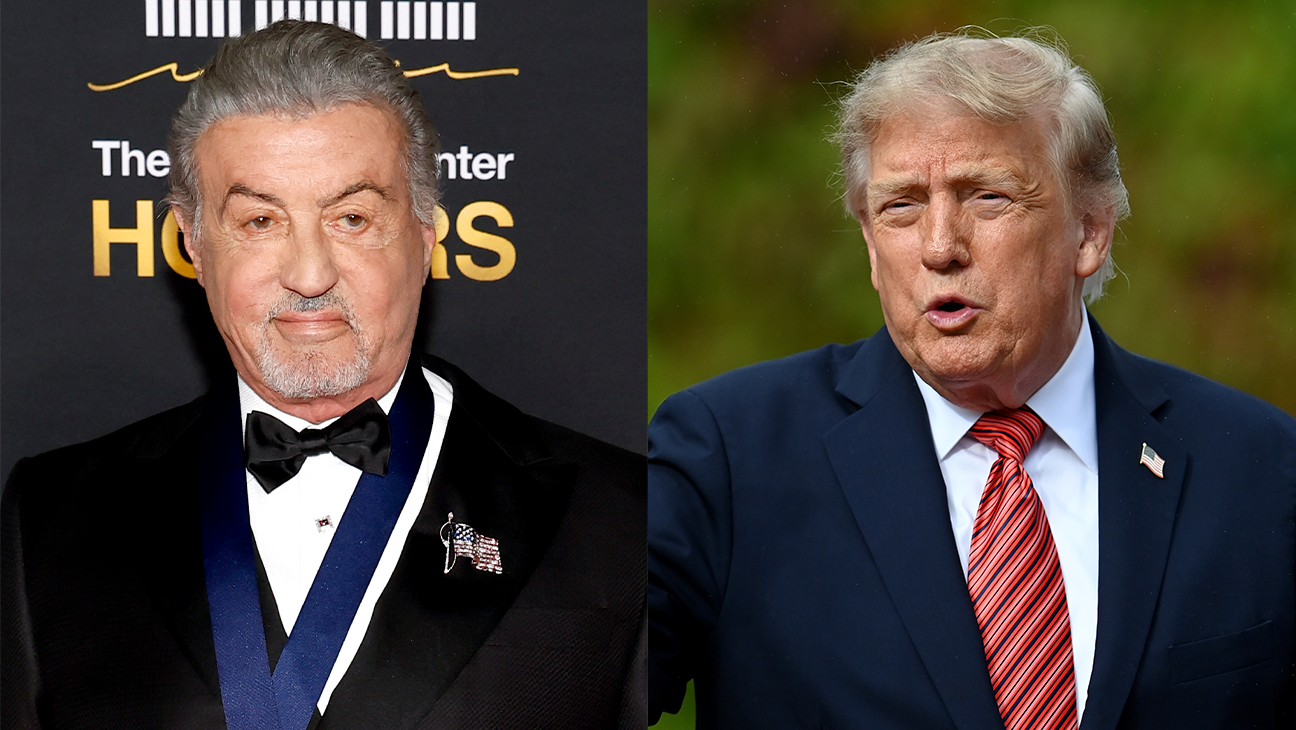
Sylvester Stallone has clarified his stance on a unique role bestowed upon him by President Donald Trump, revealing that he was effectively drafted into a position as a “Hollywood ambassador” without his prior consent or consultation.
The Rocky icon, who has long been a fixture in the entertainment industry, expressed genuine surprise when he first learned of his new title. The announcement originally came from Trump, who declared that he had appointed Stallone, alongside fellow industry veterans Mel Gibson and Jon Voight, to act as his “eyes and ears” in Tinseltown. The president’s goal was to leverage the trio to bring production business back to the United States and revitalize the domestic film industry.
A Surprise Appointment Discovered on Television
In a recent candid interview with The Sunday Times, the Tulsa King star recounted the moment he discovered his new diplomatic status. “I was watching TV one night and they go, ‘So Stallone and Mel Gibson and Jon Voight will be…’ And I went, ‘What?’ I said, ‘Excuse me? Really?’”
Stallone noted that had he been approached by the White House to discuss the role beforehand, he would have immediately declined. Beyond the lack of communication, the actor pointed to the structural realities of the modern entertainment business, which he described as a collection of “feudal states.” He argued that the complex, corporate nature of major studios makes it impossible for outside figures to dictate production strategies or financial decisions. “Corporate people won’t want to hear me tell them about finance,” he added, noting that he ultimately communicated his refusal to the administration.
Contrasting Approaches to Political Engagement
While Stallone has recently made headlines for his appearance at a post-election event at Mar-a-Lago, where he introduced the president-elect, he maintains that he is far from a partisan crusader. The actor described himself as a “political atheist,” noting that his support for political figures has spanned the spectrum throughout his lengthy career. He insists that he avoids being a “political animal,” preferring to focus on his craft rather than aligning himself with specific agendas.
This perspective stands in stark contrast to his fellow appointee Jon Voight, who has actively embraced the mission of serving as an advocate for the industry in Washington. Voight recently engaged in high-level discussions regarding federal film and television tax credits, arguing that leveling the playing field with international production hubs could trigger a massive resurgence in American filmmaking. While Voight remains bullish on the potential for a new “golden age” spurred by government intervention, he acknowledged that his fellow envoys have been occupied with their own professional commitments.
The Intersection of Entertainment and Tech Policy
The friction between political ambition and the realities of the film industry comes at a time when the broader entertainment sector is navigating its most significant technological shift in decades. As major studios grapple with the integration of generative AI in visual effects and scriptwriting, the role of federal policy has become increasingly critical.
Silicon Valley giants and legacy studios are currently lobbying for regulatory frameworks that balance the potential of AI-driven production tools with the protection of creative intellectual property. While Voight pushes for tax credits as the primary lever for economic growth, the industry at large is facing a more complex challenge: how to remain competitive in a global digital economy where AI-generated content can significantly undercut costs.
Stallone’s skepticism regarding the “ambassador” role underscores a deeper sentiment in Hollywood: that the industry’s future will likely be determined by the intersection of corporate tech innovation and shifting labor agreements, rather than the directives of political appointees. As Hollywood evolves, the gap between political rhetoric and the practical, AI-driven strategies of modern studios continues to widen, leaving veterans like Stallone to navigate their careers outside the influence of partisan mandates.
Disclaimer: This content is auto-generated for informational purposes only.
Source: Read Original News