



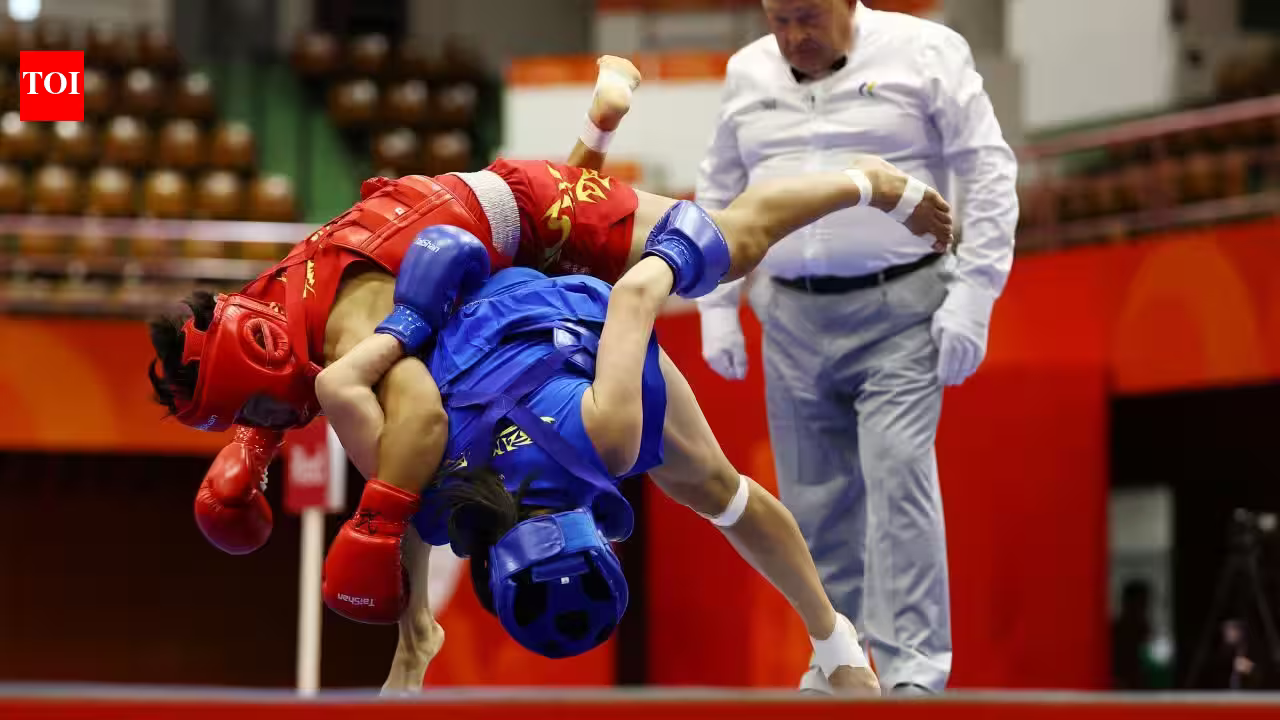
NAGOYA — In a display of grit, tactical brilliance, and sheer resilience, India’s Roshibina Devi Naorem has once again cemented her status as a titan of the Wushu mat. On Wednesday, the 25-year-old Manipuri powerhouse punched her ticket to the women’s 60kg Sanda final at the Asian Games, guaranteeing India yet another precious medal and matching the nation’s best-ever performance in the discipline at the continental level.
The path to the gold medal bout was paved with precision. Facing off against Indonesia’s formidable Thania Kusumaningtyas in the semifinal, Roshibina dictated the pace from the opening bell. Her 2-0 victory was a masterclass in the Sanda discipline—a sophisticated combat style that demands a seamless blend of striking, wrestling, and high-impact throwing. With this win, Roshibina ensured that she would stand on the podium for the third consecutive Asian Games, an extraordinary feat of consistency in a sport defined by its physicality and volatility.
From Last-Minute Call-up to Podium Icon
Perhaps the most compelling aspect of Roshibina’s journey in Nagoya is its unlikely beginning. She was not originally slated to lead India’s charge in this category. Her inclusion came as a result of a unfortunate injury sustained by Divyanshi, which opened a vacant spot in the squad. Roshibina, stepping into the void with short notice, proved that readiness is the ultimate competitive advantage.
Her transition from a replacement athlete to a finalist is a testament to her high-level training and elite conditioning. In a sport where technical precision can be the difference between victory and defeat, Roshibina has remained unflappable. Her run to the final included a dominant opening performance against Bangladesh’s Shika Khatun in the pre-quarterfinals, followed by a clinical 5-0 dismantling of Macau’s Chu Man Sin in the quarterfinals. Each round brought a different challenge, yet Roshibina navigated them with the calm of a veteran, systematically dismantling her opponents’ defenses.
A Legacy Forged in Combat
Born on December 30, 2000, in the Bishnupur district of Manipur, Roshibina has been a trailblazer for Indian Wushu for the better part of a decade. Her trajectory on the international circuit has been nothing short of meteoric. She first announced her arrival at the 2018 Jakarta Asian Games, where she secured a bronze medal, signaling that a new force had emerged from the Northeast.
She didn’t stop there. By the time the 2023 Hangzhou Asian Games arrived, she had evolved from a promising talent into a refined practitioner of the sport. In Hangzhou, she powered her way to the final, ultimately taking home silver after a grueling bout against China’s Wu Xiaowei. That performance not only elevated her profile but earned her the prestigious Arjuna Award, the highest honor for an Indian athlete.
Coming into Nagoya, the expectation was high, but the pressure to perform on the back of past success can often weigh heavily on an athlete. Roshibina, however, has treated the pressure as fuel. By reaching the final, she has now achieved a historic three-medal streak at the Asian Games, a record that secures her legacy as one of the most successful combat athletes in Indian sporting history.
The Final Frontier: A Showdown with China
As the sun rises over Nagoya on Thursday morning, all eyes will be on the final showdown. Roshibina is set to face China’s Zhang Xiaoyu in what promises to be the most rigorous test of her career. China remains the gold standard in Wushu, and Zhang represents the pinnacle of their tactical and physical training.
For the Indian camp, this is more than just a fight; it is an opportunity to rewrite the narrative. Having already assured herself of at least a silver medal, Roshibina heads into the ring with the freedom of an underdog and the poise of a champion. She is no longer just competing for a podium spot; she is competing for the top step.
The 60kg Sanda final is scheduled for 6:10 am IST on Thursday. As the nation prepares to watch, the sentiment is clear: regardless of the result, Roshibina Devi has already solidified her position in the pantheon of India’s sporting greats. Her journey—from the injury-stricken squad shuffle to the bright lights of the final—is a reminder of the relentless spirit that defines the very best in international sports. Whether she brings home the gold or adds a second silver to her collection, Roshibina’s campaign in Nagoya will undoubtedly go down as a defining moment for Indian Wushu.
Disclaimer: This content is auto-generated for informational purposes only.
Source: Read Original News