









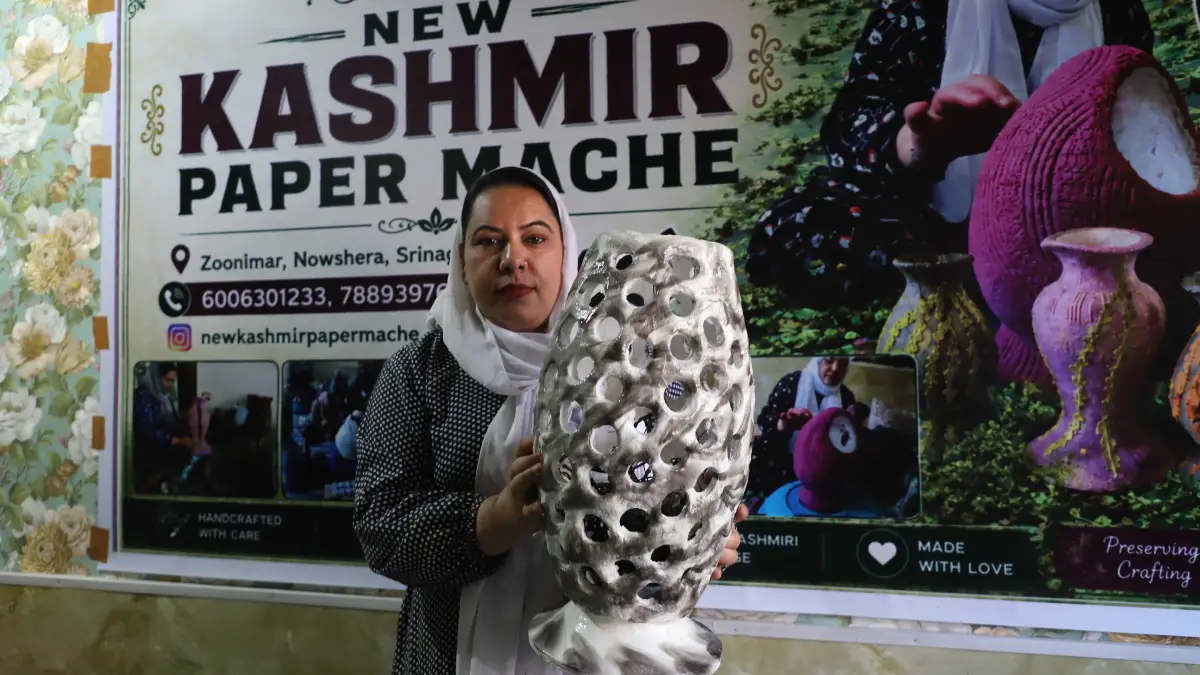
Srinagar’s ‘Grass Mâché’ Pioneer Transforms Dal Lake Waste into Sustainable Art
SRINAGAR – For decades, the massive amounts of grass and vegetation cleared from the surface of Dal Lake have been treated as nothing more than an environmental nuisance—a waste product discarded during the harvesting of Nadru (lotus stem) and Singhara (water chestnut). Today, 35-year-old Simran Irshad is proving that this “waste” is, in fact, a resource for a burgeoning green economy.
A resident of Nowshera, Srinagar, Irshad has spent the last two years pioneering a unique craft she calls “Grass Mâché.” By processing lake weeds into a pulp similar to the traditional papier-mâché technique, she is creating durable, eco-friendly decorative items. Her innovation stems from a forward-thinking concern: as paper becomes scarcer and the world shifts toward a paperless digital age, the traditional artisan community needs a sustainable alternative to ensure the survival of their craft.
“I started questioning what would happen if the trees used for paper become scarce,” Irshad explains. “I wanted to connect our long-standing handmade traditions with the urgent need to manage ecological waste.”
Her journey, however, has been far from easy. As a woman in a traditionally male-dominated artisan field, Irshad faced skepticism and societal pressure to remain at home. After persistent efforts, she secured training from local mentor Mohammad Yousuf Najar. Supported by her husband, Irshad Ahmad, she spent two years perfecting the formula for converting aquatic weeds into a malleable, workable pulp.
Beyond the artistry, Irshad’s work is deeply rooted in the economic health of her home. Because Srinagar’s economy is heavily dependent on tourism, she views the cleanliness of Dal Lake as a financial imperative. “If the Dal looks ugly, it hurts the image of Kashmir,” she notes. “By clearing these weeds to create something beautiful, I am helping the lake and the economy simultaneously.”
Despite the creative success, Irshad faces significant hurdles in scaling her production. Operating with limited space and resources, she is currently unable to meet the growing demand for her products, particularly from curious foreign tourists who value the sustainability of the materials. She is now calling on the government for financial support and infrastructure—specifically, machinery and space—to turn her experimental project into a viable industry.
Irshad’s vision extends well beyond her own workstation. She aims to establish a women-led collective that provides jobs for local women and youth, offering them a path to employment without the long, arduous struggle she endured to establish her own practice.
“My business has huge potential for employment generation,” says Irshad. “I don’t want others to spend two years finding their way alone like I did.”
As she awaits government intervention, Irshad continues to process the weeds of the Dal, turning the lake’s discarded remnants into a testament to ingenuity. Her work suggests a simple but profound truth: that in the right hands, what society calls waste is simply a story waiting for a new beginning.
Disclaimer: This content is auto-generated for informational purposes only.
Source: Read Original News