









Understanding the Mechanics of DLSS 5 Neural Rendering
The landscape of PC gaming performance has shifted dramatically with the emergence of NVIDIA’s DLSS 5, a sophisticated neural rendering framework that relies heavily on advanced artificial intelligence to upscale frames and generate entirely new pixels. By default, this technology is designed to operate within the specific architectural constraints of NVIDIA’s proprietary hardware, utilizing specialized Tensor Cores to perform high-speed FP8 (floating-point 8-bit) math. However, the open nature of software development on PC has led to a fascinating development: the DLSS-NR-on-AMD project.
This modification functions as a compatibility layer. By intercepting the calls that a game engine sends to the NVIDIA DLL, the mod translates those requests into instructions that AMD’s RDNA architecture can interpret. The key to this success lies in the recent RDNA 4 and RDNA 3 architectures, which possess enough raw compute power and support for necessary data types to handle the intensive neural calculations previously reserved for green-team hardware. By routing these neural computation tasks to the Radeon GPU, the mod effectively tricks the game into believing it is running on a compatible NVIDIA environment while utilizing the actual rasterization power of an AMD card.
Rapid Iteration and Performance Gains
The speed of the DLSS-NR-on-AMD project’s development is unprecedented in the modding community. In a whirlwind 24-hour period, the lead developer released two distinct iterations: Alpha 0.3.3 and Alpha 0.4.0. These releases were not merely minor bug fixes; they represented a significant overhaul of how the data is processed between the game engine and the GPU’s shader units.
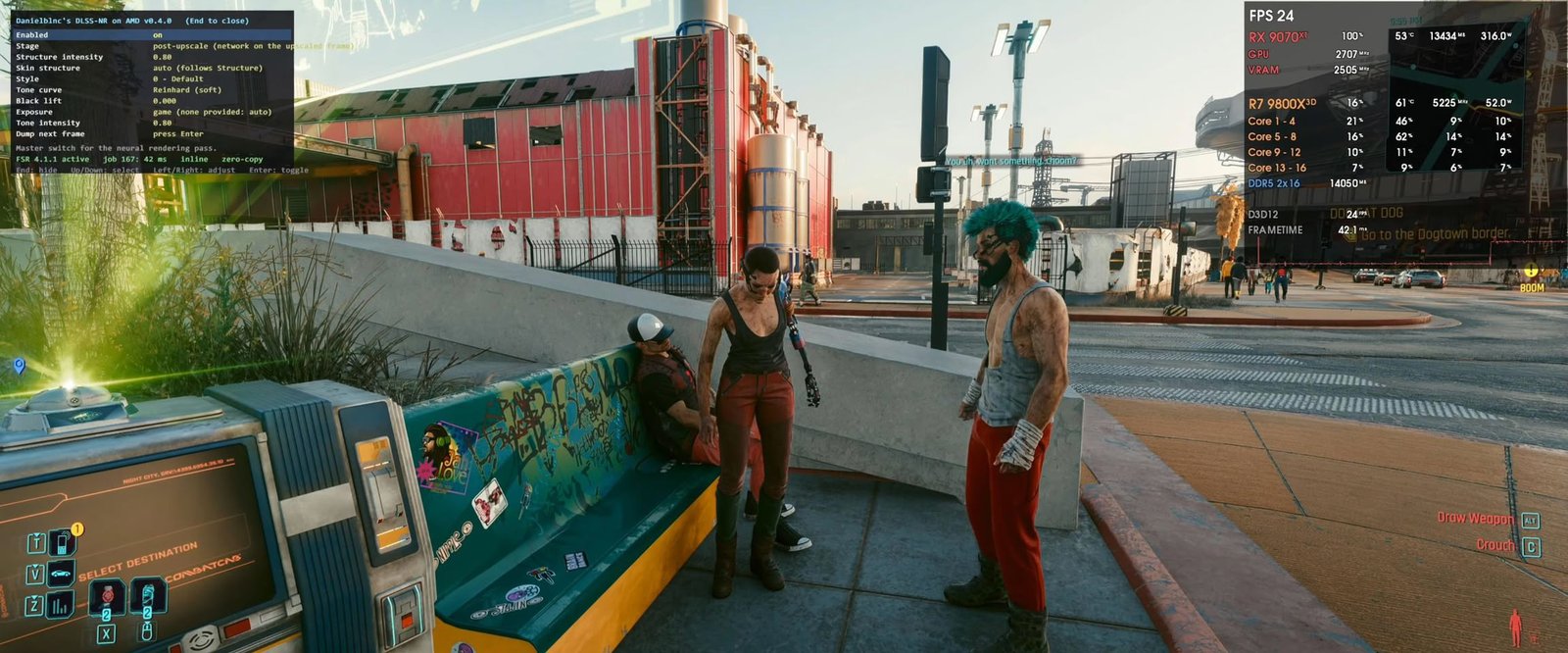
According to benchmarking data—most notably tests conducted in titles like Cyberpunk 2077 at demanding resolutions like 3440×1440—these updates have provided a cumulative performance boost of approximately 74 percent. To put this in context, early testing showed framerates lingering around a stuttering 30 FPS. With the application of the Alpha 0.4.0 build, those same scenes were pushing closer to 50 FPS. The release of Alpha 0.4.1 shortly thereafter added another 8 percent to the overall average, with a 9 percent uplift specifically during high-load scenarios. This trajectory suggests that as the translation layer becomes more efficient, the overhead required to emulate these proprietary calls is shrinking, bringing Radeon users closer to the intended performance parity of native neural rendering.
Usability and the Graphical Installer Revolution
Previously, implementing such complex modifications required users to navigate deep system file paths, manually swap dynamic link libraries (DLLs), and troubleshoot hexadecimal code errors. The release of Alpha 0.3.3 marked a turning point by introducing a graphical installer. This tool simplifies the entire process into a straightforward execution, effectively removing the barrier to entry for non-technical gamers.
The installer includes a built-in settings editor and an integrated overlay. This interface allows users to tweak the neural rendering parameters, such as sharpness presets or internal scale factors, without ever needing to restart the game or touch a configuration text file. By creating a standardized way to toggle the mod on or off and monitor its performance in real-time, the developers have successfully moved this project from a niche experimental script into a accessible utility that could eventually be managed with the simplicity of official driver software.
Broadening Compatibility Across Generations
While much of the initial excitement centered on the latest RX 9000-series hardware, the project has rapidly expanded its scope. Reports indicate that the modification is also functional on RX 7000-series cards, suggesting that the underlying math requirements are compatible with a wider range of RDNA-based hardware than many analysts initially assumed.
This universality is a hallmark of the recent wave of “leaked DLL” mods. Ever since the NVIDIA DLSS 5 DLL files became available through unintended channels, the community has taken a multi-pronged approach to implementation. Beyond the efforts on AMD hardware, variants of this technology have been successfully patched to run on older RTX 20, 30, and 40 series cards, and even surprisingly, on Intel integrated graphics. The fact that the DLSS-NR-on-AMD project shares some of these foundational discoveries highlights a collaborative spirit in the modding scene, where improvements found for one architecture are often adapted or optimized for others in near-real-time.
The Future of Unofficial Neural Rendering
The implications of this work are profound. When an unofficial mod can bridge the gap between two competing hardware architectures to provide a near-native experience, it challenges the traditional notion that proprietary software must remain tied to specific silicon. While this work remains unofficial and experimental, the gap between it and a native implementation is narrowing with every update.
The developer behind the project has hinted at further major releases, aiming to further reduce the latency penalty associated with the translation layer. For Radeon owners, this provides a glimpse into the future of frame generation and AI-assisted rendering, proving that advanced graphics techniques are not restricted by hardware brand loyalty, but rather by the limitations of software accessibility. As the project matures, it stands as a testament to the power of community-driven innovation to solve complex technical hurdles that many believed were insurmountable. Whether these tools eventually reach a state of absolute stability remains to be seen, but the current momentum suggests that neural rendering is becoming a universal standard for PC gaming, regardless of the GPU logo on the box.
Disclaimer: This content is auto-generated for informational purposes only.
Source: Read Original News