








Islamabad Levels False-Flag Allegations Following Recent Kashmir Encounter
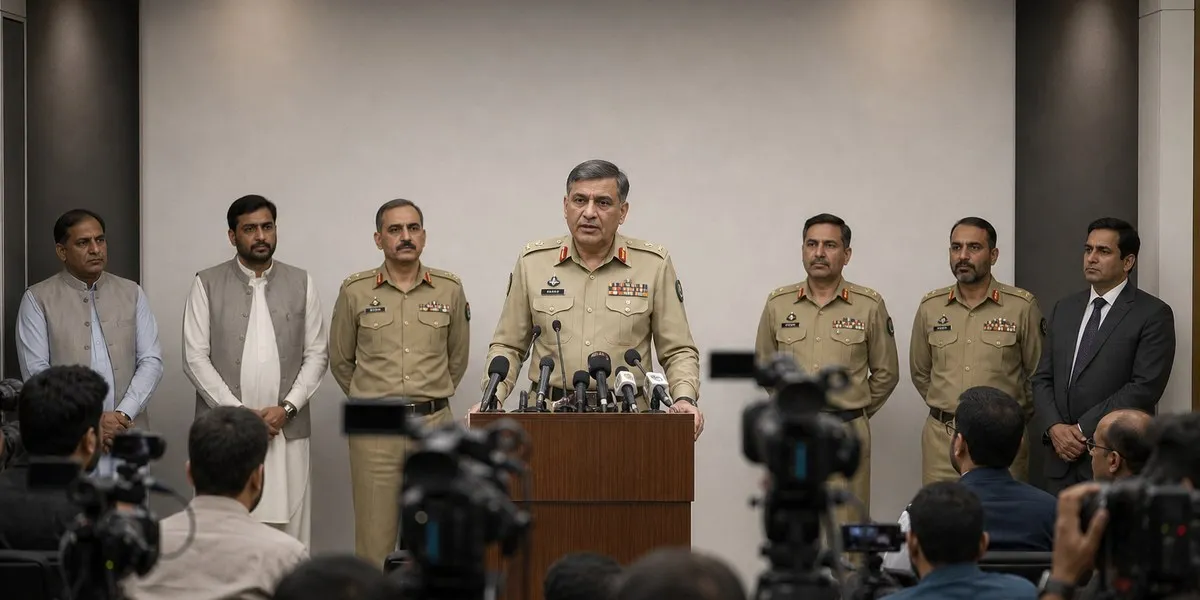
In a move that has further strained the already fragile atmosphere along the Line of Control, Pakistan’s military leadership has leveled fresh accusations against New Delhi. During a recent media briefing, Lieutenant General Ahmed Sharif Chaudhry, the Director General of the Inter-Services Public Relations (ISPR), publicly alleged that India’s military and political establishment orchestrated a “false-flag” operation to malign Pakistan.
The statement from the Pakistani military spokesperson came in the wake of an operation in the Korag area of Kashmir, where Indian forces successfully neutralized an individual identified as Mohammad Asif, alias Hashim Musa.
Details of the Kashmir Operation
According to reports from Indian media outlets, including the news agency ANI, the operation targeted a militant linked to the banned terrorist organization Lashkar-e-Taiba. Indian security agencies have identified the deceased as a key figure wanted in connection with the April 22, 2025, attack on tourists in the Pahalgam region of Kashmir.
Indian military records, specifically those cited by the Chinar Corps, suggest that Asif held a significant background in militant operations. ANI further reported that the individual had a documented history with the Pakistani military establishment, alleging he joined the Pakistan Army in 2000 and was later inducted into the elite Special Services Group (SSG). Furthermore, claims have been made that Asif was previously involved in the security detail for former Pakistani President Pervez Musharraf, a detail that New Delhi views as evidence of the deep-rooted links between state-sponsored elements and cross-border terrorism.
Pakistan’s Response and Denials
During his briefing, DG ISPR Ahmed Sharif Chaudhry dismissed the reports surrounding the encounter as a fabrication. He characterized the events of September 29, where the Chinar Corps announced the successful neutralization of the militant, as a calculated, “so-called” terrorist incident staged by the Indian state. By labeling the operation a “false-flag,” Islamabad continues its established policy of denying any connection to the violence plaguing the region.
This latest round of diplomatic and military sparring follows a period of heightened volatility. After the April 2025 Pahalgam attack, which targeted innocent civilians, New Delhi was swift to point to evidence of cross-border involvement. Islamabad, however, maintained a stance of total denial, repeatedly calling for what it terms a “neutral investigation”—a request that India has historically rejected, citing Pakistan’s failure to dismantle the infrastructure of terrorism on its own soil.
A History of Border Volatility
The rhetoric surrounding this encounter carries significant weight given the recent history of direct confrontation between the two nuclear-armed neighbors. Relations have remained severely degraded, reaching a breaking point in May 2025 when a four-day conflict erupted between Indian and Pakistani forces. That skirmish, which brought both nations to the brink of a wider war, eventually subsided following a ceasefire agreement on May 10, 2025.
As both nations trade accusations, the incident in Korag highlights the ongoing challenge of maintaining regional security. While India remains steadfast in its efforts to root out individuals linked to the Lashkar-e-Taiba network, Pakistan’s persistent strategy of casting doubt on these security operations reflects a deepening divide that shows few signs of narrowing. With both sides maintaining rigid narratives, the incident serves as a stark reminder of the volatile nature of the conflict in Jammu and Kashmir.
Disclaimer: This content is auto-generated for informational purposes only.
Source: Read Original News