








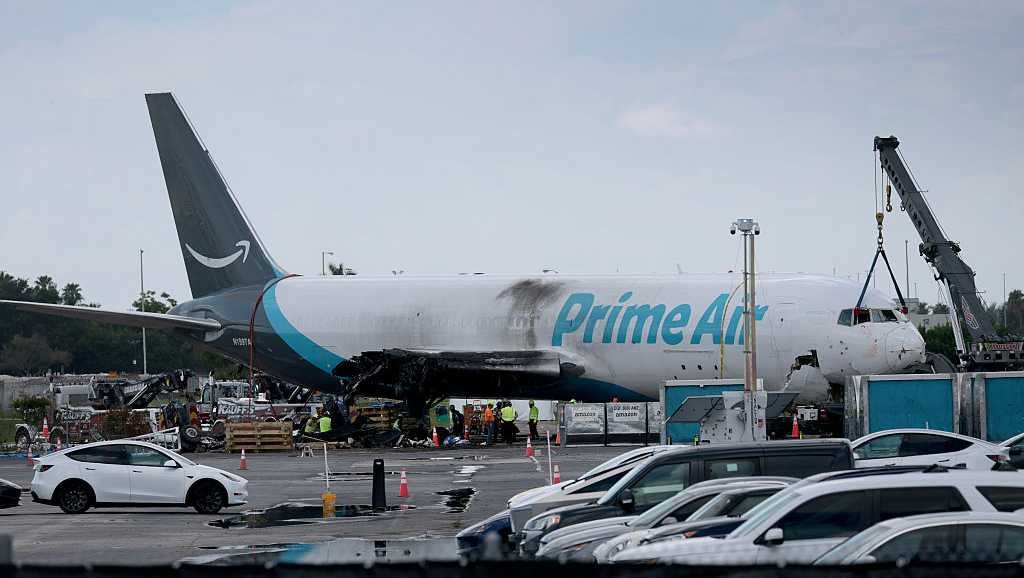
The National Transportation Safety Board (NTSB) has released its preliminary report regarding the fatal September 6 cargo jet crash at Miami International Airport, providing a harrowing glimpse into the final moments of an accident that claimed five lives.
The incident involved a Boeing cargo jet, operated by 21 Air and contracted by Amazon, which overshot the runway before colliding with a service vehicle on the tarmac. According to the federal investigators, the aircraft was traveling at approximately 130 miles per hour when it exited the runway. The collision resulted in the deaths of five people who were inside a van positioned on the airfield at the time.
The NTSB’s findings highlight a series of mechanical and procedural anomalies that occurred during the landing sequence. Most notably, the report confirms that the aircraft’s thrust reversers—critical components used to decelerate a jet after touchdown—failed to deploy. Investigators stated that it remains unclear why the systems were not activated.
Further inspection of the flight data and cockpit imagery revealed that the aircraft’s speed brakes were stowed upon landing. These panels, located on the wings, are designed to reduce lift and increase drag to help the plane settle firmly onto the runway; their inexplicable retraction during the landing phase may have significantly hindered the pilots’ ability to shed speed. Additionally, investigators noted that while wheel brakes were engaged at one point during the landing rollout, they were subsequently released.
Voice data recordings recovered from the cockpit provide insight into the pilots’ final actions. The audio indicates that one of the crew members called for a “go-around”—an emergency maneuver intended to abort the landing and initiate an immediate takeoff—just 15 seconds before the recording ends and the impact occurred.
While these findings offer a clearer picture of the aircraft’s physical state, the NTSB emphasized that the document is strictly preliminary. No official cause for the tragedy has been determined, and a final report, which will synthesize all technical and human factors, could take months or even years to complete.
In response to the release of the report, 21 Air issued a statement acknowledging the gravity of the findings. “We are reviewing the information in the NTSB preliminary report closely, alongside our own internal safety and operational protocols,” the company stated. “We will take all appropriate action to improve our safety based on the facts as they are established.”
Amazon has since announced the suspension of its operations with 21 Air in the wake of the disaster. As the investigation continues, the aviation community remains focused on the NTSB’s ongoing work to determine why the critical deceleration systems were either not engaged or failed to respond during the landing.
Disclaimer: This content is auto-generated for informational purposes only.
Source: Read Original News