







India’s Path to 2047: Navigating Growth Hurdles for Developed Status
India’s aspiration to transition into a developed economy by 2047 is an ambitious goal that hinges on consistent, high-level performance. According to the latest report, India Forward: Reimagining Growth, jointly released by S&P Global and Crisil, the nation must maintain an average annual GDP growth rate of approximately 7.8 per cent to realize this vision. While India has demonstrated remarkable macroeconomic resilience, the report underscores that sustained momentum will require a concerted effort to revitalize private investment, bolster infrastructure, and navigate critical energy and financial bottlenecks.
Building on Strong Foundations
India entered the 2026-27 fiscal year bolstered by a robust economic framework. The economy showcased significant strength in the preceding year, clocking a 7.7 per cent growth rate—a figure that comfortably outpaced analyst expectations despite a volatile global backdrop marked by trade complexities.
Several indicators point to a stable internal foundation: foreign exchange reserves now provide a comfortable cover for over nine months of imports, and the banking sector is in its healthiest state in years, with gross non-performing asset ratios hitting a decade-low of 1.8 per cent. Furthermore, central foodgrain reserves stand at a healthy 92.6 million tonnes, and Crisil reports a healthy credit rating outlook, with upgrades outpacing downgrades by 1.50 times.
However, the report warns that India’s deeper integration into the global economy—while beneficial—has heightened its susceptibility to external shocks. Geopolitical tensions in the Middle East have triggered concerns over crude oil price spikes, while erratic monsoon patterns—with rainfall trailing long-term averages by 14 per cent through August—continue to threaten agricultural stability and inflation control.
The Investment Imperative
To hit the necessary growth targets, India must raise its total investment rate beyond the current 32 per cent of GDP. The key lies in catalyzing private capital expenditure. The report identifies semiconductors, electric vehicles, and defense as the primary engines of this shift, projecting that these sectors will capture over a quarter of all industrial investment in the coming five years, more than doubling their share from the previous half-decade.
Capital flow remains a complex variable. While gross foreign direct investment reached $94.5 billion, net inflows were curtailed to $7.8 billion after accounting for repatriations and outward investments. Coupled with a 16.6 per cent decline in net foreign portfolio inflows, the data suggests that creating a more attractive, stable environment for long-term capital is essential.
Energy and Infrastructure Challenges
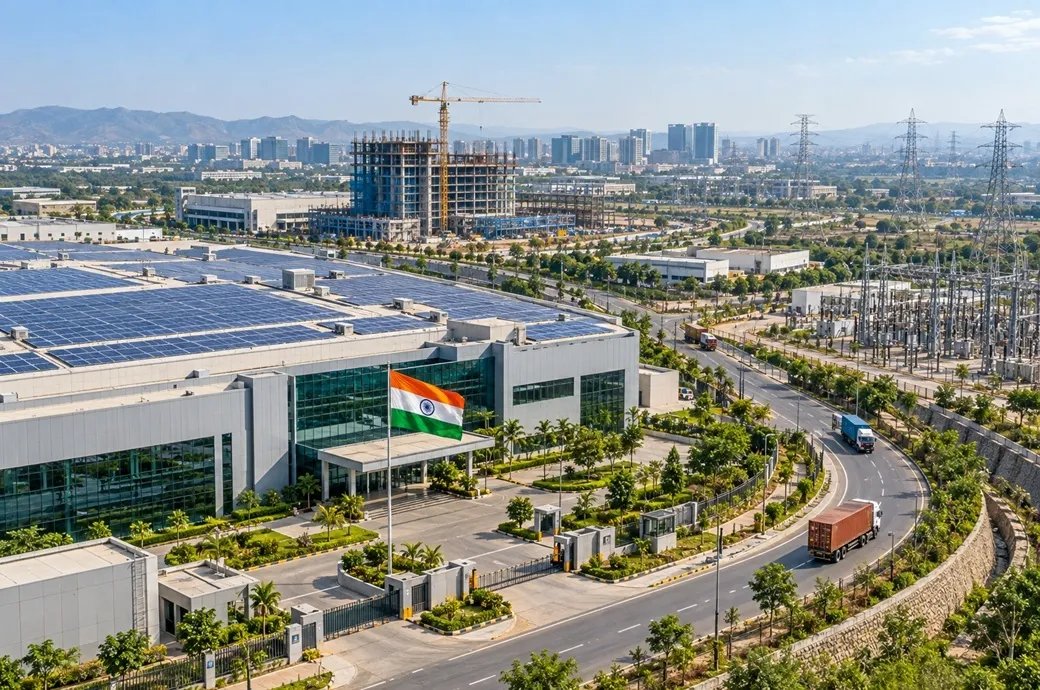
Energy security is arguably the most critical pillar for India’s industrial scaling. Electricity demand is projected to grow at an annual rate of 5.56 per cent, significantly outpacing overall energy demand. To meet this, the national energy basket must undergo a radical transformation, necessitating the addition of 300 GW of solar capacity and 95 GW of storage by 2035.
Significant hurdles remain, specifically regarding grid capacity. Infrastructure bottlenecks have already led to the stranding of solar power and the curtailment of renewable energy. The report advocates for an integrated storage strategy—linking petroleum reserves with battery and pumped-hydro initiatives—to ensure that growth is not stifled by a lack of reliable power.
Ultimately, achieving “Viksit Bharat” by 2047 will require more than just capacity building. Deepening capital markets, fostering competitive state-level policies, and reducing transaction costs through digital financial innovation will be the linchpins that transform current macroeconomic buffers into long-term, structural prosperity.
Disclaimer: This content is auto-generated for informational purposes only.
Source: Read Original News