









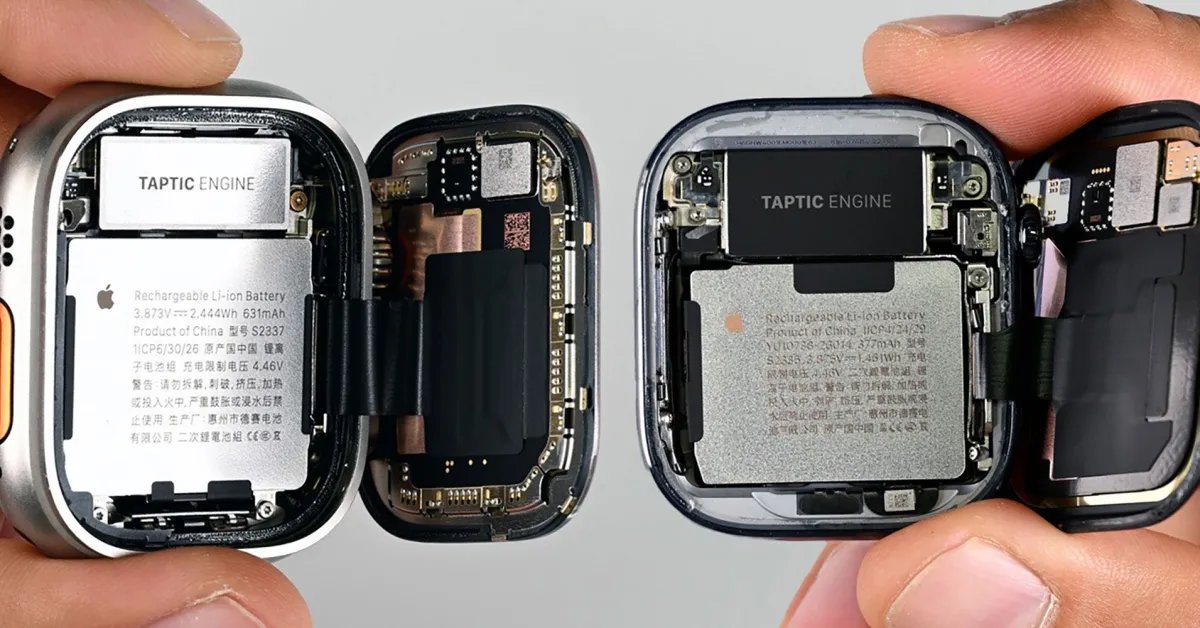
The latest hardware assessments from iFixit have provided a detailed look into the internal architecture of the Apple Watch Series 12 and the Ultra 4. These teardowns reveal how Apple is managing increasingly dense component packaging while navigating the ongoing technical challenges of product repairability. As smartwatches become more integrated, the balance between environmental sealing and user-serviceable design remains a central focal point for engineering teams and consumers alike.
Structural Analysis of the Apple Watch Ultra 4
The Apple Watch Ultra 4, designed for extreme environments, presents a formidable challenge for manual disassembly. Accessing the device requires the application of heat to the display assembly, a procedure that remains the primary barrier to entry for any repair. Once the adhesive is weakened, the display can be removed to expose the interior, which houses the 2.444 Wh battery—a modest increase from the 2.313 Wh capacity found in the Ultra 3.
Internally, the device maintains a high level of consolidation. While the four screws located on the bottom casing allow for access to the sensor assembly and specific components of the S11 chip, the primary architecture is locked behind the display. The integration of the Taptic Engine and the battery suggests that while individual parts are modular, the path to reaching them requires removing sensitive flex cables. This configuration highlights Apple’s preference for structural integrity and water resistance over modular maintenance. Despite the hardware evolution, the device earned a 4/10 on the iFixit repairability index, matching its predecessor.
Design Refinements in the Series 12
The Apple Watch Series 12 introduces subtle but meaningful changes to its internal assembly. Most notably, Apple has incorporated stretch-release adhesive and a dedicated pull tab for the battery. This feature represents a departure from traditional industrial adhesives, making the 1.461 Wh battery significantly easier to extract than in previous iterations. This is an improvement over the 1.403 Wh battery found in the 46mm Series 11 model, showcasing a slight increase in power density.
However, the Series 12 does not entirely move away from complex repair procedures. The tolerances around the display are tighter than those seen in the Ultra 4, creating an environment where even minor deviations in pressure during removal pose a risk to the display panel. Furthermore, the transition to a simpler press connector—replacing the previous ZIF connector and tape assembly—simplifies the electrical disconnection process but creates a workflow dependency. Replacing the screen now effectively necessitates the removal of the battery, creating a multi-step process for what might otherwise be a localized repair.
Technical Tradeoffs and Repairability Standards
The discrepancy between Apple’s design philosophy and the industry’s push toward modularity is evident when comparing these devices to competitors. While the Series 12 received a minor score increase to 4/10 due to the improved battery removal mechanism, it lags behind devices like the Google Pixel Watch 5. The Pixel Watch 5 features a modular design that allows for display removal via standard Torx screws and a gasket, significantly lowering the risk of accidental component damage during entry.
Apple’s design choices reflect a commitment to maintaining a compact form factor that supports high levels of water and dust resistance. By utilizing adhesive-heavy construction, the company ensures that the device maintains its structural coherence under pressure. For the end-user, this results in a high-quality product that performs reliably in diverse conditions but remains inherently difficult to maintain outside of an authorized service environment.
The Future of Wearable Hardware Maintenance
These teardowns underscore the tension between the miniaturization of consumer electronics and the demand for increased device longevity. While the addition of pull tabs in the Series 12 shows that Apple is considering end-of-life battery replacement, the fundamental requirement to remove the display to access almost any internal component serves as a major bottleneck.
For the average user, these findings emphasize the importance of hardware protection. Given that the display removal process involves high temperatures and high-precision tools, DIY repairs on modern Apple Watches remain high-risk. The technical evolution observed in the Ultra 4 and Series 12 suggests that while internal components are becoming more efficient, the path toward a truly “repairable” smartwatch will require a fundamental shift in how screens are sealed and how internal components are shielded within the watch chassis. As the ecosystem continues to prioritize water-sealed, ultra-thin frames, the barrier for entry into the internal hardware is likely to remain high.
Disclaimer: This content is auto-generated for informational purposes only.
Source: Read Original News