





In the hallowed circles of Indian cinema, there are few endorsements more coveted than a nod of approval from the “Ulaganayagan” himself, Kamal Haasan. When the legendary actor and Rajya Sabha MP opens his doors to a film crew, it is rarely just a polite formality; it is an acknowledgement of craft, vision, and the kind of cinematic resonance that defined his own storied career. This week, the team behind the recent period drama Baththa found themselves on the receiving end of this prestigious validation, cementing their film’s position as one of the most significant sleeper hits of the current season.
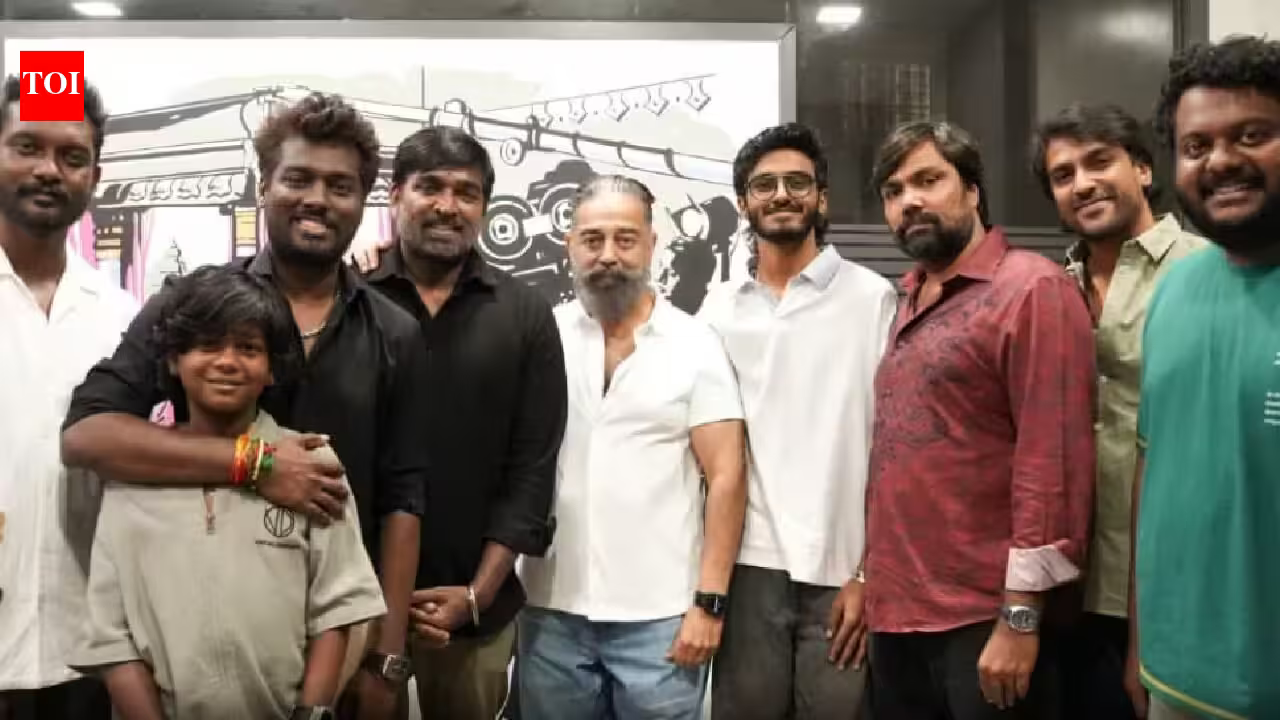
On October 7, in a meeting that has since set the industry grapevine humming, Kamal Haasan hosted the film’s central pillars: the inimitable Vijay Sethupathi, director Balaji Tharaneetharan, producer Atlee, music composer Sai Abhyankkar, and supporting cast members Hari Krishnan and Arjun Chidambaram. The gathering was more than a celebratory handshake; it was an intimate exchange between a veteran icon and a new guard of filmmakers who are currently reshaping the landscape of Tamil cinema.
The Seal of Approval from a Legend
For any filmmaker, having Kamal Haasan—a man who has spent decades pushing the boundaries of narrative and performance—deconstruct their work is the ultimate litmus test. Haasan, known for his discerning eye and uncompromising standards, reportedly spent significant time engaging with the team, dissecting the nuances of Baththa.
His appreciation for Vijay Sethupathi is well-documented, but seeing the actor-director duo of Sethupathi and Balaji Tharaneetharan receive such high praise serves as a career milestone. Having previously collaborated on projects that challenged the status quo, their third outing together has clearly struck a chord with Haasan, who commended their courage in tackling a period-specific narrative that avoids the typical tropes of mass-market cinema. For Atlee, stepping into the role of presenter for a project with such artistic gravity, the endorsement serves as a massive boost, affirming his growing reputation as a producer with a penchant for high-quality, story-driven content.
Returning to 1986 Madras
What exactly has captured the imagination of both audiences and titans like Haasan? Baththa, which hit theaters on October 1, transports viewers back to the grit and charm of 1986 Madras. By moving away from the gloss of modern-day thrillers, the film leans heavily into the texture of a bygone era, anchored by a poignant story involving a local don and an eight-year-old boy.
The alchemy of the film lies in its restraint. Vijay Sethupathi, ever the chameleon, sheds his larger-than-life image to inhabit a role that demands emotional weight over stylized swagger. Yet, the real revelation has been the performance of young Sai Prithviraj. In a performance that has become the definitive talking point of the film, the child actor navigates the complex power dynamics of the narrative with a maturity that belies his years. Alongside a stellar ensemble featuring Lijomol Jose, Ajay Ghosh, and Arjun Chidambaram, the film weaves a tapestry of survival, innocence, and the unforgiving nature of the underworld.
The ‘Baththa’ Phenomenon: Beyond the Box Office
While critical acclaim is one thing, the true health of a film in the current theatrical climate is measured by its legs. Baththa has defied the typical “opening weekend or bust” cycle, proving that quality content will always find an audience if given the chance.
In its first week, the film raked in a solid Rs 15 crore—a commendable figure for a mid-budget period piece that relies on slow-burn tension rather than explosive spectacle. However, the true success story lies in the post-release trend: the film has actually secured additional screens in its second week. In an industry where films are often pushed out of multiplexes by the third day, the theater occupancy for Baththa has been consistent enough to force exhibitors to expand its footprint. This “audience-led growth” is the holy grail for producers and clearly validates Atlee’s strategic decision to champion the project.
A Masterclass in Collaborative Filmmaking
The synergy on display during the meeting with Haasan underscores a larger trend: the rise of collaborative powerhouses in Tamil cinema. When you pair a composer like Sai Abhyankkar—whose soundscape captures the atmospheric dread and nostalgia of the 80s—with a director like Balaji Tharaneetharan, who treats the camera as an observational tool rather than a mere device for action, you get a cohesive product that feels intentional.
The inclusion of actors like Hari Krishnan and Arjun Chidambaram in the discussion with Haasan reflects the film’s ensemble strength. It signals that this was a project where every cog in the machine mattered. In an era where star-power usually consumes the conversation, the Baththa team is proving that the sum of their parts—from the screenplay’s historical grounding to the meticulous production design—is far greater than any individual contribution.
What Lies Ahead for the Team
As Baththa settles into its successful theatrical run, the conversation naturally shifts to the legacy of this project. For Vijay Sethupathi, it is another win in a career defined by eclectic choices. For Balaji Tharaneetharan, it is a restoration of his status as a master of character-driven drama.
Most importantly, for the industry at large, the film proves that there is a massive, untapped appetite for period-authentic dramas that prioritize human stakes over hyper-stylization. Kamal Haasan’s visit wasn’t just a nod to a job well done; it was a nod to the direction in which he believes Tamil cinema should be headed. With the backing of the critics, the pockets of the audience, and the wisdom of the legends, Baththa is no longer just a movie—it is a case study in how to craft cinema that lingers long after the credits roll. As the team moves forward, the pressure to replicate this success will undoubtedly be high, but for now, they are basking in the rare, well-earned glow of being the industry’s current darlings.
Disclaimer: This content is auto-generated for informational purposes only.
Source: Read Original News