








The Mahatma’s Resurgence: Why Gandhi is Reclaiming India’s Political Center
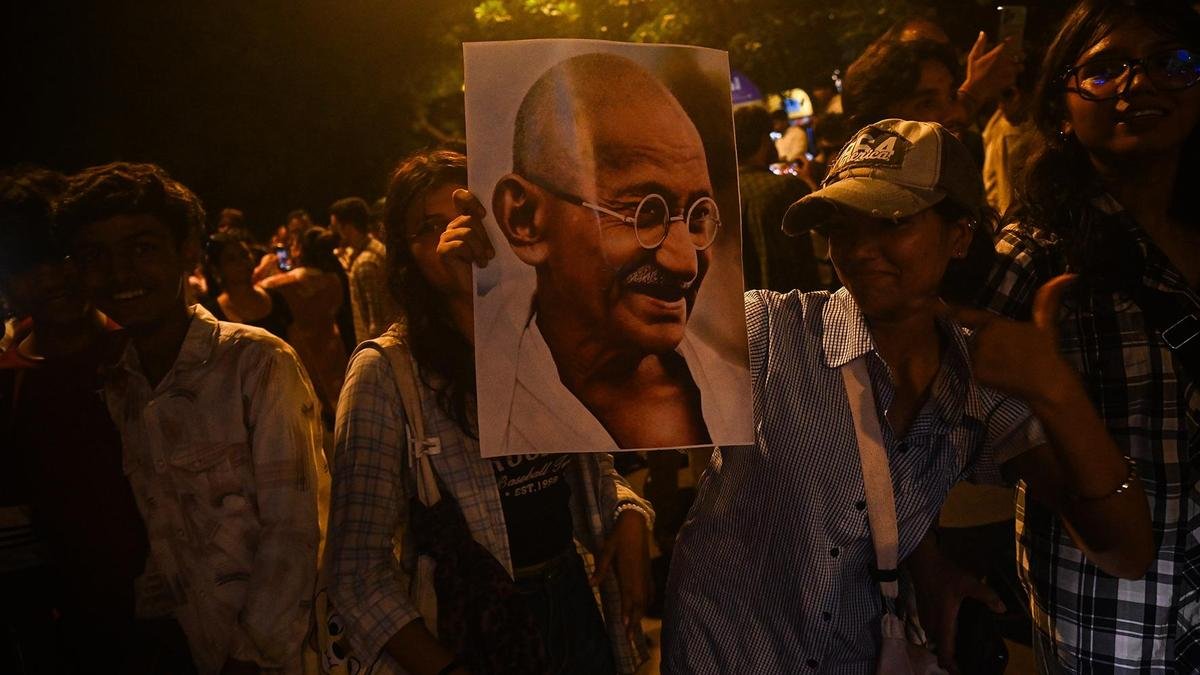
Mahatma Gandhi has returned to the heart of India’s public imagination, emerging as a primary symbol of resistance against the current establishment. From the solemn grounds of Raj Ghat, where INDIA bloc leaders held a high-profile sit-in against the Chief Election Commissioner, to the streets of Mumbai where activists label him the “soul of India,” the Mahatma’s influence is being visibly reclaimed.
Across the nation, the image of Gandhi is being revived. Whether through protestors dressing in his likeness or grassroots activists invoking his principles to combat communal violence, the Mahatma has become a shorthand for institutional accountability and civic decency. Even emerging political entities, such as Prashant Kishor’s Jan Suraaj party, are anchoring their vision of social reform in the values Gandhi championed, signaling a broader attempt to move beyond the traditional, often cynical, boundaries of Indian identity politics.
The Battle for the National Narrative
For years, the Mahatma faced a coordinated, two-pronged effort to diminish his legacy. On one side, the political right sought to rebrand Gandhi as an administrative icon of hygiene, neatly packaging him into the Swachh Bharat campaign to strip him of his radical political edge. By transforming him into a symbol for cleaning physical spaces, the establishment attempted to erase his status as a revolutionary force for political renewal, hoping to replace him in the national consciousness with V.D. Savarkar, the ideologue of Hindutva.
Simultaneously, critics within the progressive intellectual sphere launched a separate offensive. By applying contemporary intersectional lenses to Gandhi’s life, these academics and activists have highlighted his historically flawed views on race, caste, and gender. To these voices, Gandhi represents the embodiment of colonial-era hierarchies, making him a figure to be dismantled rather than admired. While the right elevated Savarkar as the true champion of a “strong” India, the identity-politics movement has sought to position B.R. Ambedkar as the exclusive moral compass of the nation, frequently relegating Gandhi to the status of an irredeemably regressive historical figure.
A Return to Foundational Politics
Despite these concerted efforts from both extremes, Gandhi has proven remarkably resilient. His revival today suggests that the country is experiencing a profound political churn—a movement characterized by cross-regional solidarity and a desperate hunger for civility.
The current re-engagement with Gandhi is not necessarily an act of deification. Instead, it is a pragmatic recognition that his life’s work provides a framework for modern dissent. Gandhi’s enduring lesson was that political transformation requires rigorous, grassroots engagement at the level of the individual and the community. After decades in which the political class largely abandoned this foundational work, forces seeking to hold power accountable are rediscovering that the path to a healthier democracy involves empowering citizens rather than pacifying subjects.
By leveraging Gandhi’s legitimacy for non-violent, systemic protest, opposition movements are finding a way to challenge the status quo without succumbing to the divisive narratives that have dominated recent years. In a landscape defined by polarized agendas, Gandhi remains the most potent instrument for those looking to inject decency into the public square. His survival in the collective consciousness indicates that while his views were indeed a product of his time, his methodology remains an essential tool for any movement seeking to foster a bottom-up, democratic transformation in India.
Disclaimer: This content is auto-generated for informational purposes only.
Source: Read Original News