







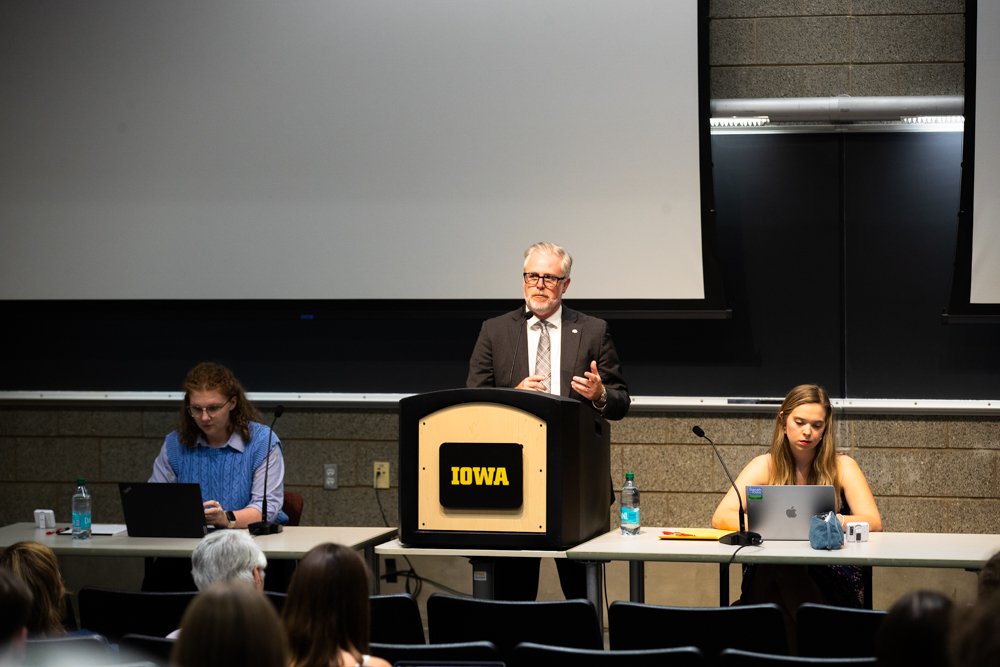
The auditorium of the University of Iowa’s Biology Building East buzzed with intellectual intensity Thursday night as students gathered to confront one of the most pressing paradoxes of the modern era: the environmental cost of artificial intelligence.
The event, part of the university’s broader “AI and Society” panel series—an outgrowth of the institution’s recent million-dollar AI discovery initiative—featured a public debate between UI debater Lily Severson and debate assistant coach Maile Huffman. The central tension of the night centered on a single question: How should society balance the rapid trajectory of AI innovation with the urgent mandate of environmental sustainability?
Senior Associate Provost Barry Thomas opened the evening by framing the debate within the context of rapid technological expansion. “Artificial intelligence offers an opportunity to amplify human potential,” Thomas noted. “At the same time, pursuing those opportunities has environmental costs.”
As the debate commenced, the stark contrast between the two positions became clear. Representing the pro-sustainability side, Huffman argued that the infrastructure required to power AI—specifically massive data centers—is already inflicting significant environmental harm. She pointed to localized air pollution and the broader carbon footprint of server farms as immediate threats, emphasizing that these negative externalities frequently fall upon marginalized communities.
“It can increase the risk of heart attacks, chronic bronchitis, and stroke,” Huffman said, detailing the physical toll of pollution generated by the energy-intensive hardware supporting large-scale models. She warned that if AI remains largely unregulated, the short-term technological gains will be quickly eclipsed by the long-term reality of environmental degradation.
On the opposing side, Severson argued that the environmental narrative surrounding AI is incomplete. She contended that AI is not merely an energy consumer, but a potential catalyst for environmental salvation. Severson suggested that as AI systems mature, they will become the primary mechanism for optimizing energy grids and developing new green technologies, ultimately saving significantly more energy than their production processes consume.
Furthermore, Severson warned that aggressive federal regulation could be counterproductive. She argued that heavy-handed government intervention might prompt tech companies to divest from sustainability initiatives. “If the federal government steps in with broad regulations, tech companies will immediately pull their funding,” she claimed, suggesting that innovation, left to its own devices, provides the most efficient pathway to a green future.
The ensuing cross-examination and rebuttal segments underscored the difficulty of the issue. While Huffman pushed for federal guardrails to mitigate immediate public health risks, Severson maintained that the risk of stifling innovation outweighed the benefits of regulation.
When the dust settled, the audience cast their votes, ultimately favoring the pro-sustainability arguments presented by Huffman. However, the mood among those in attendance was less about declaring a winner and more about appreciating the complexity of the dilemma.
Ben Kleiman, a third-year UI student and debate team member, praised the event for its ability to foster civil discourse in an increasingly polarized political climate. “It’s kind of an important skill to be able to take a step back and think about viewpoints that may be different from your own,” Kleiman said.
For many, the debate highlighted the uncertainty of the technological frontier. Second-year student Will Kunstorf, who attended the event to bridge his interests in technology and ecology, admitted that the presentations left him unsettled. “I thought this was a great experience to learn about the effects AI has on the environment versus innovation,” Kunstorf said. “We have no clue what AI is going to be like, even in the next few years.”
The event concluded with a clear consensus among the student body: as AI continues to reshape the landscape of human activity, the conversation surrounding its environmental footprint is only just beginning.
Disclaimer: This content is auto-generated for informational purposes only.
Source: Read Original News