








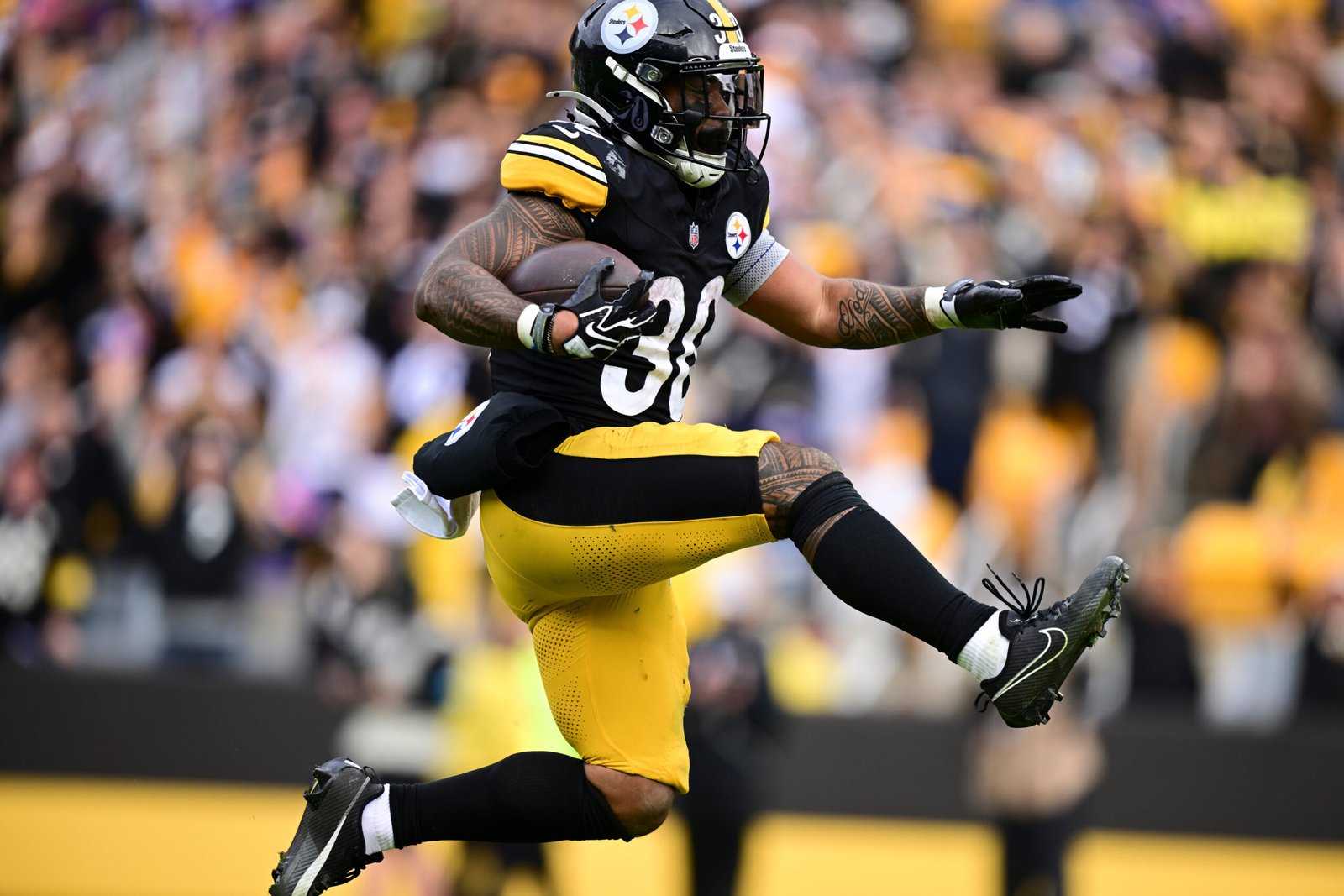
PITTSBURGH — The Pittsburgh Steelers’ dominant 34-22 victory over the Indianapolis Colts on Sunday was more than just a win; it was a career-defining performance for running back Jaylen Warren. In a display of explosive versatility that felt ripped from a highlight reel, the fifth-year back torched the Colts for 188 total yards and two long touchdowns.
As the NFL continues to integrate advanced analytics and AI-driven performance tracking, Warren’s breakout performance serves as a reminder of the human element behind the data. While tech-heavy tools help teams analyze gaps in defensive coverage, it was Warren’s raw agility—reminiscent of his early days at Snow College—that dismantled the Indianapolis defense.
## The Evolution of the Backfield and Data Integration
The Steelers (3-2) found themselves in a precarious position heading into the weekend, with backfield partner Rico Dowdle sidelined due to a toe injury. In today’s league, where sports science and AI-driven health monitoring dictate player availability more than ever, Pittsburgh’s reliance on Warren was a gamble that paid off.
Warren’s performance, highlighted by an 80-yard catch-and-run and a 50-yard scoring sprint, has reignited conversations about the value of undrafted free agents in a data-rich scouting environment. Advanced metrics often identify physical traits, but Warren’s ability to “seize the moment,” as he described it, highlights the intangible qualities that traditional algorithms still struggle to quantify. His performance made him the first player since Herschel Walker in 1986 to record a 50-yard rushing touchdown and an 80-yard receiving touchdown in the same game—a statistic that would undoubtedly light up any modern predictive modeling dashboard.
## Aaron Rodgers and the Tech-Infused Passing Game
Quarterback Aaron Rodgers, now 42, continued his efficient campaign, throwing for 235 yards and three touchdowns. His 80-yard strike to Warren saw the veteran signal-caller tie Ben Roethlisberger’s NFL record for touchdown passes of at least 80 yards.
Rodgers’ longevity in the sport mirrors the tech industry’s shift toward optimization. Just as companies like Google refine their infrastructure to handle immense data loads without failure, Rodgers has refined his playing style to remain effective while absorbing hits from defensive powerhouses like the Colts’ Grover Stewart. His ability to facilitate plays under pressure remains a benchmark for the league, proving that even as hardware ages, the underlying architecture of his decision-making remains elite.
## Strategic Stagnation in the Red Zone
While the Steelers thrived, the Colts (2-3) faced a common dilemma in modern sports: an inability to convert high-probability situations into points. Despite Daniel Jones throwing for 267 yards, Indianapolis repeatedly stalled in the red zone, settling for five field goals from kicker Spencer Shrader.
From a strategic perspective, the Colts’ failure to reach the end zone highlights a gap in situational execution. Coaches like Shane Steichen increasingly rely on AI-assisted decision-making tools to decide when to go for it on fourth down or when to kick. However, as Steichen noted, the math doesn’t matter if the execution fails. The Colts’ struggles underline a critical reality: while tech platforms like Google Cloud and AI-driven play-calling assistants provide the roadmap, they cannot replace the necessity of finding the end zone when the game is on the line.
The Steelers will now turn their attention to a road trip to Tampa Bay, while the Colts prepare to host the Tennessee Titans. As the season progresses, both teams will surely continue to leverage the latest technological advancements to gain an edge, but as Warren proved on Sunday, sometimes the best play is simply the one where talent meets pure, unstoppable drive.
Disclaimer: This content is auto-generated for informational purposes only.
Source: Read Original News