








The High Cost of Attendance: When Rigid Policies Conflict with Student Health
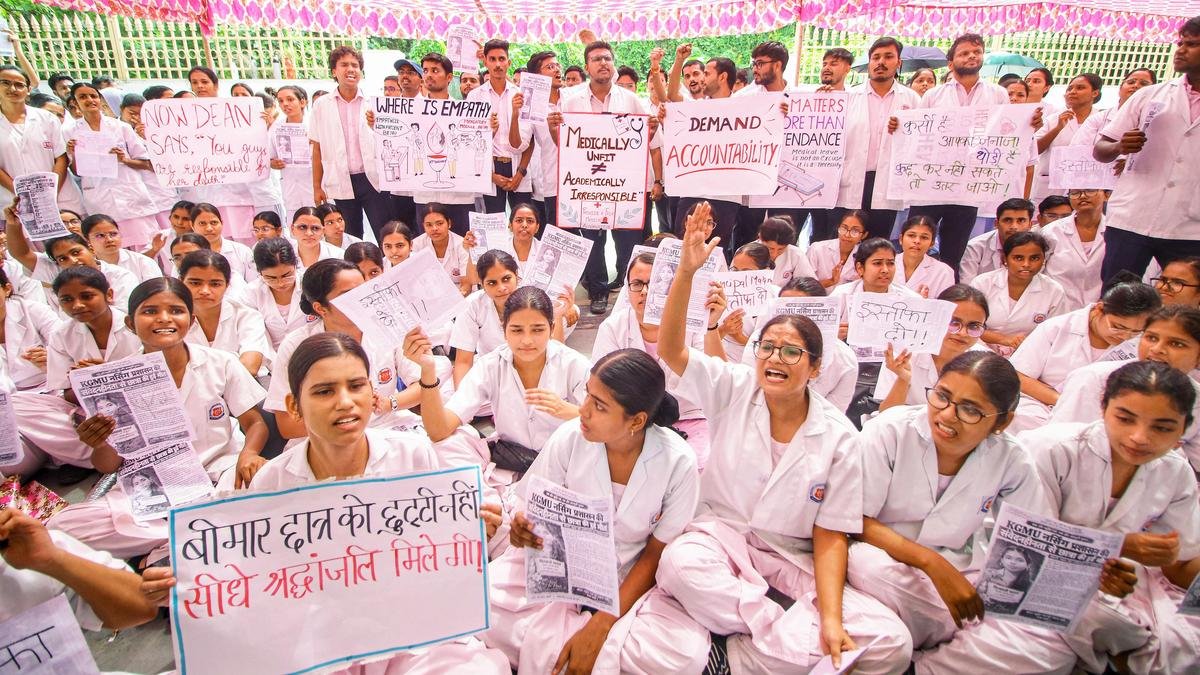
The recent protests at King George’s Medical University (KGMU), Lucknow, following the tragic death of a nursing student from dengue, have ignited a national conversation regarding the rigidity of attendance policies in Indian higher education. For many students, the academic calendar has become a source of profound distress, as institutions prioritize mandatory percentage thresholds over the physical and mental well-being of their learners.
At the heart of the issue is the persistent enforcement of minimum attendance requirements—often ranging from 75% to 80%—which many students describe as a “one-size-fits-all” barrier that fails to account for chronic illness, disability, or sudden medical emergencies.
The Policy Gap
While the University Grants Commission (UGC) shifted its stance in 2025, moving away from a universal 75% attendance mandate and granting autonomy to individual Higher Education Institutions (HEIs), the practice remains deeply entrenched. In specialized fields like nursing, regulatory bodies continue to demand near-perfect attendance, sometimes reaching 100% for practical training.
This bureaucratic framework creates a precarious reality for students. Many institutions require exhaustive medical documentation to grant even minimal leave, a process that is often described as “draining” and “bureaucratic.” For students suffering from chronic conditions—such as autoimmune disorders, genetic pain syndromes, or mental health struggles—the inability to produce instantaneous or “conclusive” medical proof often results in the denial of leave, forcing them to choose between their health and their academic standing.
Institutional Insensitivity
Student testimonies reveal a systemic failure in empathy. From suggestions that students treat serious illness with home remedies to the dismissal of medical documentation as “laziness,” the disconnect between faculty and students is stark.
The pressure is compounded by the fear of retaliation. Many students avoid seeking support because they worry that being labeled as “irregular” or “difficult” will influence how professors grade their internal assessments or manage their scholarship eligibility. In instances where students are forced to attend classes while ailing, the result is often a cyclical decline in both health and academic performance, turning the classroom into a site of suffering rather than learning.
Rethinking Academic Integrity
Experts argue that current policies fail to recognize the diverse realities of the modern student body. Dr. Debaditya Battacharya, an Assistant Professor at Jamia Millia Islamia, emphasizes that the obsession with numerical attendance markers ignores the socio-economic and biological diversity of the student population. He suggests that universities should move away from arbitrary percentages and toward a model that values the “spirit of the teaching-learning process” over rigid metrics.
Similarly, critical pedagogy scholar Sayan Chaudhuri advocates for a shift in campus culture. He argues that the solution lies in decentralizing decision-making. Rather than relying on cold, documentation-heavy policies, institutions should empower student-faculty committees to review cases on an individual basis. Such committees could act as mediators, ensuring that students with legitimate health challenges receive the support they need without the fear of systemic penalization.
A Call for Reform
The tragedy at KGMU and similar instances at other institutions across the country highlight a need for an urgent policy overhaul. True academic excellence cannot be built on a foundation that punishes the infirm. As the discourse around the National Education Policy (NEP) 2020 and its implementation continues, experts are calling for a more inclusive definition of “merit”—one that acknowledges that a student’s capacity to learn is inextricably linked to the institutional support they receive during their most vulnerable moments.
For higher education to remain a space of growth, institutions must pivot from surveillance-based attendance models to care-based pedagogical environments. Until the system recognizes that health is a prerequisite—not an obstacle—to learning, the lives of students will remain in the crosshairs of rigid policy.
Disclaimer: This content is auto-generated for informational purposes only.
Source: Read Original News