








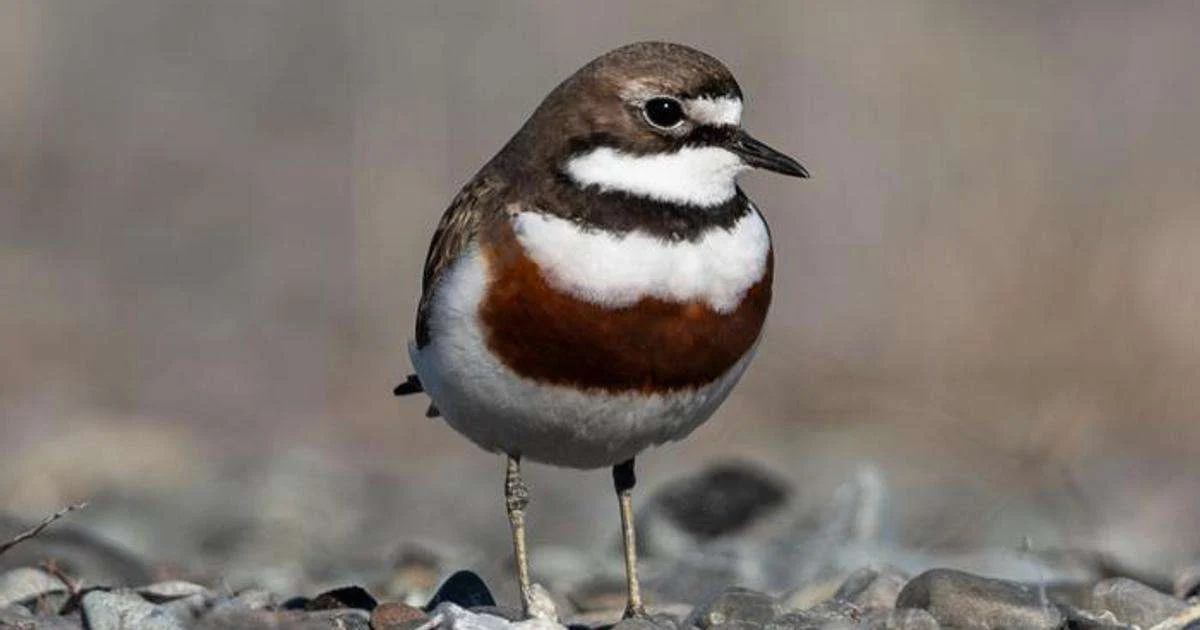
The banded dotterel, a shorebird known for its arduous annual migration across the Tasman Sea from New Zealand to Australia, is facing a shifting reality. A new study conducted by the Department of Ornithology at the Max Planck Institute for Biological Intelligence (MPI-BI) indicates that climate change is fundamentally altering the birds’ migratory schedule, potentially threatening the long-term viability of their trans-oceanic journey.
Published in the journal Ibis, the research reveals that banded dotterels are arriving at their Australian non-breeding grounds roughly four days later each year on average. When comparing data from 2014 to 2025, researchers observed no corresponding change in the birds’ departure dates back to New Zealand. Consequently, the duration of their stay in Australia has plummeted by approximately 25%—dropping from an average of 173 days in 2014 to just 129 days by 2025.
The study attributes this delay to a southward shift in the winds circling Antarctica, a phenomenon driven by human-induced global warming. This climatic alteration has made mild, calm autumn and winter conditions increasingly frequent in New Zealand, effectively removing some of the environmental urgency that once prompted the birds to seek refuge in Australia.
“The rapid pace of this change raises critical questions about where it could lead,” said Bashar Jarayseh, a Ph.D. student at MPI-BI and the lead author of the study. “Most banded dotterels that migrate come from harsher inland alpine habitats, escaping the New Zealand winter for milder conditions in Australia. But the ocean crossing is dangerous, and if their stay in Australia shortens, the benefits of migration may shrink while that risk remains.”
Jarayseh warns that these shifts could reach a breaking point. If the energy expenditure of the migration is no longer offset by a sufficiently long stay in milder territory, the species may undergo a “behavioral extinction” of migration. Should the birds abandon the crossing entirely to remain in New Zealand year-round, they would become increasingly susceptible to environmental volatility, such as a single unusually severe winter.
To reach these conclusions, the MPI-BI team utilized data from the citizen science platform eBird. By mapping the birds’ Australian non-breeding range into 23,000-square-kilometer segments, researchers were able to track the buildup and tail-off of sightings to pinpoint arrival and departure trends. When cross-referenced with the Southern Annular Mode—a major climate index for the region—the data showed a clear correlation: in years where New Zealand experienced milder late-season weather, the birds consistently delayed their departure for Australia.
While much of the scientific literature on avian migration has historically focused on the Northern Hemisphere—where birds are often observed arriving at breeding grounds earlier in the spring due to warming—this study highlights a distinct pattern in the Southern Hemisphere.
“Our results add a case from the less studied southern hemisphere, where New Zealand banded dotterels are rather reaching their wintering grounds later each year,” said co-author Luke Eberhart-Hertel.
The research team is now moving from large-scale population data to individual tracking, utilizing satellite tags and color-banding to observe how specific birds adjust their movements. Bart Kempenaers, head of the Department of Ornithology at MPI-BI, emphasizes that the next phase of research will focus on whether individuals are actively shifting their internal timing or if some birds are transitioning from migratory to resident behavior.
Understanding these mechanisms is vital for conservation efforts. The banded dotterel is already threatened by introduced predators in New Zealand; adding climate-driven changes to their seasonal navigation could further destabilize an already vulnerable population. As the study suggests, determining whether there is a definitive “tipping point” after which the Tasman crossing is abandoned remains one of the most pressing questions for the survival of the species.
Disclaimer: This content is auto-generated for informational purposes only.
Source: Read Original News