









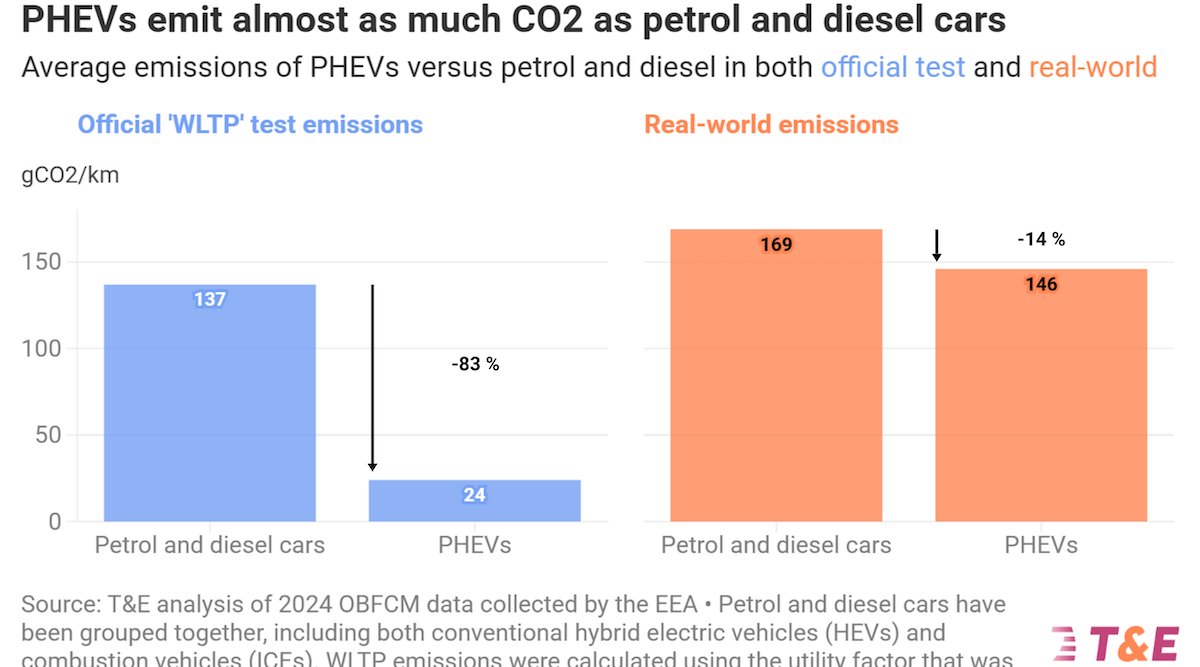
The gap between the official CO₂ emission figures of plug-in hybrid electric vehicles (PHEVs) and their performance on the road continues to widen, according to a new report from Transport & Environment (T&E). The analysis reveals that PHEV models registered in 2024 emitted six times their official CO₂ figures in real-world conditions, a significant increase from the five-fold disparity recorded in 2023.
This discrepancy is not merely a technical accounting issue; it has direct financial consequences for consumers. The report estimates that the inaccurate emissions data results in an average of €680 in extra annual fuel costs for drivers of 2024-model PHEVs. Even when vehicles operate in their electric-only mode, the combustion engine is still firing for approximately one-third of every kilometer driven, belying the environmental benefits often advertised by manufacturers.
Data from the European Environment Agency shows that real-world emissions for these vehicles are only 14% lower than those of conventional combustion and hybrid cars. This stands in stark contrast to the 83% reduction suggested by official test cycles, which rely on the “utility factor”—a metric used to calculate the share of distance powered by electricity during standard emissions testing.
In an effort to close this gap, the European Union has begun correcting the utility factor, forcing carmakers to account more accurately for how these vehicles are used. T&E’s report indicates that initial corrections implemented in 2025 and 2026 have already produced positive results, incentivizing manufacturers to improve vehicle design. By installing larger batteries and extending electric range, some carmakers have successfully offset a significant portion of the rise in official CO₂ figures that came with the stricter accounting rules.
For instance, the Volkswagen Group saw substantial improvements across its fleet. The company’s Tiguan model, for example, more than doubled its electric range from 55 km to 119 km. These design upgrades allowed the vehicle to maintain a low official emission rating of 36 gCO₂/km even after the accounting correction, demonstrating that technical progress can effectively bridge the gap between regulatory requirements and real-world performance.
However, the progress of these reforms now faces a legislative hurdle. With the next phase of the utility factor correction scheduled to take effect in November 2026, T&E is urging European governments to hold firm. The organization warns that Germany is currently pushing to freeze these upcoming corrections as part of broader automotive negotiations with France.
Lucien Mathieu, cars director at T&E, characterized the potential freeze as a deliberate manipulation of emissions data. “If Germany gets its way, carmakers will keep overstating how much PHEVs drive electric, leaving consumers with higher fuel bills and stretching the EU’s oil dependency,” Mathieu said.
The stakes of the upcoming decision are high. Freezing the rules at the 2025–2026 level would mean that real-world PHEV emissions would remain underestimated by an estimated 56%. Furthermore, T&E warns that such a freeze would weaken the 2030 emissions targets, as it would reduce the number of battery electric vehicles (BEVs) that manufacturers feel compelled to sell to remain compliant with EU law.
As the debate continues, advocates argue that the policy is about more than just numbers; it is about transparency. “A decade after Dieselgate, it is outrageous that Europe is once again debating whether to keep using misleading emissions to sell cars,” added Mathieu. “Drivers deserve the truth, not another fix to protect carmakers’ profits while leaving drivers hundreds of euros out of pocket.”
Disclaimer: This content is auto-generated for informational purposes only.
Source: Read Original News