








The Burden of Proof in Capital Gains Disputes
The Indian tax landscape is frequently marked by disputes involving the classification of share transactions, particularly those concerning penny stocks or shares suspected of price manipulation. A recent decision by the Mumbai bench of the Income Tax Appellate Tribunal (ITAT) serves as a significant legal precedent for individual investors caught in the crosshairs of tax investigations. The case revolved around a taxpayer who claimed a long-term capital gains (LTCG) exemption under Section 10(38) of the Income Tax Act, only to have the entire sale proceeds treated as unexplained cash credit by the Assessing Officer (AO).
At the heart of the conflict was the tax department’s suspicion regarding the legitimacy of the shares themselves. The authorities frequently scrutinize transactions in scrips that have witnessed abnormal price volatility, often categorizing them as “accommodation entries”—a term used to describe fictitious transactions designed to launder money or provide tax-free capital gains. However, this ruling reinforces the principle that suspicion alone, regardless of the scrip’s market performance, does not constitute sufficient grounds for tax authorities to reject a claim if the taxpayer has maintained diligent documentation.
Operational Nuances of the ITAT Decision
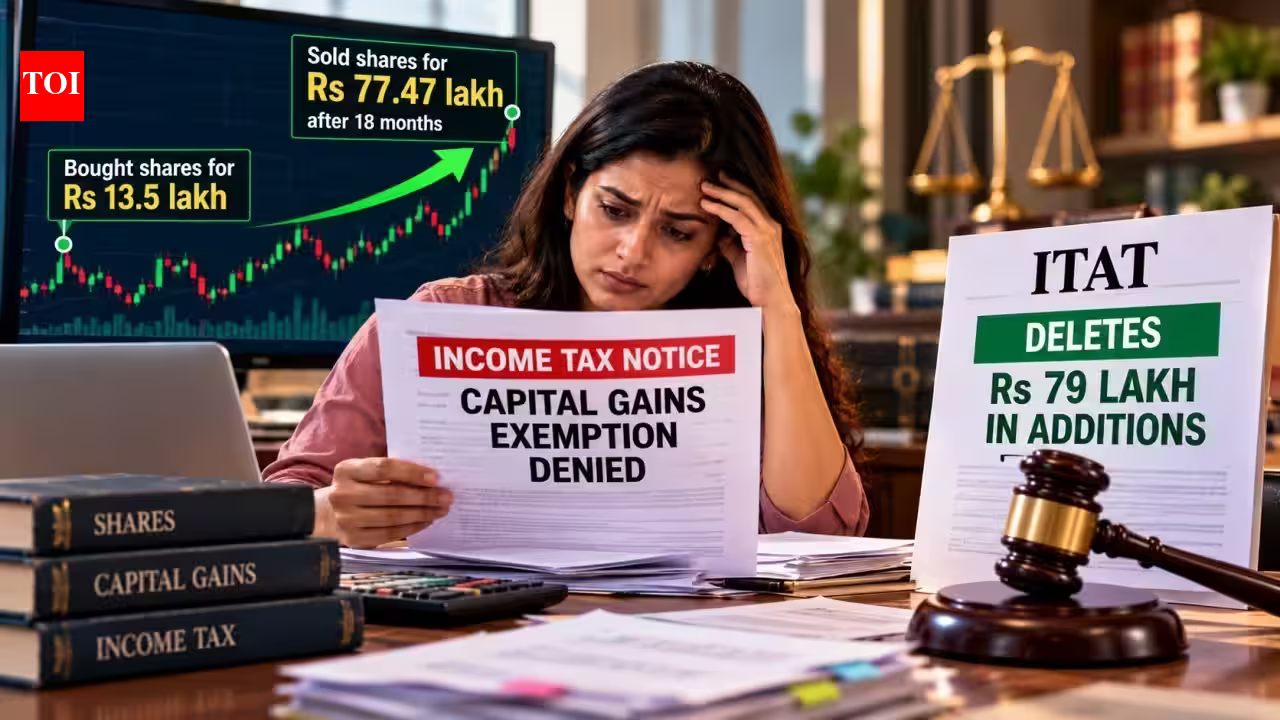
The case involved a woman who acquired 60,000 shares in 2011, which later doubled to 1.2 lakh shares following a 1:1 bonus issue. She held these shares for approximately 18 months before selling them on the Bombay Stock Exchange (BSE) via legitimate banking channels, with the transaction subject to the Securities Transaction Tax (STT). When the taxman rejected her exemption claim, they essentially labeled her entire capital gain as black money, adding a further charge of alleged commission expenditure.
The ITAT’s decision to delete these additions was rooted in the lack of “nexus.” The tribunal emphasized that while the tax department had the authority to investigate, it failed to produce any evidence linking the assessee to price-rigging cartels or promoters. Because the taxpayer produced comprehensive documentation—including contract notes, demat statements, and bank records—that the department could not prove to be fraudulent, the tribunal ruled in her favor. The verdict underscores that when a taxpayer adheres to the standard regulatory procedures of the stock market, the responsibility of proving collusion lies entirely with the Revenue department.
Documentation as a First Line of Defense
For the Indian retail investor, this case highlights the critical importance of robust record-keeping. In an era where the Income Tax Department utilizes advanced data analytics to flag suspicious transactions, taxpayers must treat their financial documentation as more than mere filing requirements. The preservation of contract notes, demat transaction history, and bank statements is the primary defense against blanket additions.
In this instance, the taxpayer’s ability to substantiate every stage of the investment lifecycle—from the initial acquisition through to the final sale—rendered the department’s rejection unsustainable. Investors often assume that filing an Income Tax Return (ITR) is sufficient, but this case demonstrates that having a “paper trail” that survives judicial scrutiny is what ultimately protects a taxpayer’s capital. The tribunal’s reliance on previous judicial precedents, such as the case of PCIT-31 vs. Indravadan Jain, signals to the lower authorities that they cannot disregard valid evidence in favor of generalized assumptions about market manipulation.
Market Volatility vs. Tax Compliance
A recurring issue in Indian tax law is the conflict between market-driven price hikes and the taxman’s interpretation of those hikes as manipulative. Some shares experience massive, unnatural appreciation due to speculative trading, which naturally triggers alerts in the tax department’s systems. However, the legal position established here is that a sharp rise in share price, in isolation, cannot be the basis for accusing a taxpayer of tax evasion.
This ruling clarifies that the tax department must provide specific evidence demonstrating that the taxpayer was an active participant in an organized scheme to inflate prices. Without evidence of a relationship with entry operators or evidence of fund rotation between the taxpayer and the company, the tax authorities cannot legally disregard the statutory exemption provided for long-term capital gains on the sale of listed shares. This provides a level of assurance to investors that legitimate investments, even those in volatile small-cap companies, remain protected by law as long as the underlying transaction is executed through established, transparent market mechanisms.
Future Outlook for Taxpayers and Authorities
The ruling serves as a cautionary tale for the tax department, reminding them that the “faceless assessment” system must still operate within the bounds of evidence-based adjudication. While the government remains committed to curbing the use of shell companies and fake share transactions, this decision reinforces that the judiciary will not allow the burden of proof to be unfairly shifted onto the taxpayer.
For the investor community, the lesson is clear: maintain impeccable records and be prepared to defend the genuineness of an investment through every available document. While the tax authorities are within their rights to investigate any transaction that appears suspicious, they are not exempt from the procedural requirement of building a factual case. As India continues to integrate technology into its tax administration, the ability to produce verifiable, real-time records of investment history will remain the most powerful tool for protecting one’s financial interests against unwarranted tax additions. Investors should continue to favor transparency, ensuring that all share dealings occur on recognized exchanges and through formal financial channels, which remains the best safeguard against future litigation.
Disclaimer: This content is auto-generated for informational purposes only.
Source: Read Original News