









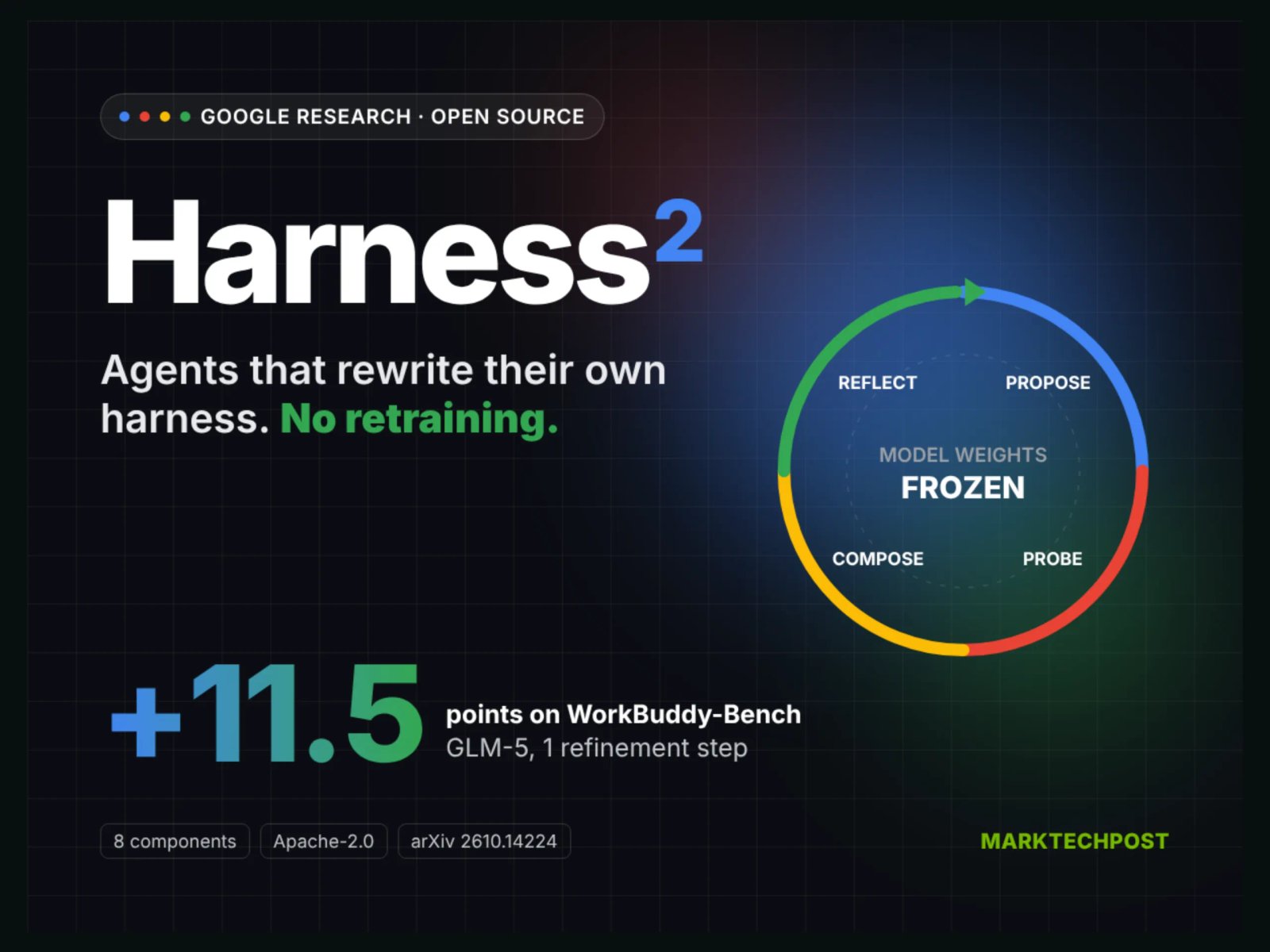
Google Cloud AI Research has introduced Harness², an open-source framework designed to elevate the performance of AI agents without the need for retraining or fine-tuning the underlying Large Language Models (LLMs). By shifting the focus from model weights to the external “harness”—the collection of prompts, tools, memory, and orchestration layers surrounding a model—this framework allows developers to iteratively optimize agent behavior in real-time.
The Architecture of Harness²
At its core, Harness² treats the AI agent as a modular system. While many contemporary efforts in artificial intelligence prioritize model training or parameter scaling, this approach recognizes that a model’s output is heavily dictated by its environmental context. Harness² effectively modularizes this context into eight distinct components: System prompts, Guardrails, Memory, Tool guidance, Subagents, Skills, Scripts, and Plugins.
Each of these components is mounted as an individual file, allowing the framework to treat the agent’s operating environment as a dynamic configuration. Because the model weights remain frozen, the framework avoids the high computational costs and data requirements typically associated with fine-tuning. This makes it a lightweight, portable solution for developers working with pre-trained models via Vertex AI or similar platforms.
Recursive Agent Improvement
The framework distinguishes itself through a two-tiered system of recursive improvement: task-level and harnessing-level recursion.
During task-level recursion, the framework executes a “Propose, Probe, and Compose” cycle. When a task is presented, the agent first executes it using a baseline configuration. An editor then generates two distinct candidate refinements: one designed to address invariant issues—such as planning errors or general tool-use failures—and another tailored specifically to the requirements of the current domain. Both candidates are probed by running them on the same task, and a composer then merges the evidence-backed edits into a new, improved harness.
This cycle is complemented by harnessing-level recursion, which occurs across multiple tasks. A reflector maintains an “EXPERIENCE.md” file that acts as a library of past lessons. This repository guides future proposals, ensuring that the agent does not merely solve individual instances but builds a cumulative knowledge base of how to optimize its own operational parameters. Because this process functions without requiring ground-truth labels or test cases, it is uniquely suited for open-world environments where success metrics are not always predefined.
Performance and Empirical Impact
The efficacy of Harness² is measured by its ability to boost performance metrics across varying benchmarks. In experimental trials, a single refinement step resulted in consistent score increases across diverse model and harness configurations.
For instance, the GLM-5 model utilized under the OpenCode framework saw its performance on the WorkBuddy-Bench rise from 64.2 to 75.7—a gain of 11.5 points. Even in scenarios where gains were more modest, such as the GLM-5 model under the Codex benchmark (improving from 23.6 to 24.8), the framework consistently demonstrated that environmental refinement adds value regardless of the base architecture. By relying on a recursive feedback loop rather than static adjustments, the system manages to find performance gains that standard prompt engineering often misses.
Versatility and Deployment
Harness² is engineered for practical deployment in Linux-based environments, utilizing Python 3.12 or 3.13 and the uv package manager. Its dependency on Vertex AI for model calls makes it a viable tool for enterprises looking to standardize agent behaviors across a fleet of applications.
The framework is highly modular, meaning developers can selectively enable or disable components based on the specific needs of their application. For example, a developer focusing on complex task orchestration might emphasize the Subagents and Skills components, while an application requiring strict adherence to safety protocols might prioritize the Guardrails and System prompt files. This granular control allows developers to tailor the agent’s behavior without navigating the opaque “black box” of model training.
The Future of Agentic Engineering
The release of Harness² marks a shift in the philosophy of agent development. By proving that a frozen, “off-the-shelf” model can be made to perform significantly better through iterative systemic changes, the research team is proposing a more sustainable path for AI scaling.
As LLMs become ubiquitous, the challenge for many organizations will not be creating the most sophisticated model, but effectively wrapping existing models in systems that allow them to function reliably in unpredictable, real-world tasks. Harness² provides a standardized language and toolkit for this type of “harnessing,” potentially setting a new standard for how developers manage the interface between powerful, frozen AI models and the complex, messy requirements of actual production environments.
For those looking to integrate these capabilities, the framework is now available for exploration on GitHub, offering a transparent and modular path toward building smarter, more resilient agents.
Disclaimer: This content is auto-generated for informational purposes only.
Source: Read Original News