








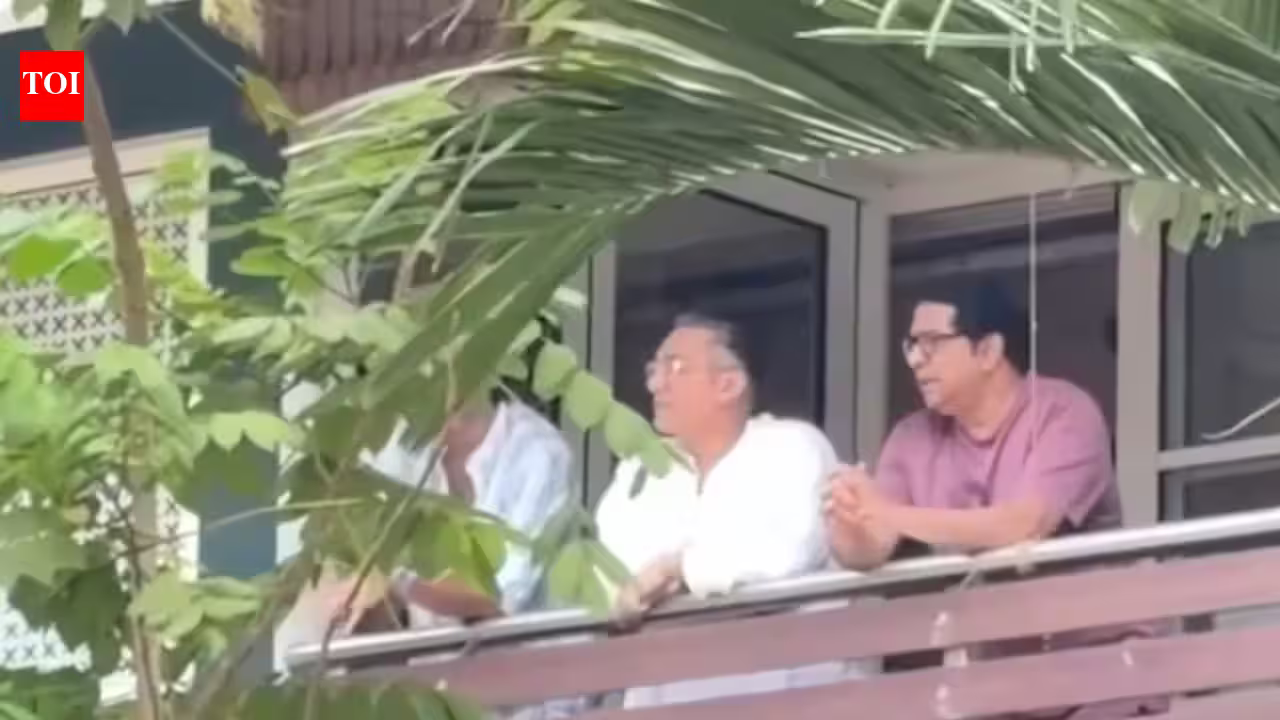
The optics of a high-profile Bollywood icon walking into the fortress of a firebrand political leader are rarely accidental, even when the participants insist otherwise. When Aamir Khan, one of India’s most enigmatic cinematic figures, arrived at ‘Shivtirth’—the iconic Mumbai residence of Maharashtra Navnirman Sena (MNS) chief Raj Thackeray—this past Sunday, it sent a ripple through the corridors of both political and film-industry power circles.
Accompanied by his wife, Gauri Spratt, the Lagaan actor’s visit was marked by the kind of quiet discretion that usually precedes a storm of public curiosity. In a city like Mumbai, where the intersection of entertainment and politics is as crowded as a local train at rush hour, the meeting has naturally become the subject of intense scrutiny. The reason? It isn’t just a friendly catch-up; it is happening against the backdrop of a brewing legal and existential firestorm for Khan’s nephew, the actor Imran Khan.
A Familiar Face in a Changing Climate
Aamir Khan and Raj Thackeray share a history that defies the conventional lines drawn between the entertainment industry and hardline regional politics. They have met on numerous occasions in the past, and observers describe their rapport as surprisingly warm, characterized by mutual respect rather than the performative friction often seen in public life.
However, context is everything. The timing of this visit is, at the very least, provocative. Imran Khan, the Jaane Tu… Ya Jaane Na star, is currently embroiled in a high-stakes legal battle following a notice issued by the Foreigners Regional Registration Office (FRRO). The document, which has cast a long shadow over the actor’s future in India, reportedly mandates his departure from the country by October 2026. For a public figure who has lived and worked in the heart of the Hindi film industry for years, the “leave India” directive is a seismic blow—one that has now thrust his family into a complex web of legal and political maneuvering.
The Speculation Machine
The internet, predictably, has gone into overdrive. Since the images of the meeting surfaced, social media has been flooded with conjecture. Was this a courtesy call, or a tactical consultation? When public figures who occupy such distinct spheres—cinema and populist politics—converge during a time of personal crisis, it is rarely perceived as a simple social engagement.
Despite the heavy atmosphere, neither side has offered a crumb of information. The “Shivtirth” walls have remained characteristically opaque. Was the plight of his nephew discussed? Did the veteran actor seek counsel or, perhaps more accurately, influence? As of now, we are left to parse the silence. Yet, the absence of a denial is, in the world of high-stakes public relations, just as loud as an admission.
The Protest That Triggered the Tides
To understand why Aamir Khan’s visit has grabbed headlines, one must look at the event that catalyzed this entire chain of reactions. On October 10, Imran Khan and his partner, Lekha Washington, participated in a demonstration at Mumbai’s historic August Kranti Maidan. The protest, organized by Citizens for Justice and Peace, was aimed at Chief Election Commissioner Gyanesh Kumar.
In a volatile political climate, the presence of a celebrity at a protest is akin to lighting a match in a room full of gasoline. The duo was subsequently detained, a move that brought immediate scrutiny to Imran’s legal standing and citizenship status. Former BJP MP Kirit Somaiya, never one to shy away from a political confrontation, escalated the matter by calling for an inquiry into the actor’s participation. This move effectively transformed a personal legal issue into a public spectacle, forcing the issue of the FRRO notice into the glaring light of media attention.
The Raj Thackeray Factor
What makes the plot thicken is the role of Raj Thackeray himself. The MNS chief has, in the past, been a vocal critic of the very individuals and policies that the protesters at August Kranti Maidan were challenging. His stance on issues of nationalism, residency, and political dissent is well-documented and often abrasive.
Some political analysts suggest that Aamir Khan’s visit could be a pragmatic attempt to bridge a divide. If there is one thing that can navigate the treacherous currents of bureaucracy and political hostility in Maharashtra, it is a personal conversation with a leader like Raj Thackeray, who possesses a unique ability to influence the discourse in the state. Whether this meeting was a desperate plea for help or a strategic calculation to secure a sympathetic ear, the underlying reality remains: the pressure on the Khan family is mounting.
The Road Ahead for the Khans
As the matter moves toward the Bombay High Court, the legal battle will likely be long and arduous. Imran Khan’s legal team is currently navigating the procedural nightmare of fighting an FRRO notice, a process that is as much about bureaucratic endurance as it is about jurisprudence.
For Aamir Khan, the situation presents a precarious balancing act. Throughout his career, he has navigated political controversies with a mix of calculated silence and targeted activism. By reaching out to a regional powerhouse like Raj Thackeray, he appears to be pivoting toward a local, personalized solution to a national legal problem.
As we await the court’s next move, one thing is certain: the meeting at Shivtirth was not just about the weather or pleasantries. In Mumbai, when the biggest stars meet the most formidable political heavyweights, the objective is rarely to discuss the past. It is to prepare for the future. For now, the public waits, the court deliberates, and the Khans remain at the center of a storm that shows no sign of abating.
Disclaimer: This content is auto-generated for informational purposes only.
Source: Read Original News