







Subverting Cosmic Horror Through A Unique Lens
The intersection of classic literary horror and game design often results in dark, atmospheric titles that lean heavily into the aesthetics of the early 20th century. However, recent developments in independent game development have seen a shift in how creators approach the problematic foundations of Lovecraftian fiction. Naphtali Faulkner, the developer behind the critically acclaimed Umurangi Generation, has introduced a distinct approach with his latest title, Penguin Colony. By juxtaposing the existential dread of ancient, cosmic gods with the seemingly innocuous lives of Antarctic penguins, Faulkner challenges the colonialist and exclusionary frameworks often found in the source material.
Instead of focusing on the typical scholarly protagonists who embody the prejudices of the era, Penguin Colony shifts the perspective to a species indifferent to human hierarchies. This design choice serves a dual purpose: it grounds the player in the harsh physical reality of the Antarctic environment while providing a neutral observer capable of navigating the insanity that ensues when human hubris clashes with forces beyond mortal comprehension.
Gameplay Mechanics and Hive-Mind Navigation
At the core of Penguin Colony is a fluid, collective movement system. Players do not control a single entity, but rather a mobile group of Antarctic birds. The central mechanic involves a “nuzzling” interaction that allows the player to transfer their consciousness instantly between different species of penguins, including Emperors, Rockhoppers, and Chinstraps. Each species possesses distinct biological advantages, such as enhanced swimming capabilities, greater jumping height, or superior traversal speeds.
This shifting mechanic is essential for solving environmental puzzles and traversing the vertical, impossible architectures found within the game’s frozen tombs. The movement system is designed to embrace a certain level of “jank,” which developers often use to give locomotion a tactile, physical quality. For instance, Rockhoppers are programmed with a specific magnetic grip that aids in platforming, though players may find themselves occasionally wedged in the complex geometry of the levels. By removing the traditional human-centric camera and controls, the game forces players to rely on the physical intuition of the creatures, turning a high-concept horror experience into a platforming-heavy exploration of the uncanny.
Recontextualizing At The Mountains of Madness
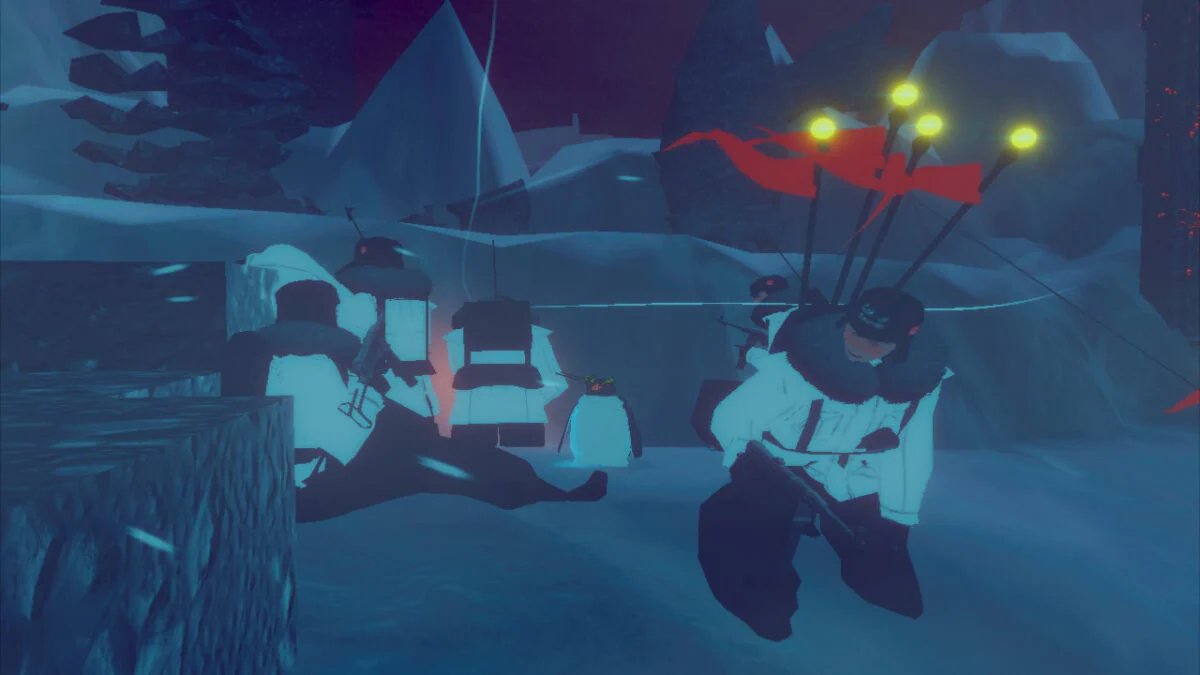
The narrative structure of Penguin Colony functions as a sharp, alternative-history retelling of H.P. Lovecraft’s seminal work, At The Mountains of Madness. However, where the original text features academic explorers from New England, Faulkner introduces a squad of Nazi scientists seeking to validate their ideology through the discovery of ancient deities. The horror is derived from the immediate failure of this mission.
The narrative reveals that the “ancient gods” held in the ice are not, as the invaders hope, evidence of a superior progenitor race that validates their worldview. Instead, they are forces of chaos that render human classifications entirely meaningless. The game portrays the scientists’ attempts to uncover these secrets not as a grand pursuit of knowledge, but as a foolish, dangerous intrusion. By forcing the player to navigate this scenario as a colony of birds, the game highlights the futility of the human characters’ actions. The penguins move through these scenes with a clarity of purpose that is absent in the flailing, self-destructing researchers.
The Role of the Observer in Apocalyptic Settings
A consistent theme in Faulkner’s work is the role of the player as a witness rather than a traditional hero. In Umurangi Generation, the player occupied the role of a photographer documenting an encroaching apocalypse. In Penguin Colony, this theme is refined. The birds are not meant to combat the horrors they encounter; they are survivors who remain largely unphased by the psychological degradation that claims the human cast.
The narrative is elevated by the voice acting of Lenval Brown, whose delivery provides a grounding, steadying presence amidst the cosmic chaos. His narration serves as a guide through the desolate landscape, emphasizing the vast, dark emptiness of the Antarctic setting. The game design explicitly avoids forcing the player to witness the suffering of the penguins themselves. When a character falls or succumbs to the influence of a shoggoth, the game quickly transitions the player to another penguin, maintaining a flow that prioritizes observation and navigation over failure or loss.
Critiquing Colonialist Narratives through Metagaming
One of the most innovative aspects of Penguin Colony is its structural critique of the horror genre. Faulkner uses the game to address how Western media frequently frames exploration and discovery as inherently noble, even when it leads to ruin. To illustrate this, the game inserts abrupt shifts in perspective, featuring brief segments that focus on indigenous caretakers who have lived in the shadow of such disasters for generations.
These segments feel intentionally disjointed, mimicking a player accidentally interacting with another game interface entirely. This serves to break the immersion of the “heroic” explorer narrative, reminding the player that the mess being cleaned up in the ice is just another cycle in a long history of outsiders meddling with environments they do not understand. By combining these surreal narrative interruptions with high-intensity platforming and a whimsical, albeit eerie, aesthetic, Penguin Colony provides a sophisticated critique of its own genre. It proves that the most effective way to dismantle a trope is not necessarily to ignore it, but to reframe it entirely through the eyes of those who have no stake in the vanity of the original storytellers.
Disclaimer: This content is auto-generated for informational purposes only.
Source: Read Original News