







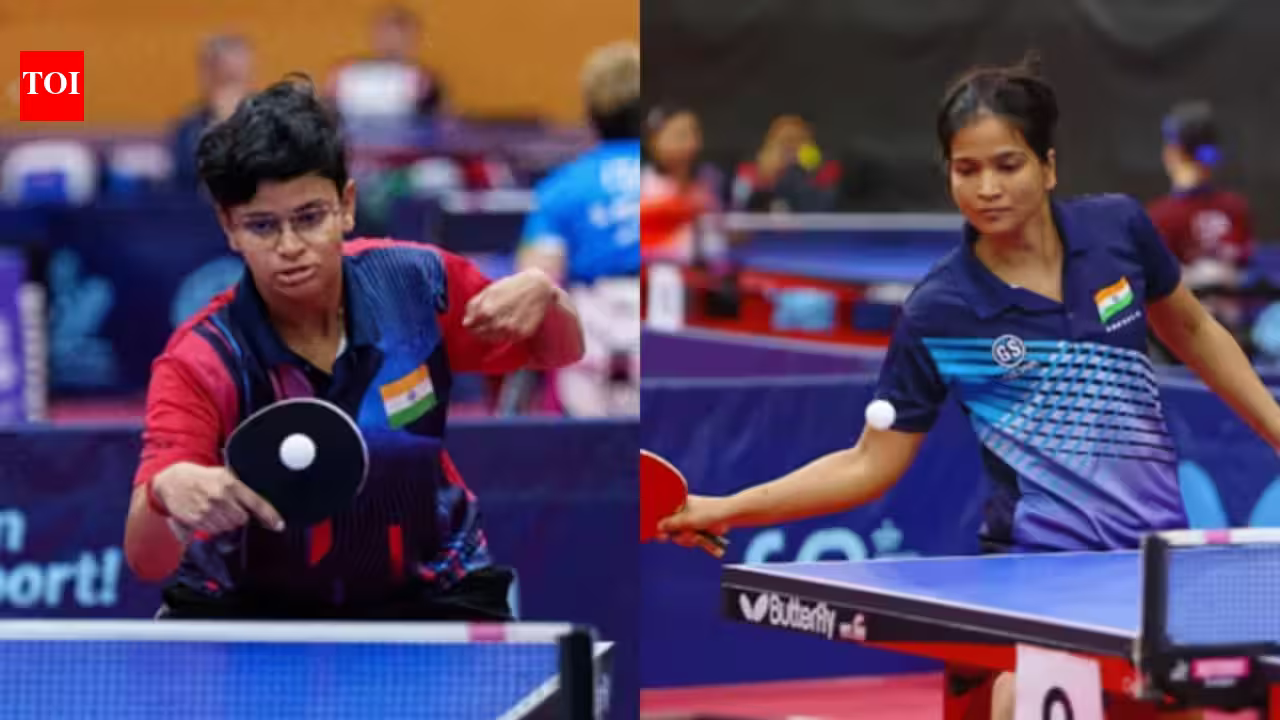
HISTORIC heights were scaled in Aichi-Nagoya on Tuesday as the Indian contingent shattered records, delivering a masterclass in resilience and skill to secure their best-ever performance in para table tennis at the Asian Para Games. With a haul of five bronze medals, the nation has officially signaled its arrival as a formidable force on the continental stage, eclipsing the previous milestone of two medals set at the last edition of the Games.
Beyond the numerical significance, the day will be remembered for the glass ceilings shattered by Ravi Baby Sahana and Prachi Pandey. By securing podium finishes in the standing category, the duo etched their names into the history books as the first Indian para-athletes to claim medals in this division at the Asian Para Games—a feat that highlights the diversifying strength of India’s para-sports infrastructure.
Sahana and Prachi: Pioneering Excellence
The significance of the performances from Sahana and Prachi cannot be overstated. Competing in highly technical classes, both athletes faced formidable opposition, yet their determination kept them in the hunt for glory.
Tamil Nadu’s Sahana, competing in the Class 9 category—designed for standing athletes with physical impairments affecting their legs or playing arm—faced the ultimate test in her semifinal clash. She squared off against China’s Mao Jingdian, a legendary figure in the sport who holds an astonishing five Paralympic gold medals. While Sahana ultimately fell 8-11, 2-11, 4-11, the experience of competing at such an elite level and securing the bronze is a testament to her rapid progression.
Similarly, Prachi Pandey showcased incredible tenacity in the Class 6 bracket, which caters to players with severe impairments affecting their arms and legs. Living with a neurodegenerative disease, Prachi’s journey to the podium is nothing short of inspirational. In her semifinal bout, she took on Iraq’s reigning Paralympic champion, Najlah Al-Dayyeni. Though the scoreboard read 9-11, 2-11, 8-11 in favor of the Iraqi champion, Prachi’s ability to stand toe-to-toe with the best in the world reinforces the depth of talent emerging from India’s grassroots programs.
A Blend of Veterans and Rising Stars
While the debutants stole the spotlight with their historic breakthrough, India’s established stars continued to cement their legacies. Bhavina Patel, whose name has become synonymous with Indian para table tennis, added yet another accolade to her illustrious career. The 39-year-old from Gujarat, a Paralympic silver medallist and former Commonwealth Games gold medallist, pushed the world’s elite to their limits.
Facing China’s eight-time Paralympic champion, Zhang Bian, in the Class 4-5 semifinal, Bhavina showcased the tactical maturity that has defined her career. Despite a 7-11, 5-11, 7-11 loss, the bronze medal serves as her second consecutive Asian Para Games honor, following her doubles silver in 2018. Her consistency remains the bedrock upon which the current Indian team builds its confidence.
Joining her on the list of distinguished performers was Sonalben Patel, who also competed in the Class 3 category. A seasoned campaigner who clinched silver at the 2018 Jakarta Games, Sonalben faced a daunting challenge against South Korea’s defending champion, Jiyu Yoon. Sonalben fought valiantly before falling 7-11, 5-11, 6-11. Her ability to consistently reach the latter stages of major continental events is a clear indicator that Indian wheelchair table tennis remains a powerhouse in Asia.
The quintet of bronze medals was rounded out by Jehan Madan in the men’s singles Class 1 event. Competing in a competitive five-player round-robin format, Madan navigated the pressure to finish fourth overall, securing his place on the podium after a hard-fought victory in one of his four matches. While his compatriot Sandeep Jangi found the going tough and finished without a victory, the experience will serve as a vital learning curve for the burgeoning squad.
A Strategic Shift in Indian Para-Sports
The five-medal tally in Aichi-Nagoya is more than just a statistical improvement; it represents a fundamental shift in how Indian athletes are prepared for the international stage. Historically, India’s success in para table tennis was often concentrated in specific categories. However, this year’s performance reflects a broader spectrum of success, with medals coming across both standing and wheelchair categories.
This evolution is the result of focused training, improved access to specialized coaching, and a growing recognition of para-sports as a legitimate professional pathway. The success of Sahana and Prachi, in particular, proves that India is no longer one-dimensional. By successfully entering the standing category with high-level performances, the nation has effectively doubled its potential medal-winning capacity for future Paralympics and world championships.
As the team prepares to depart Japan, the mood in the camp is one of optimism. The athletes have proven that they do not just attend these Games to participate; they come to compete, to challenge the global hierarchy, and to write their own history. With the 2024 Paralympic cycle gaining momentum, the Indian para table tennis team has sent a clear message to their rivals: the days of India being an underdog are long gone. The country is now firmly in the conversation for the top spots, and with a mix of veterans and hungry new talent, the future of the sport in the nation looks brighter than ever.
Disclaimer: This content is auto-generated for informational purposes only.
Source: Read Original News