








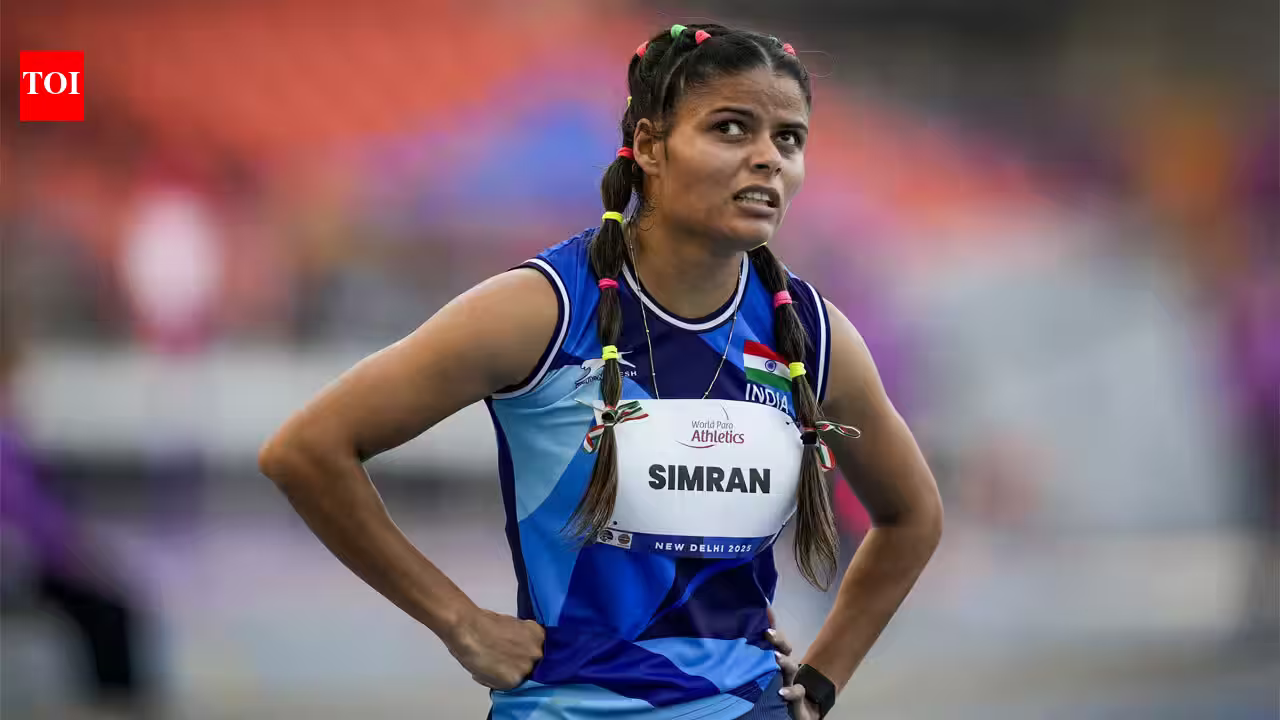
GLORY returned to the Indian athletics contingent at the Asian Para Games 2026 on Tuesday, as star sprinter Simran delivered a masterclass in resilience, clinching the women’s 200m T12 gold medal with a breathtaking Games-record performance. In a display of pure dominance, the 26-year-old stormed across the finish line in 24.80 seconds, effectively erasing the previous Games mark and signaling a triumphant return to the top of the continental podium.
The race, held under high-stakes conditions for athletes with moderate visual impairment, saw a spectacular one-three finish for India. Simran, partnered with her new guide, Shivam, surged ahead of Iran’s Hajar Safarzadeh—who clocked 25.02 seconds for silver—while India’s rising talent, Tejalben Damor, rounded out the podium with a bronze-medal effort of 25.23 seconds in her Games debut.
Simran shines with new guide after difficult transition
For Simran, this gold medal represents far more than just a victory; it is a profound testament to her ability to adapt under pressure. The athlete, who famously claimed bronze at the 2024 Paris Paralympics, faced a turbulent off-season that would have derailed most competitors. The forced separation from her long-time guide, Umar Saifi, following a doping violation, necessitated an eleventh-hour overhaul of her training mechanics.
Integrating a new guide is a process that requires months, if not years, of synchronization in pace, rhythm, and verbal communication. To achieve a Games-record gold medal with Shivam so soon into their partnership is a staggering accomplishment. The win serves as an emotional bookend to her 2023 Hangzhou campaign, where she had to settle for silver.
Reflecting on her performance, Simran was strikingly candid about the physical toll the competition took on her. Despite the record-breaking time, she admitted that she was far from peak physical condition. “My body was not feeling good, in fact, it felt tight because the recovery has not been great. I was very tired after my heat race,” she shared shortly after the victory ceremony.
She also offered a lighthearted insight into the logistical hurdles faced by the traveling team, specifically regarding dietary requirements at the host venue. Finding consistent, suitable vegetarian sustenance proved to be an unexpected challenge, but Simran laughed it off with typical athlete grit: “Otherwise, we Indians can run on willpower too.”
Though she fell slightly short of her personal Asian record of 24.46 seconds—a mark she had hoped to challenge—the gold medal validates her current trajectory. With this monkey off her back, Simran now shifts her focus to the women’s 100m, an event in which she is already a proven silver medalist from previous editions, eyeing another spot atop the podium.
Tejalben’s bronze boosts confidence ahead of 400m
While the spotlight was understandably on the gold-medal heroics, the emergence of Tejalben Damor as a genuine continental force was perhaps the day’s most inspiring narrative. A debutant at this level, the 24-year-old’s journey to the podium has been paved with significant economic hardship and immense personal sacrifice.
Speaking with raw honesty, Tejalben revealed the weight she carried into the race. “My parents have struggled financially for most of their lives, and I would even die to get a medal,” she said. This level of internal drive has clearly translated to the track. Navigating a competitive T12 field, her bronze-medal finish was not just a participation achievement; it was a clear statement that she belongs among the elite.
More importantly, the medal serves as a psychological catalyst. Tejalben views the 200m as a secondary discipline compared to her primary focus, the women’s 400m. “My next race is 400m, and that is my best event, and this medal has given me a lot of confidence for that event,” she noted. Having already secured hardware in the shorter sprint, she will head into the 400m heats with the tactical discipline and mental fortitude that only a podium finish can provide.
A watershed moment for Indian Para-Athletics
The double-podium success in the T12 category is a clear indicator of India’s sharpening focus on para-athletics. In recent years, the investment in training, the identification of talent, and the professionalization of the support staff—including the crucial roles played by guides—have begun to yield consistent results on the international stage.
As the Asian Para Games 2026 continue to unfold, the success of Simran and Tejalben acts as a bellwether for the rest of the Indian squad. Whether it is overcoming doping-related staffing crises or battling the physical demands of high-altitude recovery and nutrition, the Indian team is demonstrating a level of professionalism that is increasingly difficult for their continental rivals to contain.
With the track events intensifying as the Games progress, all eyes will now turn to the 100m and 400m blocks. If Tuesday’s performance is any indication, India’s para-athletes are not just participating in these Games; they are actively rewriting the record books.
Disclaimer: This content is auto-generated for informational purposes only.
Source: Read Original News