




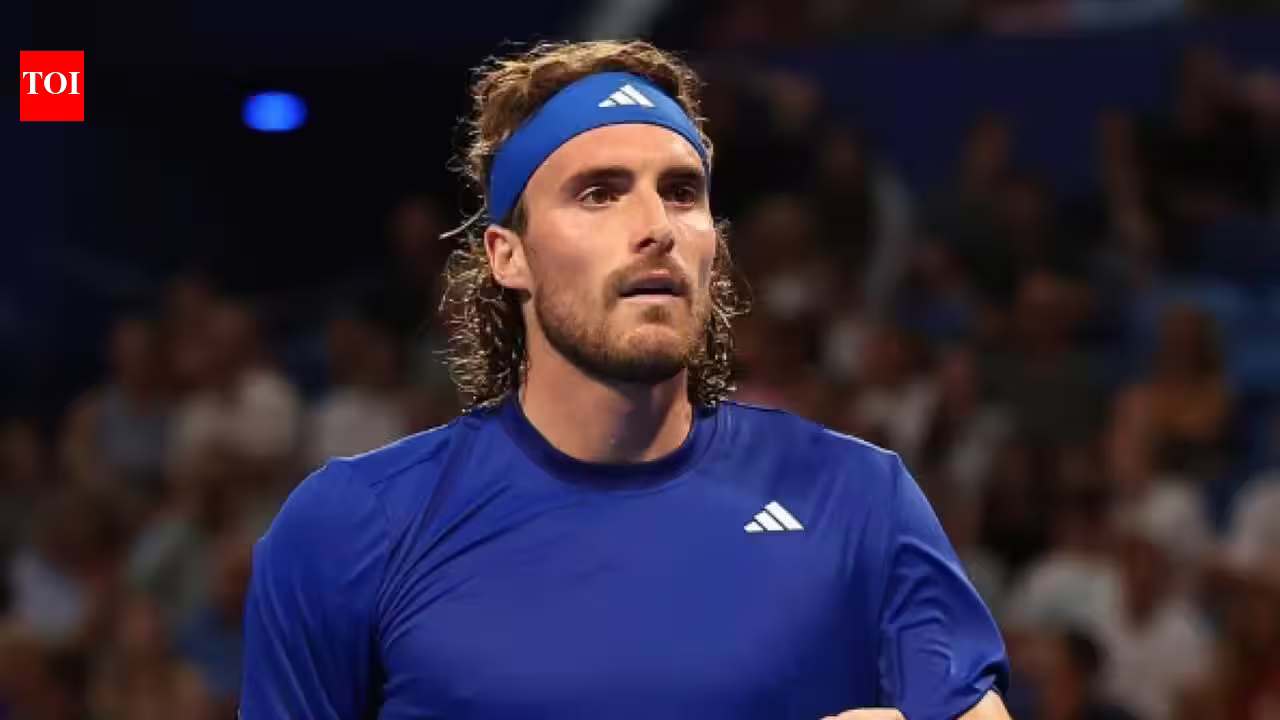
ALMATY: Stefanos Tsitsipas folded his 6 ft 4’ frame into a sofa in a busy corridor at the Almaty Open, projecting the calm composure of a man who has finally unburdened himself. For a player who held a firm grip on the world’s top ten rankings for five consecutive years, the recent slide to No. 39 was jarring. Yet, as he reflects on his journey, the 28-year-old insists that his path back to elite form began with the most difficult decision of his professional life: letting go.
For Tsitsipas, the transformation is not just about technique; it is about reclaiming his autonomy. By dismantling the professional barriers between him and his father, Apostolos, he has managed to restore a personal connection that was once fraying under the intense pressures of the tour.
The Price of Pressure
The narrative of Tsitsipas’ recent struggles is one of physical and emotional attrition. A lingering back injury, which hampered him throughout the early portion of the year, was exacerbated by a strained coaching dynamic with his father. The tension was often palpable, occasionally manifesting in public, heated exchanges that became fodder for social media. By June, as his ranking plummeted to No. 88, the environment had become unsustainable.
“I love my father, and I love him as a father,” Tsitsipas explained during his time in Almaty. “I want to keep the professional part out of my relationship with him. My relationship has improved now that he’s not my coach. It was very difficult for me to separate the coach and the father. I had reached a point where I could not avoid being triggered.”
That separation, formalized just before Wimbledon, has provided the “room to breathe” that he desperately lacked. The removal of the coach-father dual identity has silenced the triggers that previously inhibited his growth on the court. According to the Greek star, the shift has allowed him to transition from playing in a state of self-preservation to one of experimentation.
Freedom to Evolve
The tactical shift for Tsitsipas has been profound. When a player feels constantly judged, they default to “safe” tennis, prioritizing error-avoidance over genuine court craft. In the elite echelons of men’s tennis, safety is often synonymous with stagnation.
“When you feel judged, you tend to go for the safe options,” Tsitsipas observed. “And safety is not always where growth is. You need a team that isn’t going to judge you for what you do, but will analyze it and support you, because it’s all part of the process.”
That process is now being guided by a new-look support system. Working with Thomas Perrin and operating under the mentorship of veteran coach Patrick Mouratoglou, Tsitsipas has moved toward a more structured game. The results are undeniable: after a sluggish 16-14 start to the season, he has compiled an impressive 21-8 record in the ten tournaments following Wimbledon. This includes a morale-boosting title win at Gstaad in July—his first trophy in 16 months.
Revitalizing the Backhand
Perhaps the most compelling evidence of his resurgence is the evolution of his one-handed backhand. Once considered a vulnerability that opponents ruthlessly targeted, Tsitsipas has turned it into a cornerstone of his renewed offensive repertoire.
“My backhand is probably even better than my forehand right now,” he stated. “I’ve played some really good matches and used it as an actual weapon on court. Against Daniil Medvedev recently, I used it to approach the net, slice, change pace and rhythm, play down the line and open up the court.”
By integrating variety, depth, and sudden changes in direction, Tsitsipas is no longer just surviving baseline exchanges; he is dictating them. His recent victories over top-tier talent, including Arthur Fils, Taylor Fritz, and Jiri Lehecka, serve as proof that his technical adjustments are holding up against the world’s best.
The Road Ahead
Tsitsipas is bold in his assessment: “I’m playing better now than I played a few years back.” While he reached the finals of Roland Garros in 2021 and the Australian Open in 2023, he characterizes those periods as times when he was “stuck in the past,” lacking the foundational structure he now possesses.
As he navigates the remainder of the season, the pressure remains, but it is no longer the suffocating force it once was. The Almaty Open is merely the latest stop on a journey of rediscovery. For the Greek star, the mission is simple: to play on his own terms, with a clear mind, and a game that he finally trusts to carry him back to the summit of the sport. With the baggage of expectation left behind, Tsitsipas appears ready to let his racquet speak louder than the noise ever could.
Disclaimer: This content is auto-generated for informational purposes only.
Source: Read Original News