









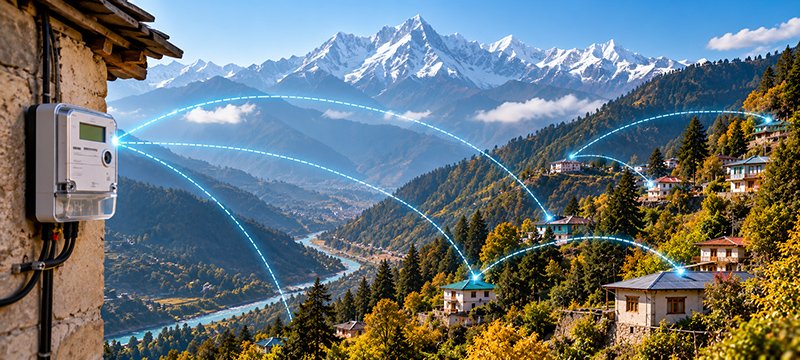
Finnish connectivity pioneer Wirepas has reached a major milestone in India’s digital infrastructure transformation, successfully deploying its specialized RF mesh technology across 700,000 smart electricity meters in the challenging terrain of Himachal Pradesh. This achievement marks a significant win for large-scale Industrial IoT (IIoT) implementation, demonstrating how decentralized connectivity can solve the “last mile” connectivity problems that have historically plagued high-altitude, mountainous regions.
## Solving the Geographical Challenge with Mesh Connectivity
Himachal Pradesh presents a unique architectural nightmare for utility providers. The state features a volatile mix of ultra-dense urban centers, where signal interference in concrete stairwells is rampant, and remote, isolated valleys where traditional cellular infrastructure is non-existent or unreliable.
Wirepas’s approach circumvents these limitations by utilizing a decentralized mesh network. Unlike traditional topologies that rely on central hubs or cellular gateways—which are prone to single-point failures—every smart meter in the Wirepas network functions as both a transmitter and a receiver. This “self-healing” grid allows data to navigate around physical obstacles, such as mountains or deep valleys, by hopping between meters. Because the system does not rely on permanent, expensive-to-maintain cellular tower infrastructure, it offers a sustainable, cost-effective alternative for utility companies looking to scale their operations without the burden of constant subscription fees or infrastructure overhead.
## Accelerating the Revamped Distribution Sector Scheme (RDSS)
The deployment is a critical component of India’s Revamped Distribution Sector Scheme (RDSS), a massive governmental push to modernize the nation’s power grid. Official data from the Ministry of Power reveals that the state’s smart meter installations have surged nearly four-fold in just nine months, climbing from approximately 174,000 in early 2025 to over 700,000 by the year’s end.
This rapid acceleration is vital for achieving the nation’s ambitious energy goals. By replacing manual, error-prone meter reading with reliable automated reporting, utilities can significantly reduce Aggregate Technical and Commercial (AT&C) losses—a key metric for financial sustainability in the power sector. The Wirepas-powered network is currently maintaining a 99.9 percent service level, proving that automated, AI-driven data collection can handle the volatility of mountainous environments as efficiently as it manages dense city grids.
## The Future of Massive IoT and the NR+ Standard
Beyond the immediate impact in Himachal Pradesh, this deployment highlights the growing influence of the NR+ standard in the global tech ecosystem. As the world’s first non-cellular 5G standard specifically designed for massive IoT, NR+ allows for high-density, low-latency communication that operates independently of commercial cellular carriers.
For the broader tech industry, the Himachal Pradesh case study serves as a benchmark for how non-cellular 5G can be applied to critical national infrastructure. Wirepas, which has been operating in India since 2018, now maintains its largest global footprint in the country. By aligning its technology with India’s IS 15959 DLMS requirements and collaborating with local manufacturers, the company is positioning itself as a core player in the global move toward smarter, more resilient utility grids.
As the RDSS mandate continues through 2028, the success of this mesh network proves that for large-scale IoT projects, the solution to complex geography isn’t more tower-based infrastructure—it is the creation of intelligent, decentralized networks that grow smarter with every added node. As AI continues to influence grid management, having a reliable, high-integrity data stream from these 700,000 meters will empower utilities to optimize load distribution and predictive maintenance with unprecedented precision.
Disclaimer: This content is auto-generated for informational purposes only.
Source: Read Original News