








Integrating Personal Intelligence into the Driving Experience
The landscape of automotive software is undergoing a significant transformation as Google integrates its Gemini artificial intelligence platform directly into the driving experience. By introducing “Personal Intelligence” to Android Auto and vehicles equipped with Google built-in, the company is bridging the gap between a driver’s digital workspace and their physical transit. This update moves beyond simple voice commands and static navigation, enabling the vehicle to act as an extension of the user’s personal digital assistant.
The core of this advancement lies in Gemini’s ability to interface directly with the user’s broader Google ecosystem. Historically, in-car voice assistants were limited to querying general information or controlling basic vehicle hardware like media volume and climate settings. With the new integration, the AI gains access to data across Gmail, Calendar, Maps, Photos, YouTube, and Search, provided the user explicitly grants permission. This allows the vehicle to process contextual queries that require cross-referencing multiple sources of information simultaneously.
Contextual Awareness and Operational Use Cases
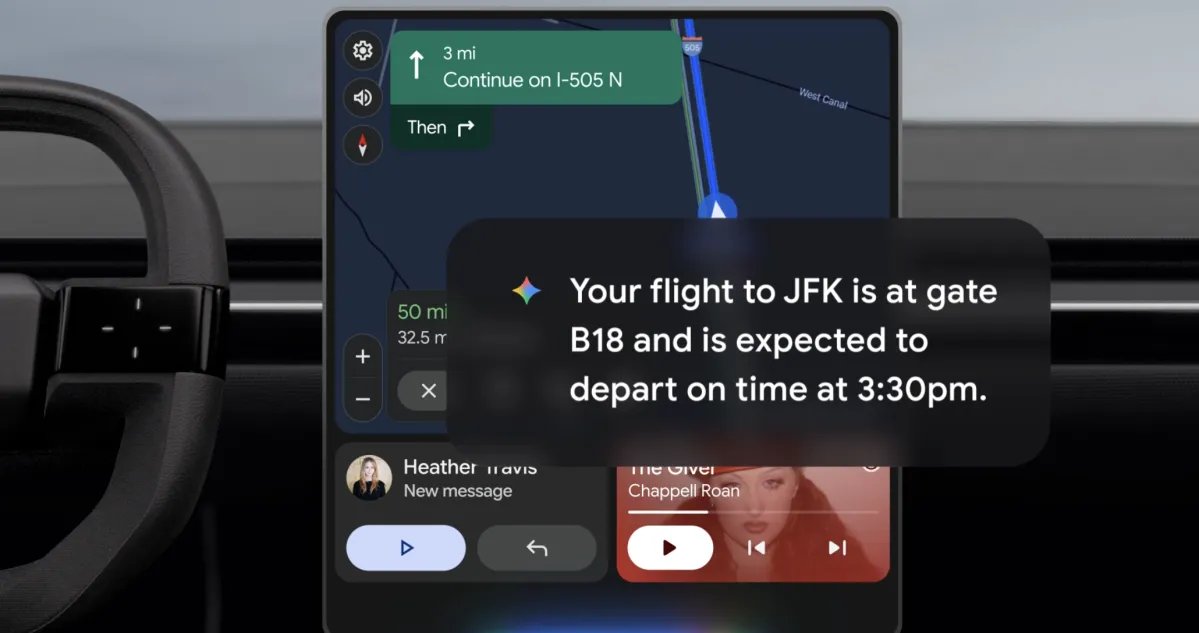
The primary benefit of Personal Intelligence is the reduction of cognitive load for the driver. Instead of manually searching for specific information on a phone or infotainment screen, a driver can utilize natural language queries to retrieve complex data. For instance, a driver heading to an airport can simply ask Gemini about their flight status. The AI scans the user’s Gmail account for confirmation emails, extracts the flight number, and retrieves real-time status updates, delivering the information via audio without the driver needing to take their eyes off the road.
This capability extends to schedule management and location-based tasks. If a user has a saved appointment in their Calendar, they can request the vehicle to initiate navigation to that destination by name, such as “take me to my doctor’s appointment,” without needing to manually input an address. Even more complex tasks, such as finding a specific location from a photo stored in Google Photos, are now achievable. A driver could ask the assistant to locate a car wash they visited previously based on a saved image; the system parses the metadata of the photo to identify the location and sets the destination in the navigation module. These use cases demonstrate a shift from command-based interfaces to goal-oriented interaction.
Privacy Controls and User Agency
A critical component of this deployment is the emphasis on user consent and data privacy. Google has implemented Personal Intelligence as an opt-in feature rather than a mandatory update. The system is designed to remain dormant regarding personal data unless the user actively enables the setting. This ensures that users who prefer a standard, non-personalized experience can continue to utilize basic functionalities like navigation, music streaming, and standard voice inquiries without their personal app data being accessed.
Furthermore, the architecture relies on the connection between the user’s mobile device and the vehicle. Personalized responses are processed when the phone is actively connected to the car’s system, ensuring that sensitive data is tied to the local device environment. For those who choose not to enable Personal Intelligence, the vehicle’s core operations remain unaffected. The standard features of the infotainment system persist, but the responses provided by the AI remain general, rather than tailored to the user’s specific history or private information.
Deployment Roadmap and Compatibility
The rollout of Personal Intelligence is staged to ensure a stable transition across different automotive environments. As of today, the feature is available for Android Auto, allowing users with compatible smartphones to leverage these new capabilities in vehicles that support the platform. For cars that feature Google built-in—a system where Google services are integrated directly into the vehicle’s onboard software rather than projected from a phone—the rollout is scheduled for the coming months.
This tiered approach highlights the technical differences between Android Auto, which relies heavily on the tethered phone’s processing power and software version, and Google built-in, which requires deep integration into the vehicle’s operating system. By prioritizing Android Auto first, Google is enabling a broader range of vehicle owners to access these advanced AI features immediately, while the subsequent release for built-in systems will ensure that native vehicle software is fully optimized to handle the intensive data processing required for deep application connectivity.
The Future of In-Car AI Architectures
The integration of Gemini into the driving space marks a pivot in how manufacturers and software developers view the vehicle cabin. It is no longer just a space for transit, but a mobile computing environment that requires intelligent orchestration of digital services. As AI models become more adept at synthesizing data from disparate apps, the role of the voice assistant will likely evolve from a simple query tool into an agent capable of managing sequences of actions, such as checking a schedule, navigating to an appointment, and managing communication, all through a unified interface.
The impact of this update is twofold. For the user, it provides a seamless transition of digital workflows from the office or home into the vehicle. For the automotive industry, it establishes a new benchmark for software-defined vehicles where the intelligence of the user interface is determined by the depth of integration with cloud services. As this technology matures, the ability for an AI to understand context—the “why” behind a request—will likely become the standard requirement for in-car software, fundamentally changing the human-machine interface in the automotive sector.
Disclaimer: This content is auto-generated for informational purposes only.
Source: Read Original News