








The recurring deaths of Scheduled Caste (SC) and Scheduled Tribe (ST) students within India’s elite higher education institutions—most notably the Indian Institutes of Technology (IITs) and the All India Institutes of Medical Sciences (AIIMS)—have ignited a national dialogue on the systemic barriers facing marginalized scholars. As these institutions serve as the primary gateways to professional success in India, the persistent reports of exclusion, harassment, and academic distress have forced a re-examination of how merit, equity, and institutional support are defined in the classroom.
The Crisis of Institutional Accountability
The gravity of the situation was recently underscored by the tragic death of Sahil Wakode at IIT-Bombay, an event that triggered widespread student protests and forced the administration to reissue its anti-discrimination guidelines. These incidents are not merely isolated failures of student support services; they point to a broader, structural crisis in how universities handle social diversity.
At the heart of the current policy debate is the role of the University Grants Commission (UGC). In 2026, the UGC attempted to introduce updated equity rules aimed at fostering inclusive campuses. However, these regulations were met with intense scrutiny and were eventually stayed by the Supreme Court. This legal deadlock has left a void in governance, leaving individual institutions to navigate the complex challenges of caste-based discrimination without a unified, mandatory regulatory framework. Consequently, the burden of ensuring a safe learning environment has fallen on the institutions themselves, leading to inconsistent outcomes and, at times, a lack of transparency in grievance redressal.
Policy, Equity, and the Academic Environment
For students from marginalized backgrounds, the transition into elite higher education often involves navigating “hidden curricula”—unspoken social codes and academic expectations that favor those with specific cultural capital. When these institutions fail to provide robust anti-discrimination policies, the academic environment can become exclusionary, directly impacting a student’s mental well-being and academic performance.
The ongoing discourse suggests that real change requires more than just revised handbooks. It demands a shift in institutional culture that recognizes the sociological realities of Indian students. Policy experts argue that meaningful inclusivity must integrate support systems into the pedagogical process itself, ensuring that faculty are trained to identify and mitigate bias, and that students have access to non-punitive support structures.
Engaging with the Path Forward
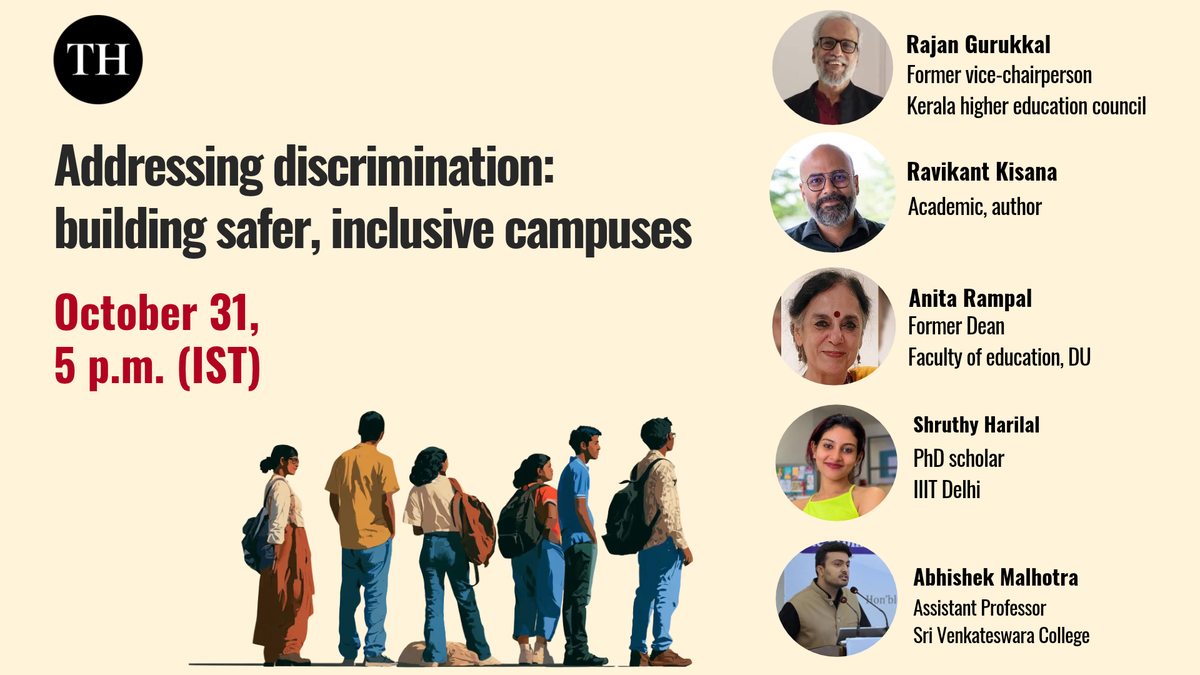
To delve deeper into these systemic issues, The Hindu is hosting a webinar titled “Addressing discrimination: building safer, inclusive campuses” on October 31 at 5 p.m. Moderated by M. Kalyanaraman, head of the education vertical at The Hindu, the session aims to bridge the gap between academic research and policy formulation.
The panel features a multidisciplinary group of experts who bring years of experience in higher education governance, sociological research, and policy-making:
- Rajan Gurukkal: Former V-C of M.G. University and a renowned historian and social scientist.
- Ravikant Kisana: An academic and independent researcher, creator of the ‘Buffalo Intellectual’ platform, focusing on caste and cultural commentary.
- Anita Rampal: Former Dean of the Faculty of Education at the University of Delhi, whose work with the NCERT has been instrumental in shaping national curriculum frameworks.
- Shruthy Harilal: A PhD scholar at IIIT Delhi whose research specifically investigates the intersection of caste, gender, and social stratification.
- Abhishek Malhotra: An Assistant Professor at Sri Venkateswara College, DU, with deep experience in economic policy and urban economics.
This webinar offers a critical space for students, researchers, and administrators to discuss how India’s higher education system can move toward a more equitable future. Registration is free and open to the public, providing an opportunity for attendees to engage directly with the panelists. By fostering this dialogue, educational stakeholders hope to move beyond reactive measures and toward a proactive, systemic framework that ensures every student, regardless of their background, has the opportunity to thrive in the classroom.
Disclaimer: This content is auto-generated for informational purposes only.
Source: Read Original News