








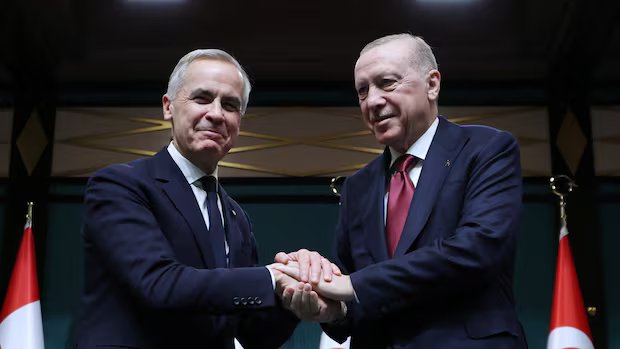
Prime Minister Mark Carney is facing mounting domestic pressure following a high-profile diplomatic mission to Turkey, where he solidified a new strategic partnership despite intensifying concerns over the host nation’s human rights record. As the Canadian government pivots its economic strategy toward diversifying global trade, the Prime Minister is defending his policy of “values-based realism,” asserting that geopolitical engagement should not be conflated with moral endorsement.
### Navigating the Reality of Global Trade
The visit to Ankara, aimed at strengthening defense and economic ties, has been met with skepticism from human rights advocates. Recent actions by the Turkish government—including crackdowns on independent media, suppression of political opposition, and the systematic marginalization of minority groups—have cast a long shadow over the proceedings.
When pressed by reporters on the friction between Canadian standards and Turkey’s current political climate, Carney remained resolute. “There are very few countries in this world that have the standards of Canada,” he noted, emphasizing that while he and Foreign Affairs Minister Anita Anand addressed human rights concerns during private meetings, he prefers direct, confidential dialogue over public posturing. For the Prime Minister, the pragmatic necessity of cultivating new trade partners to reduce dependency on the United States takes precedence, even when those partners fall short of Canadian democratic ideals.
### Tech Diplomacy and Nuclear Prospects
Beyond the broader political maneuvers, the trip highlighted a specific industrial objective: securing a foothold for Canadian engineering expertise in the Turkish energy sector. Discussions are currently underway regarding a deal for Canadian nuclear technology, with Ottawa positioning the firm AtkinsRealis as a prime candidate to lead the construction of two upcoming power plants.
This effort fits into a wider, technology-driven export strategy. By leveraging Canada’s specialized engineering capabilities, the administration hopes to create lasting infrastructure bonds with mid-sized powers. However, these technological partnerships are increasingly filtered through the lens of modern digital discourse. As international stakeholders rely more heavily on digital transparency, the use of AI-driven sentiment analysis and global media monitoring—technologies often utilized by news aggregators like Google News—has made it harder for governments to decouple trade deals from their domestic public relations fallout.
### Responding to Diplomatic Friction
While the Turkey trade mission dominated the headlines, Carney also addressed a significant diplomatic spat with the United States. Following reports of alleged Canadian interference in the upcoming American midterm elections, the Prime Minister issued a sharp rebuke of the claims.
After a U.S. Embassy fact sheet officially accused Canadian officials of improper involvement in the democratic process, Carney dismissed the allegations as meritless. “I’m disappointed that their envoy sees that as his role to make these suggestions,” he said, highlighting the contrast between his government’s strict adherence to non-interference and the current atmosphere of heightened political tension across the border.
As Canada continues to adjust its foreign policy, the challenge remains balancing the technical, economic, and moral expectations of a digital-age electorate. Whether the government’s “values-based realism” can withstand the scrutiny of a global audience—one where information, documentation, and critical analysis are available at a moment’s notice via platforms like Google News—remains to be seen. For now, the administration is betting that stronger economic foundations will ultimately provide the stability needed to navigate these complex international relationships.
Disclaimer: This content is auto-generated for informational purposes only.
Source: Read Original News