








“What the hell is that?”
The incredulous cry from commentator Simon Katich echoed the collective frustration of the Australian cricket public during the second Test against South Africa. With Australia reeling and tasked with the mountainous job of saving a match following a follow-on, Marnus Labuschagne appeared to be the beacon of stability. Batting with composure, he reached 39—a platform built to steer the visitors toward a hard-fought draw. Then, the decision-making malfunctioned.
Dancing down the track to off-spinner Simon Harmer, Labuschagne attempted a lofted drive over the long-on boundary. He failed to connect cleanly, looping a catch to Marco Jansen. The brain fade effectively ended Australia’s resistance and shattered the 92-run stand he had formed with Travis Head. Australia collapsed to an innings-and-31-run defeat, and the spotlight on Labuschagne intensified into a glare.
When Marnus Ruled the World
It is difficult to reconcile the current malaise with the meteoric rise of the batter who once sat atop the ICC Test rankings, looking down on the “Fab Four”—Steve Smith, Joe Root, Virat Kohli, and Kane Williamson.
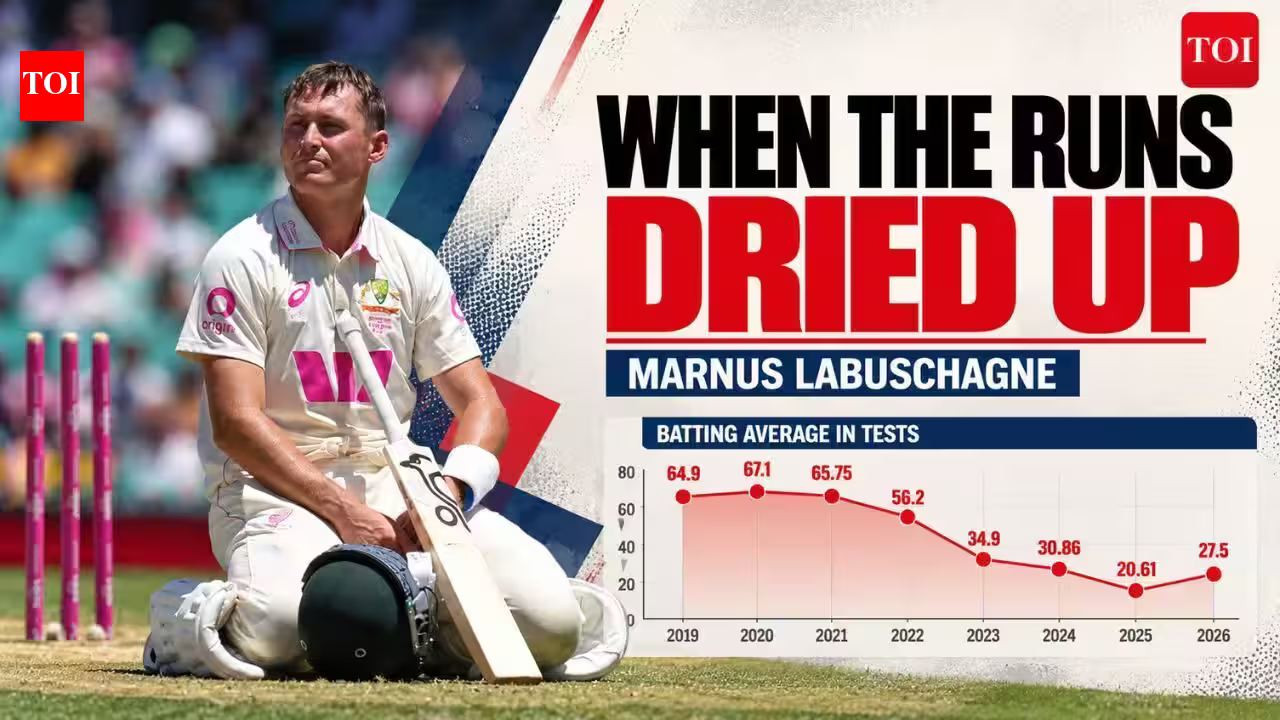
Labuschagne’s origin story remains one of the most remarkable in the sport. Entering the 2019 Ashes at Lord’s as the world’s first concussion substitute for Smith, he looked immediately at home under pressure. That baptism by fire ignited a golden era. Between 2019 and 2022, he was a run-scoring machine, amassing 2,990 runs at an average of 62.3, including 10 centuries. He wasn’t just a part of the side; he was the engine room of the Australian middle order.
A Long Way Down From the Top
The numbers since 2023 tell a sobering story of decline. In 66 innings, his average has plummeted to 29.7, yielding only one century. Perhaps most concerning is his vulnerability against pace; an area where he once thrived with technical fluidity. Between 2019 and 2022, he averaged 59.2 against fast and medium-fast bowling. That figure has cratered, dropping to a dismal 18 in 2025.
The number three position—a spot held by icons like Don Bradman, Ricky Ponting, and Rahul Dravid—is meant for the anchor, the player who shields the middle order from the new ball’s danger. During his peak, Labuschagne averaged 65.85 at the position. Since 2023, that average has dipped to 31.72, leaving him with the lowest return among the world’s top-tier players in that role. He is no longer the safety net; he has become the loose thread.
What is Labuschagne Doing Wrong?
Turning 32, an age where a cricketer should be in their tactical prime, Labuschagne finds himself battling both mental and technical demons. Greg Chappell, the former Australian captain, has posited a theory of “Elite Performance Decline Syndrome.” Chappell suggests that elite players possess a finite reservoir of “innings,” and when that well runs dry, the mental resilience required to weather the long hours at the crease begins to fray.
Technically, eagle-eyed observers have noted his chest position at the point of defense, suggesting he is becoming too front-on, which opens the door for edges to the slips. Yet, Pat Cummins has resisted blaming technique alone. To the Australian captain, it is a matter of temperament.
“It’s certainly not a technique error. It’s… maybe a couple of decision-making, some decisions (when) maybe the game demanded something a little bit different,” Cummins noted post-match. The dismissal against Harmer was not the result of a magical delivery, but a choice to abandon caution when the team’s survival dictated otherwise.
The Clock is Ticking
History serves as a stern warning for Labuschagne. Australian cricket has long held a low tolerance for lapses in judgment against the Proteas. From Damien Martyn to Brad Hodge, illustrious careers have been derailed by moments of madness against South African attacks.
While Labuschagne remains confident in his ability to reclaim his form, the grace period is rapidly expiring. He has done the hard work of surviving the initial barrage of a new ball, only to throw it away before the substantial rewards can be reaped. As Australia looks toward the upcoming series against New Zealand, the selectors face a grueling choice. They can either continue to back the pedigree of a former world number one or, if the third Test in Cape Town yields another premature exit, accept that the once-dominant number three may need a period out of the fire to rediscover his identity.
For now, the faith remains, but it is being tested in a way it never has been before.
Disclaimer: This content is auto-generated for informational purposes only.
Source: Read Original News