









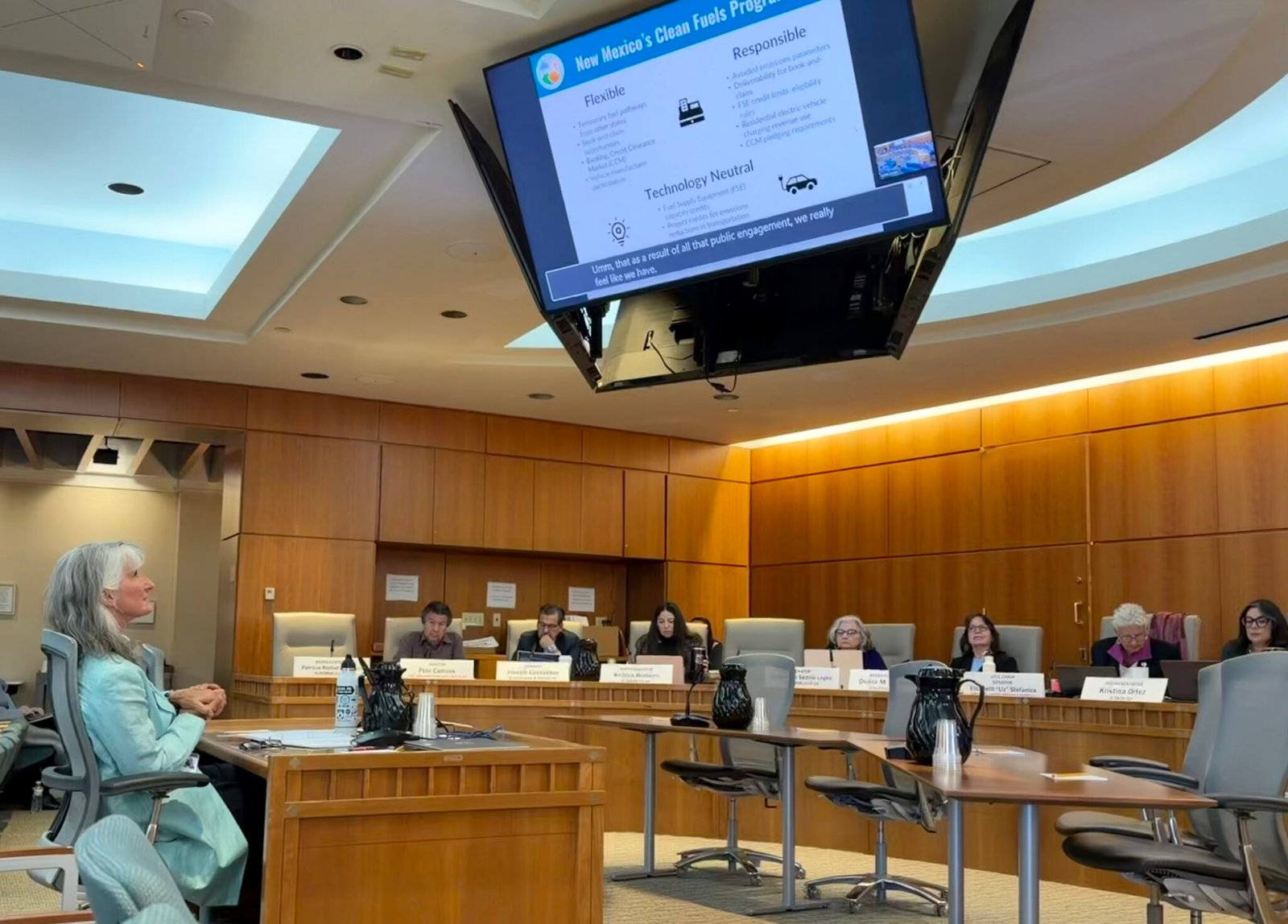
New Mexico is currently off-track to meet its ambitious 2030 climate goals, according to an assessment presented by state environment officials this week. Despite concerted efforts to pivot toward a greener economy, the state is falling significantly short of the emissions reduction targets established by Gov. Michelle Lujan Grisham.
In 2019, Gov. Lujan Grisham issued an executive order mandating a 45% reduction in greenhouse gas emissions by 2030, compared to 2005 levels. Claudia Borchert, chief of the Climate Change Bureau at the New Mexico Environment Department (NMED), told members of the interim Water and Natural Resources Committee on Monday that while the state has achieved a 21% reduction since 2005, the current trajectory is insufficient to bridge the gap to the 45% target.
“Current policies don’t have us getting to our desired outcome,” Borchert stated during the hearing.
The shortfall has prompted concern among state lawmakers who point to the increasing frequency of extreme weather as a call to action. Recent events, including catastrophic flooding in San Juan County and a rare tornado in Santa Fe, have sharpened the debate over the state’s environmental strategy.
“We really need to buckle down,” said state Rep. Tara Lujan (D-Santa Fe). “It’s beyond critical. It’s a crisis.”
To close the gap, the NMED has outlined a comprehensive “Climate Action Plan,” which includes 45 specific recommendations. These range from the decarbonization of electric grids and the implementation of more energy-efficient building codes to the expansion of forest health programs designed to improve carbon sequestration and post-fire recovery.
The challenge of reducing emissions is complicated by the state’s economic reliance on industrial sectors. According to NMED data, the oil and gas industry, transportation, and agriculture remain the primary drivers of greenhouse gas emissions in New Mexico. Within the transportation sector, large commercial trucks account for a significantly higher share of emissions than passenger vehicles, complicating potential regulatory solutions.
Furthermore, new industrial pressures are threatening to undermine existing air quality progress. Energy experts recently warned lawmakers that proposals for large-scale data centers—often powered by on-site “microgrids” utilizing fuel cells and natural gas—could potentially reverse two decades of environmental gains.
The state has seen some successes, particularly in regulating methane emissions, which has helped lower the state’s carbon footprint relative to neighbors like Texas. New Mexico has also made significant capital investments in renewable infrastructure, such as the SunZia wind project, currently the largest wind farm in the United States.
However, these investments have sparked legislative debate regarding policy focus. During Monday’s committee meeting, Rep. Randall Pettigrew (R-Lovington) questioned the logic of exporting energy produced by massive projects like SunZia to other states. He suggested that New Mexico should prioritize retaining that clean energy to offset local emissions.
“Let’s go back and do some course correction,” Pettigrew urged.
While the NMED’s broader climate plan also envisions achieving total carbon neutrality by 2050, the immediate focus remains on the 2030 benchmark. As the administration faces pressure to reconcile its economic interests with its environmental mandates, officials acknowledge that without more aggressive, systemic changes, the state’s climate objectives will remain elusive.
Disclaimer: This content is auto-generated for informational purposes only.
Source: Read Original News