








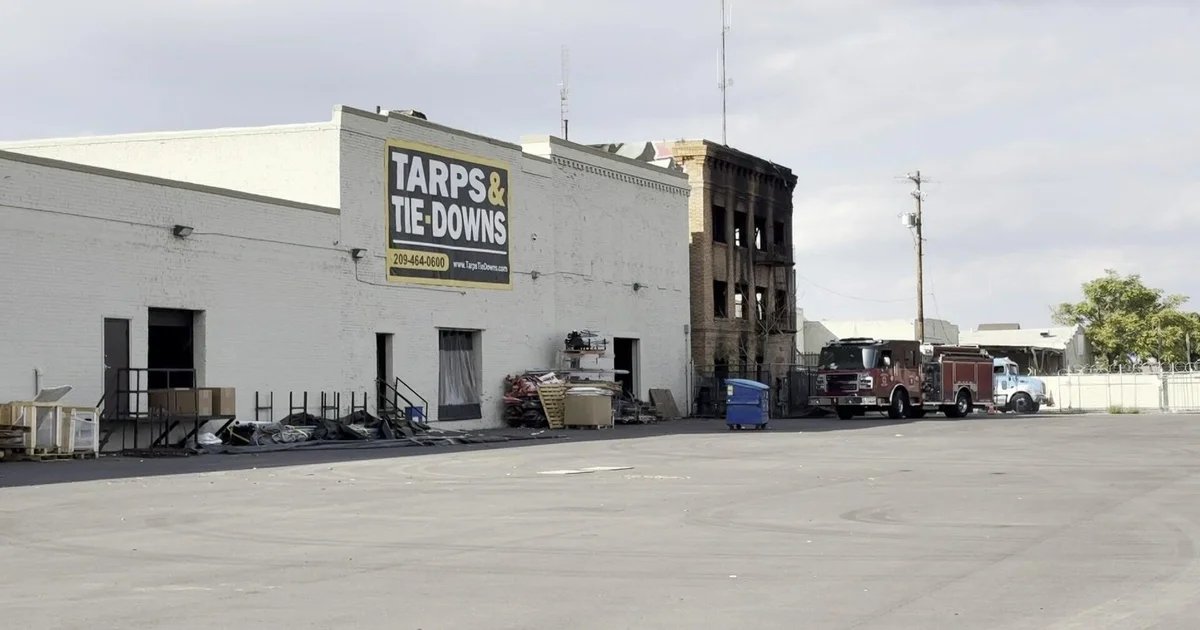
Stockton firefighters were forced into a high-stakes standoff with a three-alarm blaze on Friday morning after a fire engulfed the vacant Waldomore Apartments on East Market Street. The incident, which prompted a rapid emergency response, narrowly missed destroying a nearby warehouse heavily stocked with flammable paper products. While fire crews managed to bring the inferno under control in less than 30 minutes, the event has reignited local frustrations regarding urban safety, infrastructure management, and the lack of systemic solutions for recurring neighborhood hazards.
Growing Concerns Over Urban Blight and Neglect
For David Lee, the owner of the adjacent business Tarps & Tie-Downs, the fire was not an isolated tragedy but a predictable outcome of long-standing systemic neglect. Lee reported that one of his employees first detected smoke drifting into their facility around 7:00 a.m. Friday.
Beyond the immediate damage to the apartment structure, Lee pointed to a strip of railroad property directly behind his storefront that has become a flashpoint for safety issues. According to Lee, the area frequently serves as a site for homeless encampments, leading to repeated small-scale fires that have already scorched the exterior walls of his business. Despite his persistent attempts to coordinate with railroad officials and city leadership to secure the area—either through cleanup efforts or the installation of defensive fencing—Lee says he has been met with bureaucratic indifference. “I call many times to complain, but nobody takes care of it,” Lee noted, adding that he has stopped attempting to paint over the damage caused by frequent fires, as the cycle of neglect continues unabated.
The Role of Smart City Tech in Hazard Mitigation
The struggle faced by business owners like Lee highlights an ongoing challenge in municipal management: the disconnect between real-time urban reporting and effective government response. In the modern era, “Smart City” initiatives are increasingly utilizing AI-driven tools to bridge this gap. Platforms like Google’s Project Green Light or various AI-powered city maintenance dashboards are designed to aggregate data from public reports, traffic cameras, and sensor networks to identify urban blight and fire hazards before they escalate into three-alarm emergencies.
By integrating machine learning models, cities can now prioritize maintenance requests for areas showing patterns of recurring illicit activity or fire risks. If the data from property damage reports were successfully integrated into a centralized AI dispatch system, local fire departments and public works teams could theoretically receive automated alerts to clear brush or secure vacant properties before a catastrophe occurs. However, as Lee’s experience suggests, the technology is only as effective as the policy enforcement that follows. Without a robust feedback loop between digital reporting tools and physical urban cleanup crews, the promise of the “smart city” remains out of reach for business owners on the front lines.
AI and the Future of Disaster Prevention
The intersection of technology and public safety is rapidly evolving. Google’s ongoing investments in predictive AI—such as their work on flood forecasting and wildfire tracking—demonstrate a shift toward proactive disaster management. These sophisticated models process satellite imagery and meteorological data to predict where fires are likely to start or spread.
In a hypothetical application for a city like Stockton, AI could analyze historical fire incident reports and transit property occupancy rates to suggest optimal locations for physical security barriers. As these technologies become more accessible, local governments are under increasing pressure to adopt them. The goal is a digital infrastructure that doesn’t just record complaints, but actively triggers human intervention. Until such systems are fully deployed to address the root causes of the East Market Street concerns, residents and business owners remain in a vulnerable position, waiting for a solution to a problem that many believe has been clear for years. As for the Waldomore Apartments fire, authorities have yet to identify a definitive cause, leaving the investigation ongoing.
Disclaimer: This content is auto-generated for informational purposes only.
Source: Read Original News