







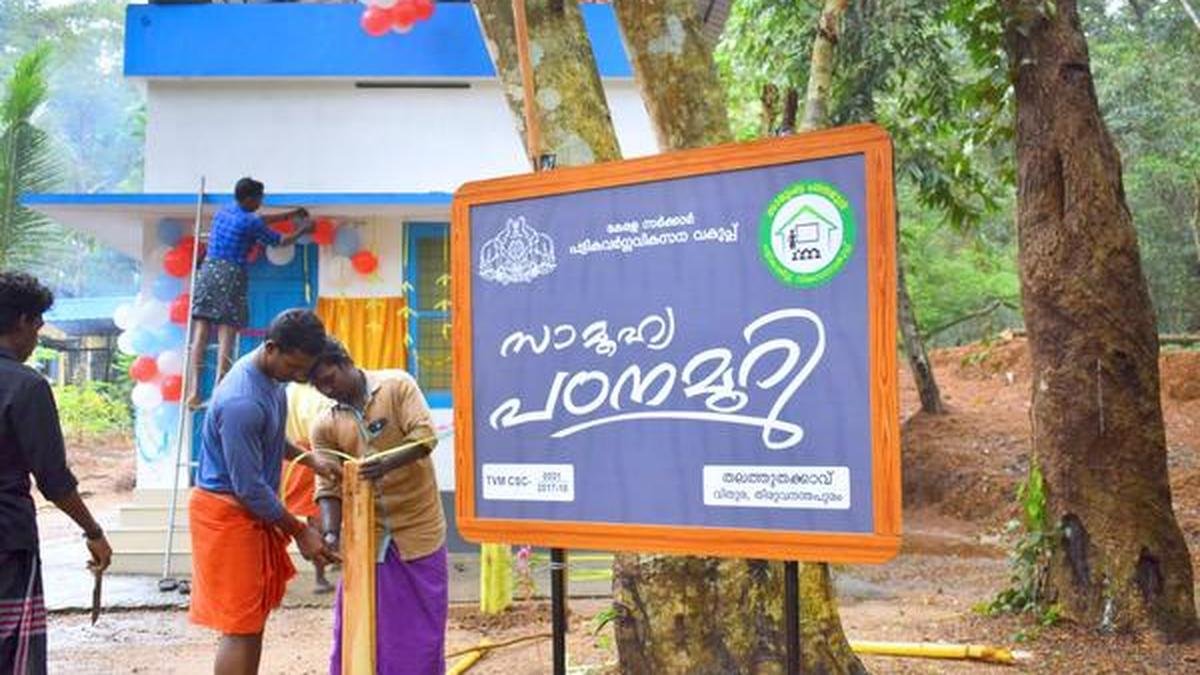
The concept of “access” in education is often treated as a numerical victory. When a school is built in a remote hamlet or a student is successfully enrolled, administrators mark the box as checked. However, a significant gap remains between the physical presence of a student in a classroom and their actual academic achievement. In Kerala, the Samoohya Patana Muri, or Community Study Centres (CSC), launched by the state government, serves as a vital case study on why policy must move beyond mere inventories to prioritize the social architecture of learning.
Beyond the Inventory: The Infrastructure of Inclusion
In places like the Vithura panchayat in Thiruvananthapuram, the CSCs are physically modest. They contain the expected markers of a modern learning space: a handful of computers, essential learning materials, and a quiet room that remains open long after the final school bell rings. These facilities are designed to bridge the resource gap for children from tribal communities who may lack adequate study environments or digital connectivity at home.
However, as these centers evolve, educators are realizing that the efficacy of a center cannot be measured solely by the equipment it houses. A ledger can track how many computers were purchased or how many students have registered for an after-school session, but it cannot measure the intangible “social contract” formed within those walls.
The “Participation” Gap in Education Policy
Traditional education policy often operates on a philosophy of “access as achievement.” By focusing on enrollment statistics, square footage of buildings, and standardized pass percentages, policymakers create a skeletal structure of education. While these metrics are not trivial—they provide the foundational resources needed for schooling—they represent only the starting point.
True learning requires “active participation,” a state where the student is not merely a passive recipient of instruction but an engaged partner in the process. When a student fails an exam, the institutional response is often cold and bureaucratic. In a system obsessed with pass rates, failure is treated as a statistic that needs to be corrected. But for a tribal student, failure can be a source of profound alienation. The policy challenge, therefore, is to create environments where failure does not signal the end of a student’s journey, but rather the beginning of a specific, targeted intervention.
Building Resilience Through Relationships
The most critical asset of a community-based study center is not the hardware, but the psychological safety it provides. The ability of a student to walk back into a learning center after a poor exam result, knowing that they will find support rather than judgment, is an act of resilience that is inherently social. It requires a relationship-based model of education where facilitators act as mentors rather than mere proctors.
When a child believes that an institution is fundamentally invested in their progress, their capacity for persistence increases. This is the “hidden” variable that policy must account for. If the social space of a school or study center is exclusionary or indifferent, the student will effectively “opt out” of the learning process, even if they continue to physically attend.
Reframing the Future of Policy
To improve outcomes for marginalized communities, education policy must pivot from a purely mechanical focus to a socio-pedagogical one. This means shifting the KPIs (Key Performance Indicators) of these centers:
* **From Enrollment to Engagement:** Tracking not just who is present, but the frequency and quality of their interactions with tutors.
* **From Pass Rates to Learning Trajectories:** Focusing on the growth of a student’s confidence and competence over time, rather than their performance on a single high-stakes examination.
* **Community Integration:** Ensuring that the center feels like an extension of the community, rather than an intrusive, top-down imposition.
By treating the Samoohya Patana Muri as a social space rather than just a facility, Kerala’s model highlights a universal truth: schooling is a social act. Unless we prioritize the relationships that encourage students to persist through adversity, our investments in computers and buildings will remain—at best—only half-complete. Education policy must be courageous enough to count things that are difficult to measure, because those are often the things that determine whether a child succeeds or falls behind.
Disclaimer: This content is auto-generated for informational purposes only.
Source: Read Original News