






MEA Debunks Deepfake Video Targeting External Affairs Minister S Jaishankar
The Ministry of External Affairs (MEA) has officially dismissed a viral social media campaign that utilized manipulated video footage and fabricated quotes attributed to External Affairs Minister S Jaishankar. The ministry’s dedicated fact-checking unit identified the posts as malicious disinformation, emphasizing that the content—which alleged a diplomatic rift between India and Russia—was entirely manufactured.
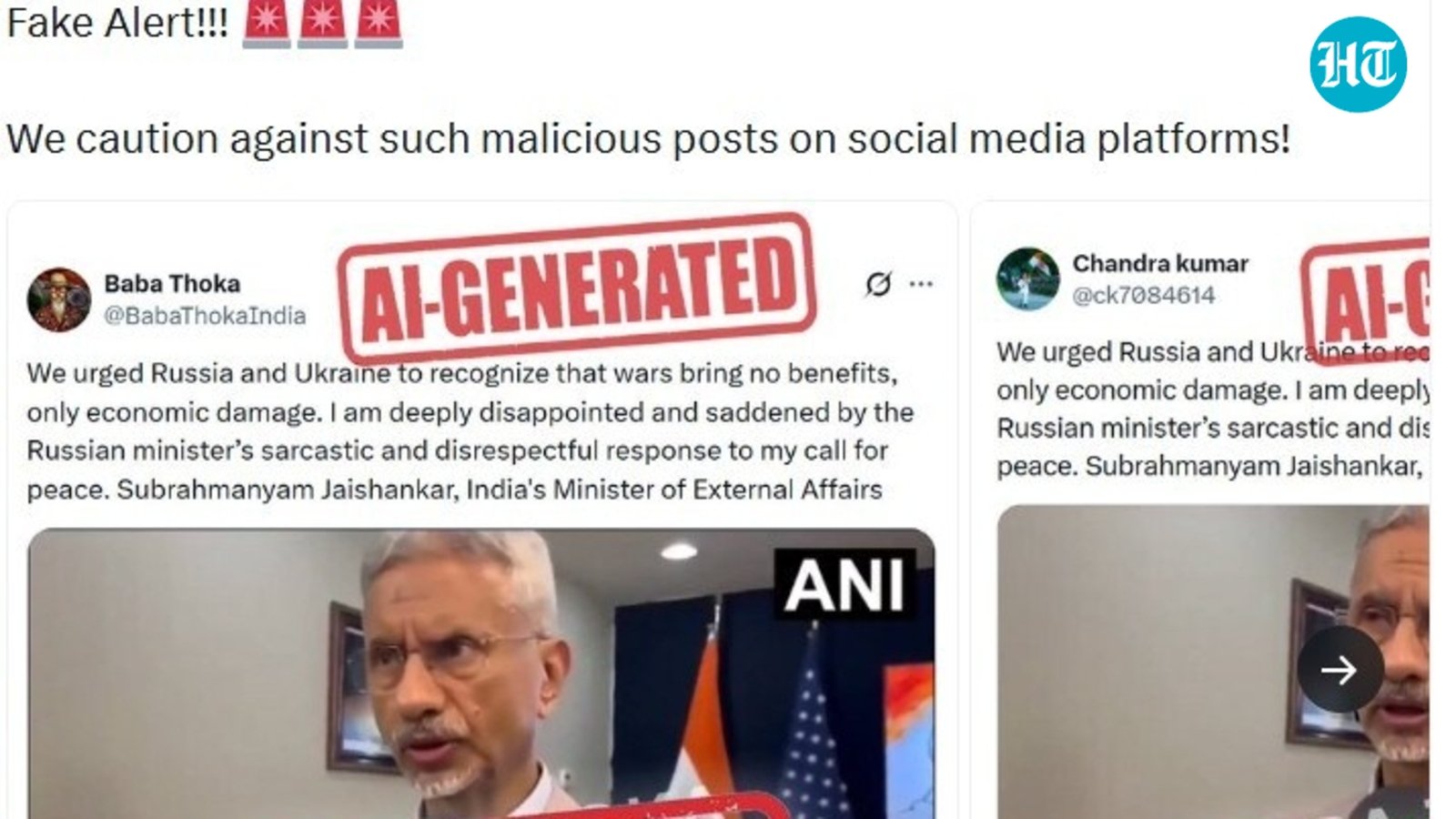
The deceptive posts, which proliferated across various social media platforms, featured an AI-generated clip of the Minister. The accompanying text falsely claimed that Jaishankar had expressed deep disappointment regarding a supposed “sarcastic and disrespectful” response from the Russian Foreign Minister to India’s peace mediation efforts. Another variation of the misinformation portrayed the Minister as lecturing global counterparts on the economic futility of conflict, using inflammatory phrasing to distort India’s measured diplomatic stance.
In response, the MEA Fact Check unit released several screenshots of these posts, branding them with a bold “Fake” and “AI-generated” stamp. Officials have issued a stern warning to the public, urging users to verify information before sharing and to exercise extreme caution against the rising tide of sophisticated digital disinformation.
Setting the Record Straight
The doctored footage appears to be a cynical repurposing of genuine clips taken during the G20 Foreign Ministers’ meeting held in Atlanta, US, on October 30–31. In the authentic recordings of those proceedings, Minister Jaishankar provided a candid update on India’s ongoing diplomatic engagements regarding the Russia-Ukraine conflict, focusing on three specific humanitarian and economic pillars.
During the actual summit, Jaishankar articulated that India’s diplomatic focus remained on the protection of civilian shipping and the safety of seafarers. Furthermore, he highlighted efforts to normalize grain exports between the warring nations and addressed the complex challenges surrounding global energy security.
Contrary to the fabricated narratives of hostility, the Minister clarified that India remains in consistent contact with both Moscow and Kyiv. He noted that New Delhi’s approach involves coordinating with international partners, including the United States, to support ongoing peace mediation initiatives. By twisting these nuanced diplomatic discussions into a sensationalized narrative of a personal diplomatic fallout, malicious actors sought to create international friction where none exists.
Rising Wave of Disinformation
This incident is part of a broader trend of misinformation targeting national security and diplomatic integrity. Just last week, the Indian Army’s fact-checking division was forced to intervene following the circulation of misleading claims regarding the India-China border at Sikkim’s Nathu La.
In that instance, social media accounts circulated footage of Chinese commercial vehicles at a designated border trade point, falsely framing the sight as an unauthorized military intrusion. The Army’s report, titled “Coordinated Inauthentic Behaviour Exposed,” clarified that the JAC-branded vehicles were at a legitimate transit zone. The misinformation campaign had further alleged that mainstream Indian media was suppressing the news, a common tactic used to erode public trust in official channels.
As the reach of AI-generated content grows, both the MEA and the Indian Armed Forces are intensifying their monitoring efforts. Authorities continue to stress that the spread of such deepfakes is not merely a nuisance but a calculated attempt to manipulate public opinion on matters of national interest.
Disclaimer: This content is auto-generated for informational purposes only.
Source: Read Original News