








India Boosts Maritime Firepower with $5.7 Billion Corvette Deal
NEW DELHI — In a decisive move to modernize its maritime defense, the Indian government has finalized a $5.7 billion contract with domestic shipbuilders to construct eight next-generation corvettes. This ambitious project aims to replace the Indian Navy’s aging fleet with high-speed, stealth-capable vessels engineered for complex anti-submarine, anti-surface, and littoral warfare.
Strengthening Indigenous Defense Manufacturing
The project represents a landmark moment for India’s “Atmanirbhar Bharat” (Self-Reliant India) initiative. For the first time, these advanced warships will be built entirely in domestic, state-owned shipyards based on designs curated specifically by the Indian Navy.
Five of the vessels will be constructed by Garden Reach Shipbuilders and Engineers (GRSE), while the remaining three will be handled by the Goa Shipyard. According to technical specifications provided by GRSE, the ships will measure 127 meters in length with a displacement of 4,950 tons. Equipped with sophisticated sensor suites and weaponry—including medium-range anti-ship and surface-to-air missiles, alongside 324 mm torpedo tubes—these corvettes are designed to dominate air, surface, and sub-surface domains simultaneously.
Safeguarding Vital Trade Routes
With India’s coastline spanning over 11,000 kilometers and nearly 90% of its trade volume traveling via sea lanes, the expansion of the fleet is a core national security priority. These corvettes are central to the Navy’s strategy to secure its economic arteries while countering growing regional pressures.
The procurement comes amid a shifting geopolitical landscape in the Indo-Pacific, marked by China’s expanding naval footprint and the strengthened military ties between Beijing and Islamabad. To address these challenges, Chief of Naval Staff Admiral Dinesh Tripathi has outlined a roadmap for the Indian Navy to scale its fleet from the current 145 vessels to more than 200 by 2035.
A Multifaceted Naval Expansion
The acquisition of the eight corvettes is just one pillar of India’s broader naval overhaul. The government is also moving forward with a high-stakes $8 billion partnership with Germany to construct six advanced, conventional submarines. These vessels, to be built by Mazagon Dock Shipbuilders in collaboration with Germany’s TKMS, will feature state-of-the-art Air-Independent Propulsion (AIP) technology. This capability will grant the Indian Navy extended underwater endurance, providing a significant tactical advantage in patrolling strategic Indo-Pacific waters.
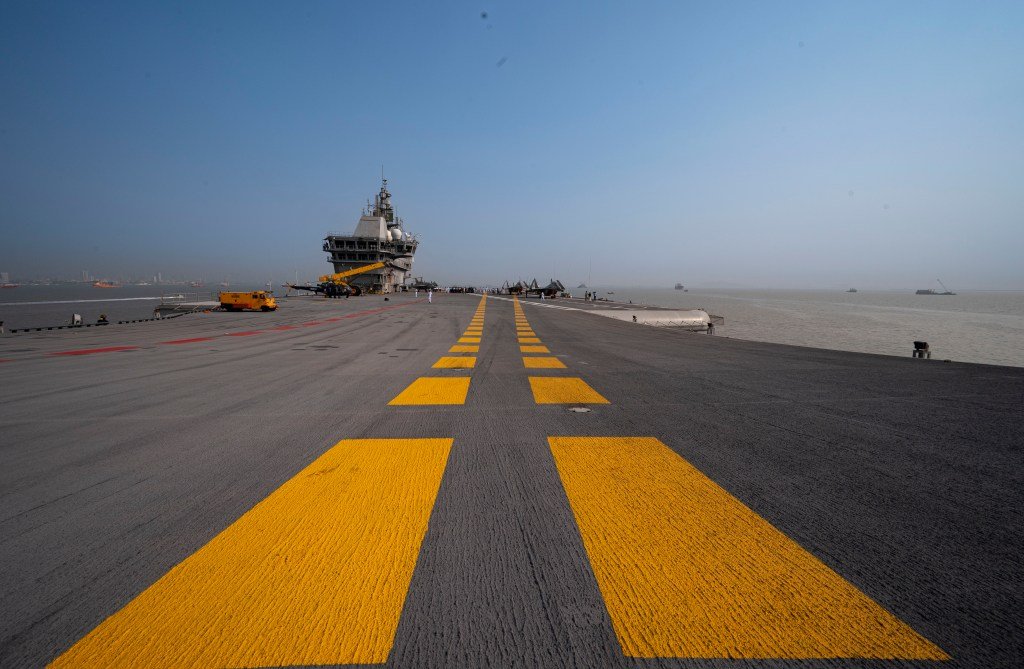
Simultaneously, the Indian Navy is advancing its carrier-based aviation capabilities. On October 29, the service reached a critical milestone when a Rafale Marine fighter jet successfully completed compatibility trials on the decks of the INS Vikrant.
The $7.5 billion deal for 26 Rafale Marine aircraft, signed 18 months ago, is designed to bolster the Navy’s multirole strike potential. By integrating these French-manufactured jets alongside the existing Russian-made MiG-29K fleet, India is significantly enhancing the combat readiness of its two aircraft carriers.
As these diverse maritime assets—from stealthy corvettes and AIP-equipped submarines to cutting-edge carrier-borne fighters—are progressively inducted, the Indian Navy is positioning itself as a dominant force capable of safeguarding its maritime interests in an increasingly contested regional environment.
Disclaimer: This content is auto-generated for informational purposes only.
Source: Read Original News