








Spanish football is reeling this week following the tragic death of CD Tenerife forward Jesús de Miguel, whose passing has cast a somber shadow over the nation’s sporting landscape. The 30-year-old striker died on Tuesday, a day after suffering a catastrophic on-field collision during a second-division match against FC Andorra. As clubs, teammates, and fans across the country mourn a life cut short, the focus has pivoted toward the complex, often clinical processes of the law and the Spanish Football Federation as they attempt to reconcile a fatal accident with the rules governing the game.
At the heart of this unfolding crisis is FC Andorra goalkeeper Jesús Owono. The Equatorial Guinea international, who was involved in the collision that led to the tragedy, is reportedly in a state of deep shock. Despite the sorrowful nature of the incident, Owono has become the target of vitriolic abuse on social media, with some users going so far as to brand him a “murderer.” Legal and sports experts are now urging caution, emphasizing that a fatal outcome in a contact sport does not automatically equate to criminal intent or sporting malpractice.
What happened in the collision?
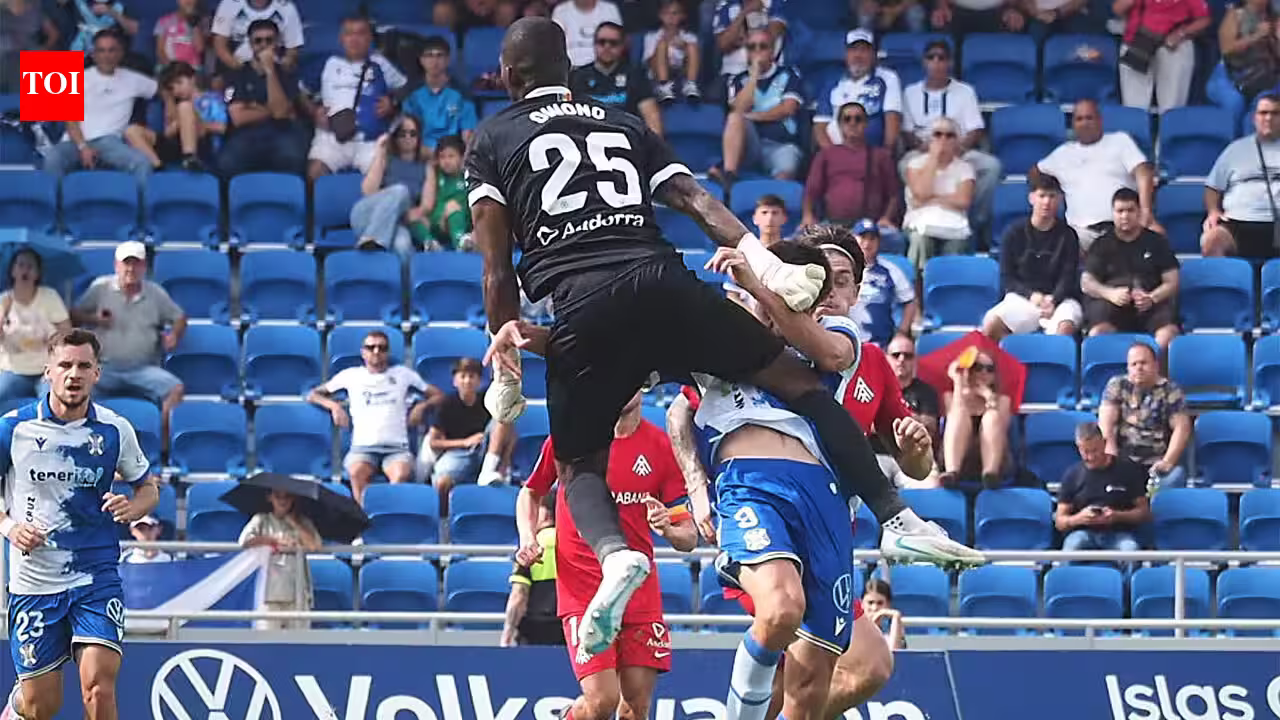
The incident occurred during a tense Monday night matchup as CD Tenerife pushed for a late-game winner. With the score tied at 2-2 in the dying minutes of stoppage time, Jesús de Miguel chased a long ball deep into the Andorra half. Goalkeeper Jesús Owono rushed off his line to intercept, launching himself into a clearance attempt. The momentum of the play led to a heavy collision, with Owono striking the forward in the chest with his knee.
The impact proved devastating. De Miguel collapsed on the pitch, requiring over five minutes of intensive medical attention before being rushed to a nearby hospital by ambulance. Reports indicate that the striker suffered a cardiac arrest during transit, requiring emergency resuscitation. Despite the best efforts of medical personnel, his condition failed to stabilize, and he passed away on Tuesday. The match was abandoned immediately following the incident, leaving the footballing world in a state of disbelief. CD Tenerife released a statement expressing the club’s “racked pain” and describing the loss as a void that feels impossible to fill.
What sporting sanction could Owono face?
From a disciplinary standpoint, the Spanish Football Federation’s Disciplinary Code is clear but nuanced. Article 102 of the code addresses “violent conduct,” allowing for suspensions ranging from four to 12 matches for players whose actions result in serious injury or harm to an opponent.
However, football authorities are quick to note that the application of such a sanction is never automatic. Disciplinary committees are tasked with a forensic review of the tape to determine the nature of the challenge. Was it a genuine, albeit reckless, attempt to play the ball, or was there an element of malice? The tragic death of De Miguel, while emotionally overwhelming, does not serve as a predetermined outcome for the suspension length. The federation must evaluate the goalkeeper’s intent and the specific mechanics of the challenge before deciding whether Article 102 applies.
Could the goalkeeper face criminal proceedings?
The question of criminal liability represents a distinct and far more serious legal hurdle. Under Spanish law, a death during a sporting event sits in a delicate grey area. While a fatality does not automatically trigger a criminal charge, the courts have a duty to investigate whether the event was a “normal” sporting accident or the result of criminal negligence.
Article 142 of the Spanish Penal Code outlines the criteria for negligent homicide. Investigators will likely examine the incident to see if Owono’s actions breached the duty of care expected of a professional athlete. This involves analyzing whether the fatal outcome was reasonably foreseeable and whether the goalkeeper’s actions constituted “gross negligence” or “less serious negligence.”
The legal threshold for such charges is high. The justice system must distinguish between the physical reality of a high-speed collision—which is inherent to the sport—and a conscious disregard for the safety of an opponent. As of now, there is no indication that charges will be filed, but the potential for an inquiry remains a possibility that will hang over the goalkeeper as the investigation into the exact circumstances of the collision proceeds.
Two separate processes, one deeply painful tragedy
The administrative reality of this situation is that there are two entirely separate tracks: the sporting inquiry managed by the Federation and the potential legal inquiry managed by the courts. The Federation does retain the power to refer the matter to the Public Prosecutor’s Office should they find evidence of a criminal act, but such a move is rare and would only occur after a thorough review.
For now, the footballing community remains centered on the life of Jesús de Miguel. A key figure in Tenerife’s rise, De Miguel had scored 11 goals in 30 appearances, helping spearhead the club’s promotion efforts. His legacy is one of athleticism and dedication, and the tributes flowing from his former clubs, Internacional de Madrid and CD Castellón, highlight the impact he had on his colleagues.
As the legal and sporting processes begin, the public is reminded that a tragedy of this magnitude defies easy answers. While the rules of the game and the laws of the land will eventually dictate the consequences for the participants, the immediate priority for the footballing world is mourning the loss of a 30-year-old athlete whose final act on the pitch will be remembered with heavy hearts for years to come.
Disclaimer: This content is auto-generated for informational purposes only.
Source: Read Original News