








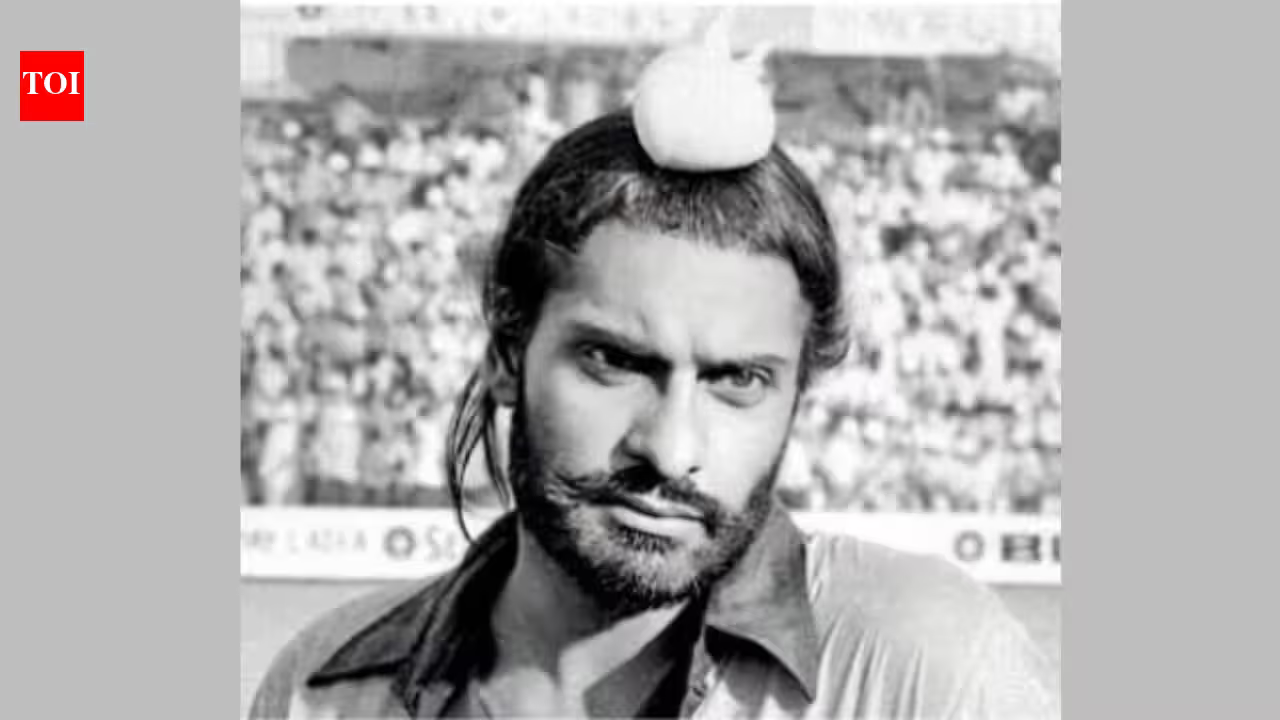
JALANDHAR: Every city has its legends, but few are woven into the regional identity quite like the late, great Surjit Singh Randhawa. More than four decades after his tragic passing in a 1984 road accident, the spirit of this hockey icon does not merely linger in the history books of Jalandhar—it remains a living, breathing force that continues to shape the future of Indian hockey.
As the city pulses with the excitement of the ongoing Asian Champions Trophy, the name “Surjit” remains ubiquitous. It greets fans as they walk through the gates of the Surjit Hockey Stadium, and it serves as the heartbeat of the academy that carries his name. The academy has evolved into a powerhouse of talent development, currently acting as the nursery for six members of the modern Indian national team, most notably the towering captain and penalty-corner specialist, Harmanpreet Singh.
A Legacy Forged in Gold
To understand the reverence Jalandhar holds for Surjit Singh Randhawa, one must look back to the pinnacle of Indian hockey. Surjit was more than just a skilled athlete; he was a World Cup winner, a seasoned Olympian, and an Arjuna Award recipient who defined the grit and defensive elegance of a bygone era.
His most iconic moment, arguably, arrived during the 1975 World Cup final. Facing arch-rivals Pakistan, India found themselves under immense pressure. It was Surjit’s thunderous, composure-laden equalizer that shifted the momentum of the match, setting the stage for Ashok Kumar to slot home the title-winning goal. That victory remains the golden chapter of Indian hockey history, and at the center of it stood a man whose nerves were as steady as his defensive technique.
“He was a dependable defender, a penalty-corner specialist, and a fighter to the core,” recalls Ajit Pal Singh, who captained that legendary 1975 squad. “As captain, I always had complete faith in him. He was one of the true pillars of that generation.”
From Village Prodigy to Global Icon
The trajectory of Surjit’s rise is the stuff of local folklore. Brigadier Harcharan Singh, a three-time World Cup medalist, remembers scouting a teenage Surjit at a village tournament in 1969. “I knew the moment I saw him play that he was special,” Harcharan noted. Recognizing the raw talent, he facilitated Surjit’s admission to the Sports College in Jalandhar.
It was a transformative decision. Within a few short years, the boy from the village had transitioned into one of the world’s most formidable defenders. His relentless work ethic became the stuff of legend. While he was a gentleman off the pitch, he was a tactical nightmare for opponents on it.
Former India goalkeeper Alloysius Edwards, who later represented India at the 1996 Atlanta Olympics, never shared the pitch with Surjit, but the stories of his ferocity survived long after his retirement. “I heard a story from a goalkeeper playing for JCT about a match against Surjit,” Edwards shared. “He told me he actually fractured a finger while trying to stop one of Surjit’s penalty-corner strikes. That was the level of power he possessed.”
The Lineage of Power
In the tactical landscape of Punjab hockey, there is a clear, genealogical progression of penalty-corner expertise—a direct line that connects the past to the present. The lineage begins with the legendary Prithipal Singh, transitions through the iron-willed Surjit Singh Randhawa, and finds its current expression in the drag-flicking brilliance of Harmanpreet Singh.
The connection between Surjit and Harmanpreet is more than just technical; it is spiritual. When Harmanpreet steps up to the mark, takes a deep breath, and prepares to launch a strike, he is carrying forward a tradition of excellence that was cultivated in the very soil of Jalandhar. The academy that bears Surjit’s name ensures that his methodologies, his discipline, and his tactical intuition are passed down to the next generation of defenders.
A Presence Beyond the Pitch
For those who lived, breathed, and struggled alongside him, Surjit was never just a highlight reel. He was a teammate, a mentor, and a steadfast friend. His loss in 1984 left a void that, in many ways, has never been filled, yet his memory serves as a benchmark for excellence.
Today, as Jalandhar hosts international titans during the Asian Champions Trophy, the city isn’t just celebrating a sport; it is celebrating a standard. The Surjit Singh Randhawa legacy serves as a reminder to every young player donning a kit in Punjab that they are part of a storied lineage. Whether it is through the infrastructure of his namesake stadium or the success of the academy that continues to produce international captains, the “Full-back of the Century” remains at the forefront of the sport he loved.
Surjit Singh Randhawa died young, but the foundation he laid remains unshakable. As long as a hockey stick is gripped with conviction in Jalandhar, the spirit of Surjit will never truly leave the field. He remains the standard-bearer, the silent coach, and the eternal heartbeat of Indian hockey.
Disclaimer: This content is auto-generated for informational purposes only.
Source: Read Original News