








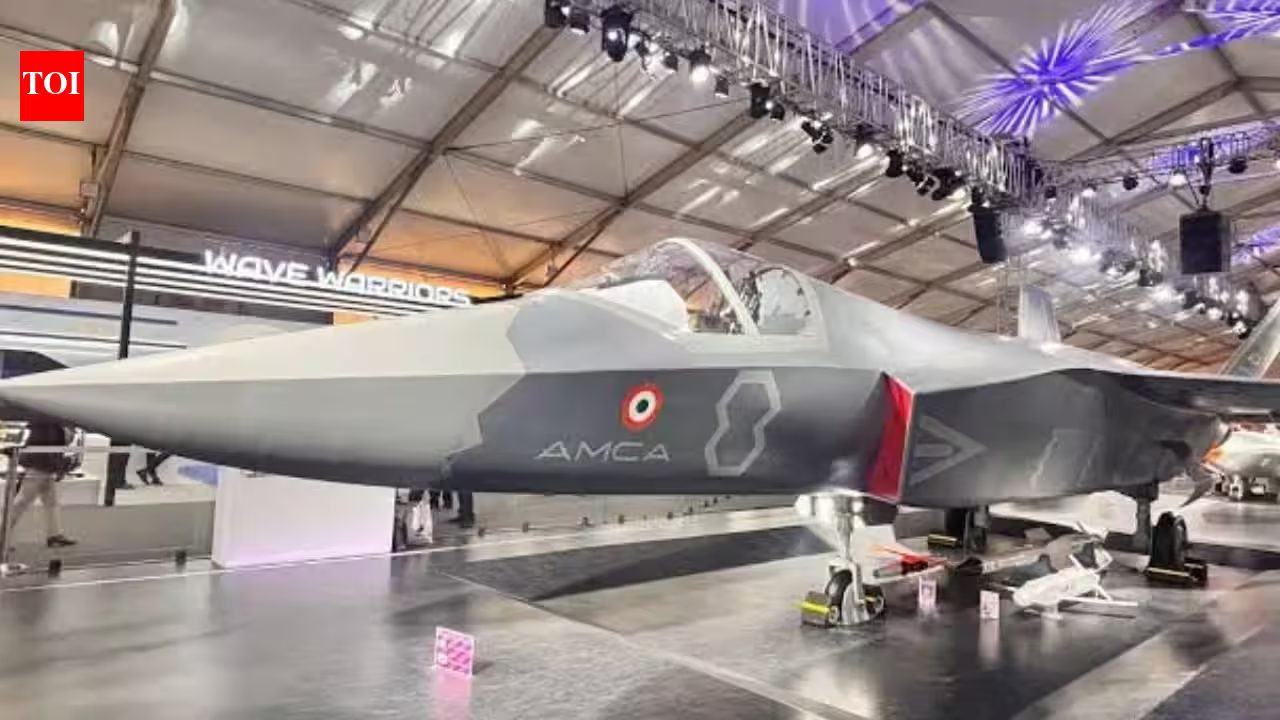
India’s AMCA Program Hits Key Milestone: Evaluation Begins for Prototype Development
NEW DELHI: India’s ambitious quest to join the elite club of nations operating indigenous fifth-generation stealth fighter jets has gained significant momentum. The Advanced Medium Combat Aircraft (AMCA) program, a multi-billion-rupee initiative aimed at revolutionizing the Indian Air Force’s (IAF) aerial warfare capabilities, has reached a critical juncture with the submission of bids for prototype development.
A high-level review committee appointed by the Ministry of Defence is currently evaluating proposals from three major Indian industry players. The selection process will determine the Development-cum-Production Partner (DCPP), who will work in close coordination with the Aeronautical Development Agency (ADA) to bring the country’s most sophisticated fighter jet project to life.
A Competitive Field for a National Priority
The race to partner with the ADA involves some of India’s most prominent industrial heavyweights. Bids were officially submitted by the October 30 deadline, following a brief extension granted to allow firms to navigate the intricate technical requirements of such a complex stealth project.
The contenders include a consortium led by Larsen & Toubro (L&T) which features Bharat Electronics Ltd (BEL) and Dynamatic Technologies. Additionally, Tata Advanced Systems Ltd (TASL) has entered the fray as a solitary bidder, while the third entry comes from a consortium spearheaded by Bharat Forge, joined by BEML Ltd and Data Patterns. With the bids opened on November 1, the review committee is now meticulously assessing these proposals to select a partner capable of executing the ambitious manufacturing timeline.
Scaling the Stealth Frontier
The AMCA project, estimated at a cost of approximately Rs 15,000 crore, is designed by the ADA to serve as the backbone of India’s future air superiority. The initial phase of the project involves the manufacturing of five twin-engine prototypes. These aircraft will be put through rigorous testing, including an estimated 1,800 test sorties over seven years. This extensive flight-test campaign is essential to validate the jet’s advanced AI-driven avionics, internal weapons bays, next-generation sensor fusion, and its critical stealth characteristics.
A pivotal element of the program’s success hinges on propulsion. Reports suggest that the AMCA is likely to be powered by twin GE F414 engines. As part of a larger strategic defense cooperation, Hindustan Aeronautics Ltd (HAL) and US-based GE are currently working toward a deal for the joint production of these engines within India, a move that would ensure the long-term sustainment of the AMCA fleet.
Strategic Necessity for the IAF
For the Indian Air Force, the AMCA is more than just a technological milestone; it is a strategic necessity. With the current number of fighter squadrons hovering at 29—significantly lower than the authorized requirement of 42.5—the AMCA is expected to play a vital role in addressing this critical shortfall.
While full operational induction is anticipated between 2034 and 2035, the program is being fast-tracked to counter the rapidly evolving aerial landscape in the region. China already fields the Chengdu J-20 and the Shenyang J-35 fifth-generation jets, and with Pakistan signaling intentions to acquire the J-35, the indigenous development of the AMCA has become an urgent national security priority. By developing this stealth platform, India aims to maintain a qualitative edge in the skies, ensuring robust deterrence in an increasingly complex geopolitical environment.
Disclaimer: This content is auto-generated for informational purposes only.
Source: Read Original News