








Redefining the Living Room Computing Experience
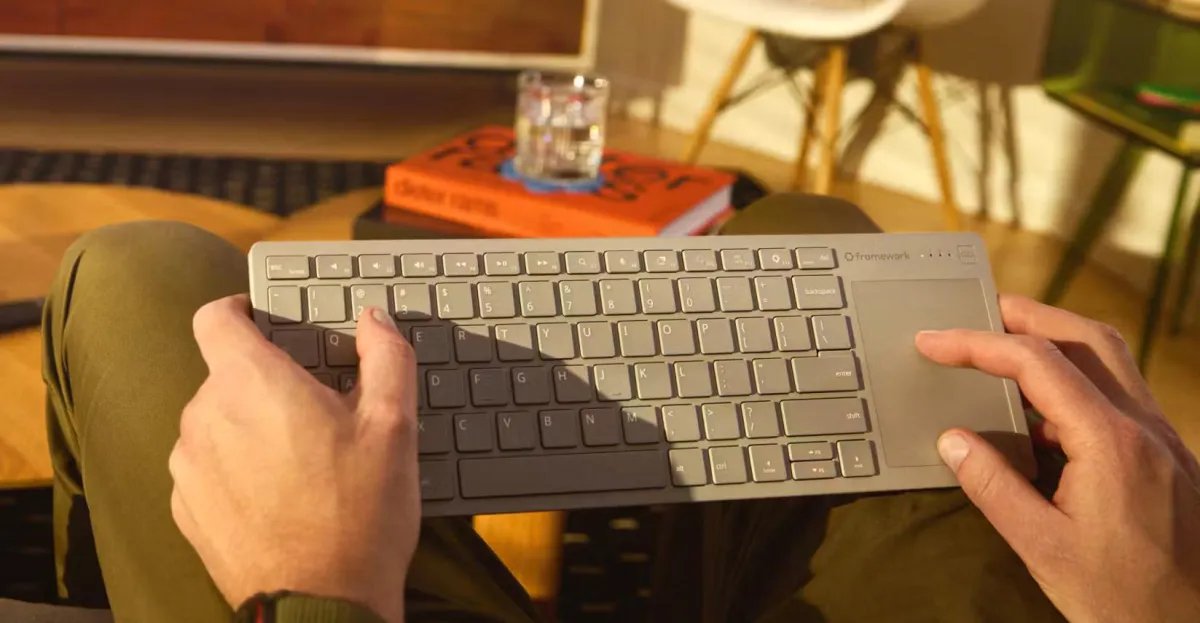
The landscape of input devices has long been dominated by budget-focused couch keyboards, often characterized by flimsy construction and compromised touchpads. Framework, the modular hardware company known for its repairable laptops, is challenging this status quo with the release of its new Wireless Touchpad Keyboard. Priced at $99, the device enters the market at a significant premium compared to ubiquitous legacy hardware. However, this cost reflects a strategic departure from disposable peripheral design, focusing instead on high-fidelity components, modularity, and cross-platform versatility. By leveraging the same proven hardware architecture found in its acclaimed Laptop 13 series, Framework is positioning this device not just as a casual remote for media centers, but as a primary input interface for power users who demand consistency across diverse computing environments.
Hardware Synergy and Component Quality
A central tenet of the Framework design philosophy is the reduction of electronic waste through component standardization. Rather than engineering a bespoke, low-cost keyboard mechanism from scratch, the company has integrated the identical input module found in its signature Framework Laptop 13. This provides users with a typing experience that has been refined through years of customer feedback, offering distinct travel and tactile response rarely found in portable wireless units.
The integration extends to the pointing device, which features a precision 120Hz touchpad. By utilizing the same high-performance controller found in their full-sized computers, the touchpad achieves a level of accuracy and tracking fluidity that distinguishes it from the jittery or laggy interfaces typically associated with couch keyboards. This hardware parity ensures that users transitioning from a Framework laptop to this external peripheral encounter no learning curve, maintaining muscle memory and operational speed regardless of the display or host machine being used.
Connectivity and Multi-Device Management
Modern computing frequently involves juggling multiple screens, from home theater PCs and gaming consoles to workstations and mobile tablets. The Framework Wireless Touchpad Keyboard is designed to be the central hub for these devices, offering robust connectivity protocols to manage complex setups. The unit supports Bluetooth pairing for broad compatibility with Windows, macOS, Linux, and mobile ecosystems. To ensure reliability in environments prone to wireless interference, the device also includes a dedicated 2.4GHz USB receiver.
One of the most practical features for power users is the ability to maintain simultaneous connections with up to four distinct devices. Users can transition between a living room streaming box, a primary desktop, a tablet, and a gaming console with a simple press of a button. For scenarios demanding zero latency, such as competitive gaming or precision editing, the keyboard can be tethered directly to the host device via USB-C. This dual-purpose wired and wireless functionality removes the compromise often associated with mobile input devices, ensuring that performance requirements are met regardless of the environment.
Energy Efficiency and Longevity
Power management remains a critical concern for wireless peripherals. Framework has addressed this by pairing a 1,200mAh lithium-ion battery with an aggressive power-efficient architecture. The result is a device with adaptive endurance that scales based on usage patterns. Under light or intermittent use, the keyboard is rated to last for over a year on a single charge. For users who rely on the device as their primary keyboard for several hours per day, the unit still provides over a month of operation.
Crucially, in alignment with the company’s broader mission regarding repairability, the internal battery is user-replaceable. While many competing devices become electronic waste the moment their internal cells degrade, Framework’s design ensures that the keyboard can be maintained over a multi-year lifespan. This approach effectively amortizes the initial $99 investment, as the hardware is built to survive through multiple battery cycles and potential firmware updates, contrasting sharply with the “replace-on-failure” lifecycle of standard consumer peripherals.
Open Firmware and Customization
Hardware utility is only as good as the software driving it. Recognizing that power users often have specific needs regarding layer switching, macro assignments, and key remapping, Framework has chosen an open-source path for its firmware. By basing the internal control software on a fork of ZMK, the device grants users unprecedented control over how their keyboard behaves. ZMK is a modern firmware framework known for its focus on low power consumption and advanced wireless capabilities.
By utilizing this open architecture, Framework allows developers and enthusiasts to modify the keyboard’s logic to suit specialized workflows. Whether a user requires specific media control layouts for different operating systems or wants to customize the touchpad gesture sensitivity beyond the standard OS settings, the firmware provides a foundation for deep personalization. This level of transparency is a rarity in the peripheral market, where input devices are usually locked into proprietary drivers that limit functionality and data privacy. By empowering the user with control over the keyboard’s logic, Framework has created a versatile tool that can evolve alongside the changing needs of the modern digital workspace.
Disclaimer: This content is auto-generated for informational purposes only.
Source: Read Original News