









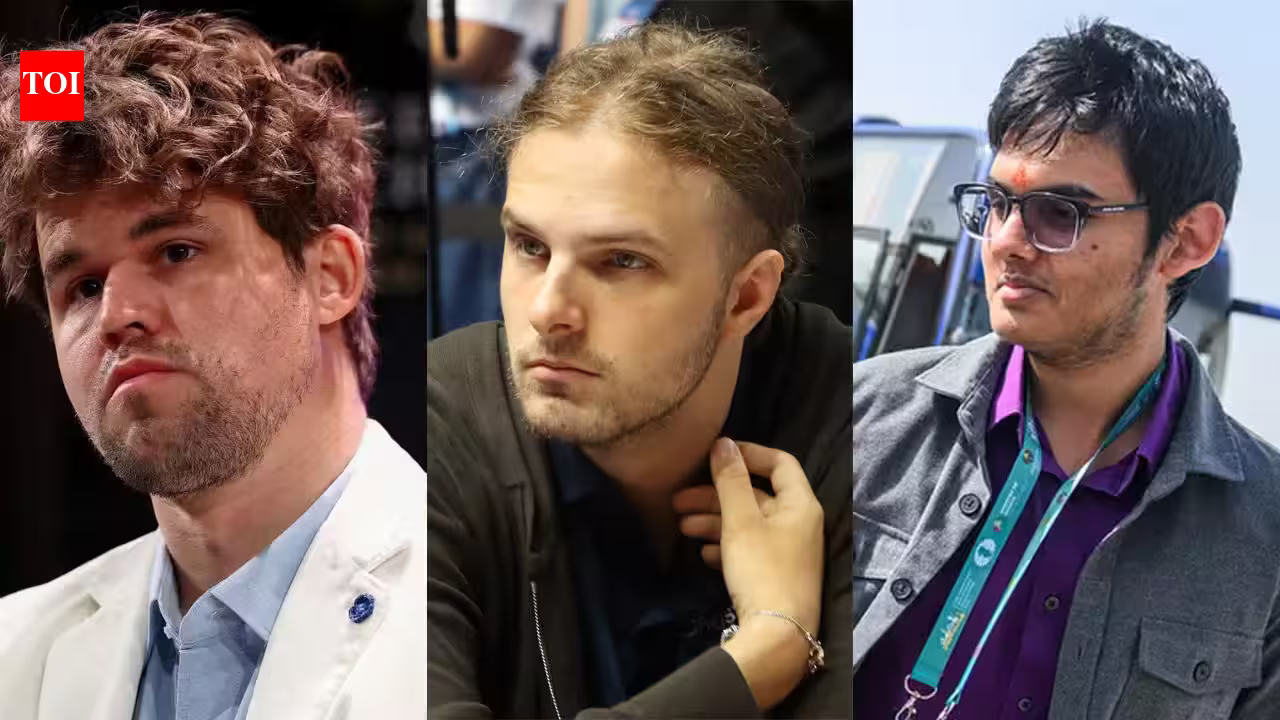
Controversy has gripped the Total Chess World Championship Tour Pilot this week, as a growing wave of walkovers threatens to undermine the integrity of the tournament’s innovative format. What began as an individual decision by World No. 1 Magnus Carlsen has rapidly escalated into a wider structural crisis, with Grandmasters Richard Rapport and Abhimanyu Mishra opting to skip their own concluding “Fast Classic” fixtures on Wednesday.
The sight of empty chairs in the playing hall has left opponents, fans, and officials in a state of bewilderment, sparking an intense debate regarding professional sportsmanship and the necessity of ensuring that all matches reach their natural conclusion.
Mishra explains decision as format fatigue sets in
The drama hit a new peak when 17-year-old prodigy Abhimanyu Mishra failed to appear for his match against India’s R Vaishali. Having dominated the opening phases of their tie with an unassailable 11-1 lead, Mishra secured his path to the next round before the final classical game even commenced.
In the wake of the walkover, which handed Vaishali eight points, Mishra took to X to clarify his position. He pointed to a grueling tournament schedule and lingering ambiguity regarding whether the “Fast Classic” games would impact official FIDE ratings—a factor that has clearly weighed heavily on the players’ minds.
“Well in advance of the next game, I approached the chief arbiter to ask whether it would be acceptable for me not to show up,” Mishra stated. “She told me that the decision was entirely mine and that it was perfectly acceptable not to play. Given that uncertainty, combined with the fatigue I felt, I had sufficient reasons not to show up.”
For her part, Vaishali declined to elaborate on the incident, offering only a brief “There’s nothing to say” before departing the playing area. She is now slated to face Uzbekistan’s Nodirbek Abdusattorov in a match aimed at avoiding a last-place finish.
Rapport joins the exodus
The trend of absences continued with Hungarian Grandmaster Richard Rapport. Unlike Mishra, whose absence came from a position of insurmountable strength, Rapport’s situation was different; he had already mathematically lost his tie against Armenia’s Haik Martirosyan. After conceding the first day 9-11 and trailing 2-10 on day two, Rapport elected to forfeit the final Fast Classic game, leaving Martirosyan sitting across from an empty board.
The growing list of forfeits has created an optics nightmare for the tournament, which is designed to showcase the pinnacle of chess talent. As more players mirror the actions of the world champion, questions regarding the mandatory nature of every scheduled fixture are becoming impossible for the organizers to ignore.
Carlsen’s shadow looms over the debate
The catalyst for this domino effect is undoubtedly Magnus Carlsen. The Norwegian legend first raised eyebrows by walking away from his matches against Kazakhstan’s Bibisara Assaubayeva on consecutive days. Even after building a 10-2 lead through blitz and rapid segments, Carlsen refused to play the concluding classical game, labeling it “meaningless.”
“There will be no classical game as I understood, the match is over,” Carlsen told Norwegian broadcaster TV2. “The only consequence of not showing up is that you will lose a totally meaningless game.”
Carlsen’s rationale—that he has little desire to continue playing classical chess once the aggregate outcome is sealed—has been met with sharp rebukes from the broader chess community. American Grandmaster Hans Niemann has been particularly vocal, alleging that the top-tier players are benefiting from preferential treatment that wouldn’t be afforded to others. Additionally, FIDE Chief Executive Adviser Emil Sutovsky and India’s Olympiad captain, Srinath Narayanan, have publicly criticized the lack of professional courtesy, suggesting that skipping matches undermines the commitment players owe to their opponents and the viewing public.
Organizers look to 2027
Total Chess CEO Kjell Madland has moved to temper the backlash, framing the Budapest event as an essential, if tumultuous, learning curve. The tournament, which serves as a pilot for the official launch in March 2027, is currently acting as a pressure test for its regulations.
“The Budapest pilot is an important learning exercise for Total Chess,” Madland said in a formal statement. “While we have developed the format and regulations with considerable thought and input, the real test is how they work in a live competitive environment.”
As the organizers gather feedback from arbiters and players, the central question remains: how can the tour enforce competition until the final second of every match? With the prospect of further forfeits looming, pressure is mounting on tournament officials to draft more stringent, mandatory participation clauses. Whether through automatic fines or stricter regulation enforcement, the Total Chess tour must ensure that the board is occupied for the duration of the match, or risk losing the public’s trust before its official inception in 2027.
Disclaimer: This content is auto-generated for informational purposes only.
Source: Read Original News