







The Simulated Chaos of Leonida’s Traffic AI
The release of Grand Theft Auto 6 introduces a highly sophisticated traffic simulation system set within the sprawling, sun-drenched state of Leonida. Beneath the surface of its high-fidelity visuals lies an intricate artificial intelligence framework governing the behavior of every non-player character (NPC) behind the wheel. Unlike previous iterations of the franchise, which relied on relatively static pathfinding, the new traffic system utilizes a dynamic state machine. This allows NPC drivers to react to environmental stressors, accidents, and player intervention in ways that mirror the unpredictability of human behavior. However, this complexity often manifests as chaotic, aggressive, and sometimes counter-intuitive navigation that challenges even the most seasoned digital motorists.
Physics-Driven Accidents and Reactive Environmental Objects
A notable technical update in the simulation is the integration of physics-based environmental damage. When an NPC driver veers off the road and impacts a static object like a traffic light pole, the simulation does not simply despawn the obstruction. Instead, the pole collapses, creating a physical barrier that persists in the environment. The resulting debris forces nearby traffic to recalculate pathfinding in real-time. In many observed instances, the pathfinding logic struggles to prioritize these new obstacles, leading to situations where AI vehicles attempt to drive over downed infrastructure. This behavior illustrates a gap between the physics engine’s commitment to permanence and the decision-making logic of the NPCs, who prioritize maintaining their programmed route over avoiding hazards.
The Visibility Challenges of Leonida Infrastructure
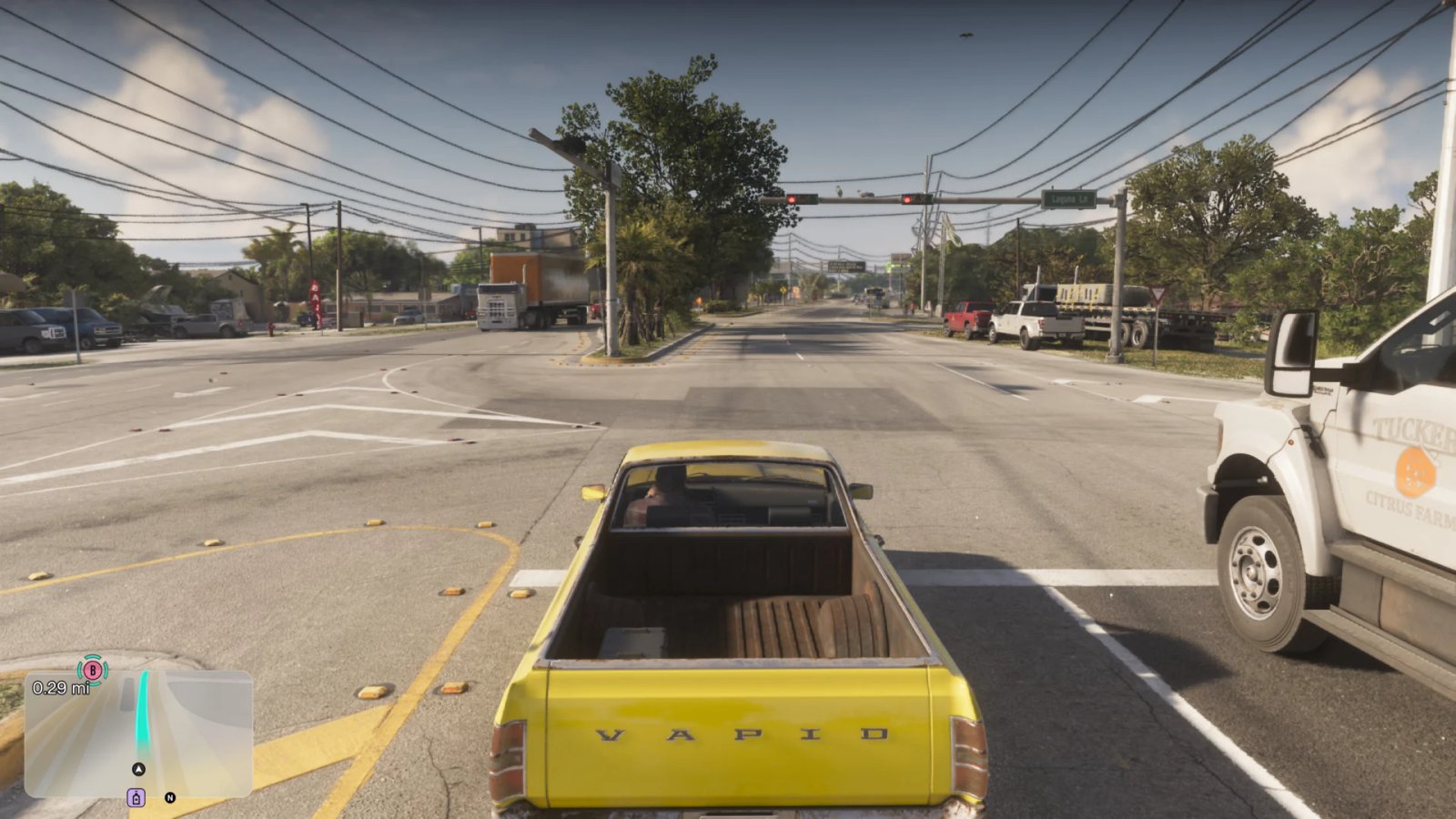
From a design perspective, the visibility of traffic signals in Leonida has become a focal point of critique. The system employs a scale-dependent rendering method for traffic lights, which aims to keep assets in proportion with the sprawling geography of the world. However, this implementation creates significant visual clarity issues. At long distances, the signal indicators—often small LEDs—lack the necessary luminance contrast to be distinguishable from ambient light sources during daylight hours. This creates a technical blind spot for the player. While the game provides subtle audio cues for state changes, the inability to visually confirm a signal color at a distance forces players into reactive driving, often leading to potential collisions with cross-traffic that is already utilizing the intersection.
AI Behavioral Profiles and Roadway Aggression
The traffic logic within Leonida utilizes varied behavioral profiles for its NPC population. These profiles dictate speed tolerance, lane-changing frequency, and reaction times. Observations suggest that these profiles are weighted toward high-aggression outputs. This is likely an intentional design choice to inject constant tension into the navigation loop, preventing the world from feeling too sterile. When an NPC determines that the player is obstructing their path, the AI triggers a conflict response. This can range from sustained honking to aggressive lane changes that disregard safety buffers. In some instances, the AI’s collision-avoidance subroutines fail when a player occupies a lane, causing the NPC to force the player off the road rather than decelerating.
Impact on Player Navigation and Interaction
The impact of this aggressive AI on user experience is substantial. For players attempting to adhere to standard road safety protocols, such as using turn signals or waiting for clear intersections, the system often rewards the opposite behavior. Because the AI drivers frequently ignore lane discipline and traffic laws, a player who follows them is essentially at a disadvantage. This creates an environment where defensive driving is actively penalized by the system. The propensity for NPCs to engage in road rage after a collision, even when the player is not at fault, suggests an advanced, if somewhat cynical, implementation of interaction systems designed to drive conflict. This design ensures that the act of driving in Leonida remains a high-stakes, interactive activity rather than a passive transit period.
Future Adjustments and System Optimization
While the current state of traffic in Leonida serves the game’s focus on high-energy, chaotic narrative beats, there remains a technical desire for more consistency in how NPC vehicles navigate urban spaces. Future updates could address the visibility of traffic assets, potentially through improved shaders for signal lights or higher-contrast iconography. Additionally, fine-tuning the collision avoidance logic to allow for better merging and yielding would significantly improve the flow of traffic. As the game continues to evolve through post-launch patches, balancing the desire for unpredictable, lively NPC behavior with the need for navigable, logical infrastructure will be a key performance indicator for the developers. Until such adjustments are made, players must adapt to the reality that in Leonida, the road is rarely a place of order, but rather a complex system of conflicting AI objectives.
Disclaimer: This content is auto-generated for informational purposes only.
Source: Read Original News