









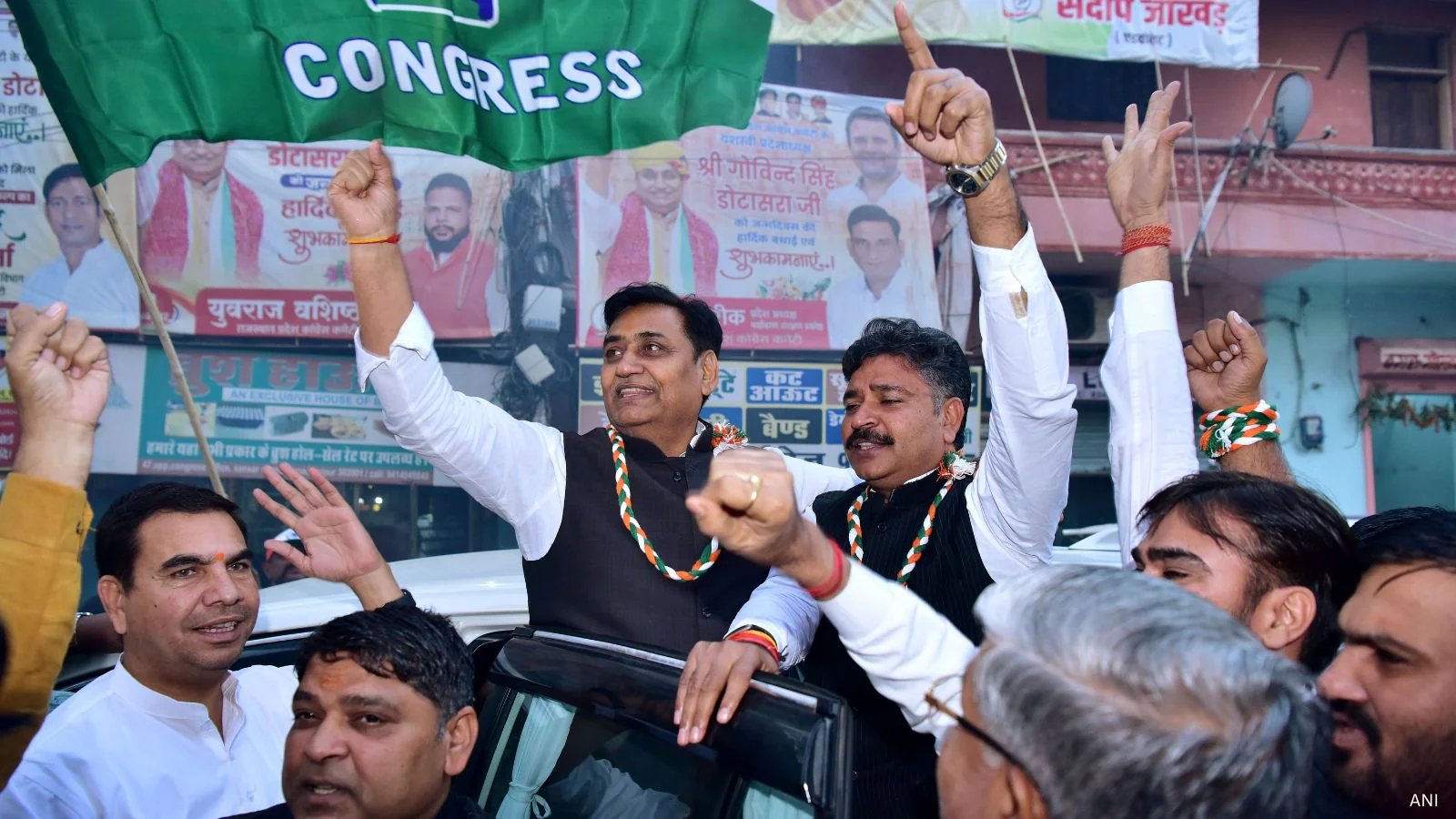
Rural Rajasthan Verdict: BJP Faces Major Setback as Congress Dominates Local Body Polls
The ruling Bharatiya Janata Party (BJP) in Rajasthan is grappling with a significant political reality check following a disappointing performance in the state’s rural local body elections. While the party celebrated a strong showing in urban municipal polls just two months ago, the latest results from the rural heartland indicate a sharp reversal of fortunes, with the Congress party securing a decisive majority in 23 out of 37 Zila Parishads.
A Blow to Ministerial Strongholds
Beyond the headline statistics, the results reveal a deep-seated dissatisfaction with the current administration at the local level. The outcome has been particularly bruising for the ruling party’s leadership, with several senior ministers witnessing the collapse of their influence in their own home turfs.
In a shocking development, 17 of the 21 state ministers saw candidates from their respective constituencies suffer defeat. The Chief Minister’s own constituency, Sanganer, became a battleground where the Rashtriya Loktantrik Party (RLP) emerged as a spoiler. In the 15-seat Sanganer Panchayat Samiti, the RLP secured eight seats, leaving both the BJP and the Congress to settle for just three each.
Similarly, in the Chief Minister’s home district of Bharatpur, the Congress swept 21 of the 31 Zila Parishad seats, while the BJP was limited to a single win. Furthermore, the embarrassment extended to the doorstep of Urban Development Minister Jhabar Singh Kharra, whose family members failed to secure victory in Sikar’s Shri Madhopur, even contesting against his own instructions.
Anti-Incumbency and Caste Calculus
Political analysts and opposition leaders point to strong anti-incumbency as the primary driver behind these results. Former Chief Minister Ashok Gehlot seized on the performance, labeling key figures like Deputy Chief Minister Prem Chand Bairwa as “zero performers” following the BJP’s third-place finish in the Dudu Panchayat Samiti.
A central issue identified by party insiders is the BJP’s failure to effectively manage the complex caste dynamics of rural Rajasthan. The electoral math, which relies heavily on the consolidation of communities such as Gujjars, Meenas, Jats, and the Mali community, appears to have shifted away from the saffron party. Critics within the party ranks argue that the leadership failed to leverage prominent community leaders, leading to significant erosion of support in belts like Jamwa Ramgarh.
The Rise of a Third Force
While the Congress secured a clear lead—winning 3,758 of the 7,520 Panchayat Samiti seats compared to the BJP’s 2,213—the RLP has positioned itself as a formidable third force. By winning nearly 500 Panchayat Samiti seats, the RLP, led by Hanuman Beniwal, has expanded its reach far beyond its traditional Nagaur stronghold.
Beniwal characterized the election as a “semi-final to 2028,” signaling his intent to disrupt the traditional two-party system in Rajasthan. As the BJP prepares for an “intensive introspection exercise” to understand why its urban popularity failed to translate into rural victory, the message from the countryside remains clear: the electorate is demanding a recalibration of leadership and local governance.
Disclaimer: This content is auto-generated for informational purposes only.
Source: Read Original News