








Strong 5.3 Magnitude Earthquake Jolts Eastern Nepal; Tremors Felt Across North India
A powerful earthquake measuring 5.3 on the Richter scale struck the mountainous terrain of eastern Nepal early Tuesday morning, sending shockwaves across a wide swathe of South Asia. According to the United States Geological Survey (USGS), the seismic event occurred at 7:02 AM local time, with its impact reverberating through parts of India, Bhutan, Bangladesh, and China.
Epicenter and Seismological Data
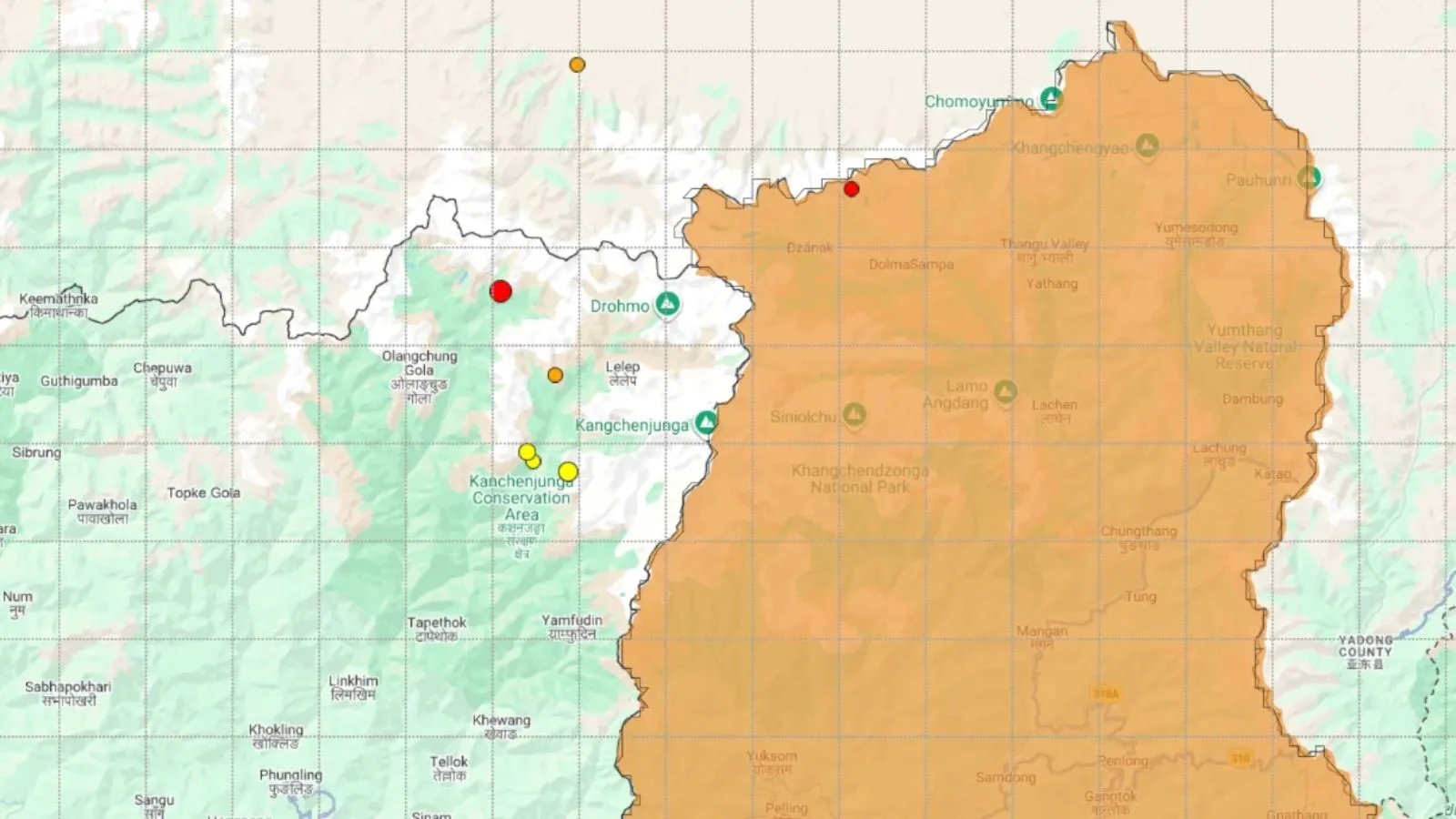
The earthquake’s epicenter was identified near Olangchung Gola in the Taplejung district, a remote region situated roughly 275 kilometers east of the Nepalese capital, Kathmandu. The tremor originated near Lelep, positioned strategically close to the China-Nepal border.
While the National Centre of Seismology (NCS) in India reported the seismic activity at a depth of 20 kilometers, international agencies provided slightly varying assessments regarding its intensity and depth. The European-Mediterranean Seismological Centre (EMSC) estimated the focal depth at 10 kilometers below the surface. Despite these minor discrepancies, all major monitoring bodies confirmed the significant nature of the quake, which was powerful enough to be felt across international borders.
Impact Felt Across North Bengal and Sikkim
The tremors were prominently reported by residents living in the Indian states of Sikkim and parts of North Bengal. Frightened citizens in towns including Darjeeling, Jalpaiguri, and Cooch Behar reported feeling the ground shake as the seismic waves passed through the Himalayan foothills. In the immediate aftermath, social media platforms saw a surge of activity from residents in these regions describing the intensity of the vibrations, which disrupted the morning routine for many.
In eastern Nepal, the impact was even more pronounced. Authorities in the Taplejung district confirmed that the tremors were felt widely across the neighboring districts, causing brief panic among the local population who are well-acquainted with the seismic vulnerability of the Himalayan region.
No Casualties or Damage Reported
Despite the reach of the earthquake, preliminary assessments provide a sigh of relief for authorities. As of Tuesday afternoon, there have been no official reports of casualties, injuries, or structural damage to buildings and infrastructure in Nepal or India.
Local disaster management teams in the affected Indian districts, alongside their Nepalese counterparts, remain on high alert. While there has been no immediate threat of widespread destruction, officials are conducting routine surveys in the more remote areas near the epicenter to ensure that isolated communities have not suffered any hidden impacts.
The Himalayan region remains one of the most seismically active zones in the world, often subjected to tremors due to the ongoing tectonic shifts between the Indian and Eurasian plates. While today’s 5.3 magnitude quake caused widespread alarm, experts suggest that the depth of the epicenter and the relatively sparsely populated nature of the immediate impact zone helped in avoiding a significant disaster. Authorities continue to monitor for potential aftershocks, advising residents in the affected regions to remain vigilant and follow standard safety protocols.
Disclaimer: This content is auto-generated for informational purposes only.
Source: Read Original News