









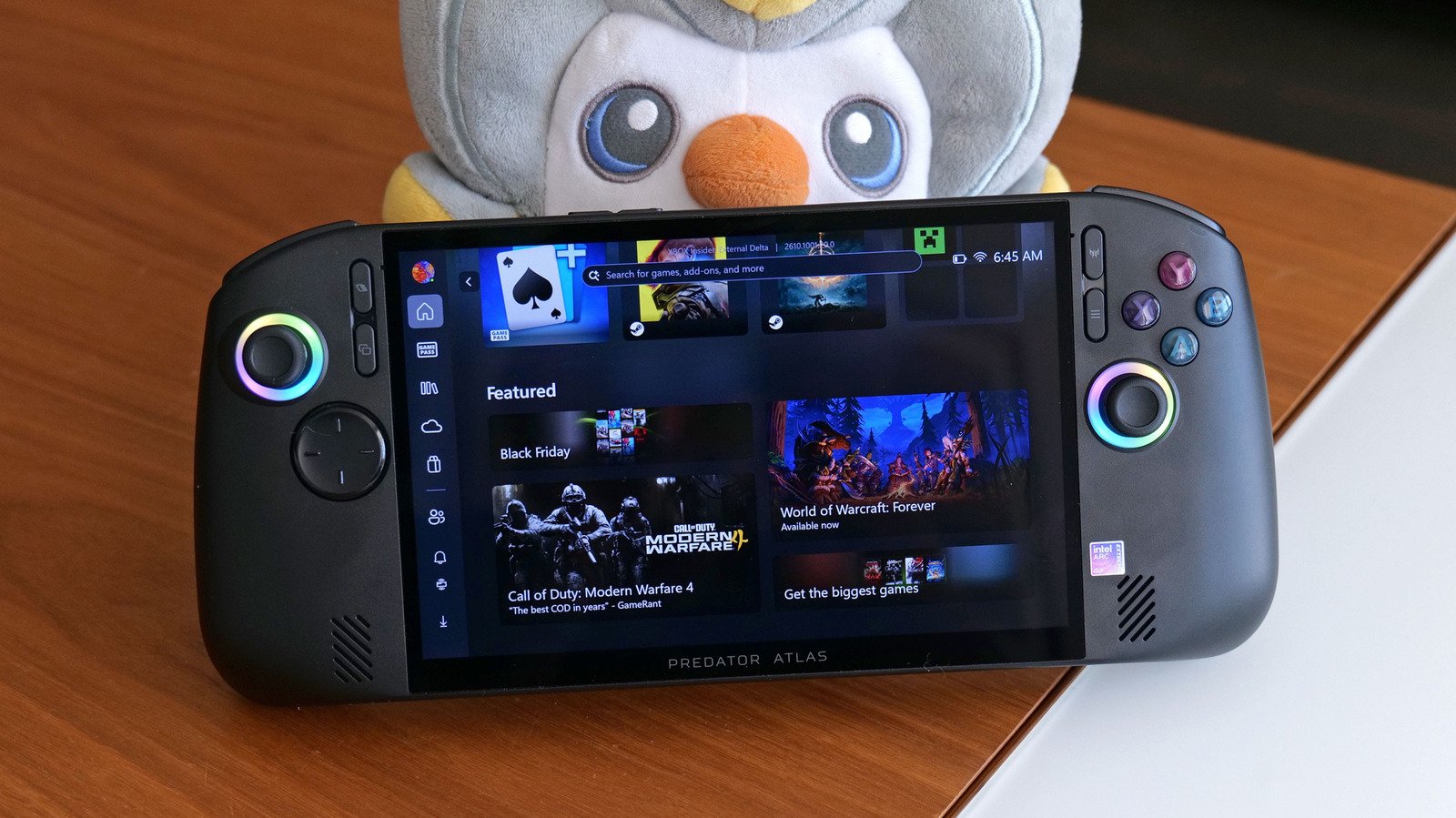
The market for handheld gaming PCs has evolved rapidly, shifting from niche companion devices to high-performance systems capable of rivaling dedicated gaming rigs. Acer’s latest entry into this space, the Predator Atlas 8, aims to capture the high-end segment of this market by offering a familiar, potent architecture at a more accessible price point. By leveraging the Intel Arc G3 Extreme chip, the Atlas 8 provides competitive frame rates that mirror more expensive rivals, all while shaving $350 off the cost of the comparable MSI Claw 8 EX AI+.
Design and Display Engineering
The physical construction of the Predator Atlas 8 follows the established ergonomic template common in modern handhelds. Centered on the device is an 8-inch LCD TFT display, which supports a 120Hz refresh rate and reaches a peak brightness of 500 nits. This combination ensures fluid motion in fast-paced titles and adequate visibility in various lighting conditions.
The control scheme features TMR analog sticks and a standard Xbox-style button layout. While the circular D-pad design lacks the precision required for high-level fighting games, it remains functional for standard interface navigation. Ergonomically, the rear of the unit includes two programmable paddles and shoulder buttons, complemented by Hall-effect triggers that offer consistent travel—a necessary addition for racing titles where variable input is critical.
Connectivity is handled along the top edge of the chassis, featuring dual USB-C ports with Thunderbolt 4 support, a microSD card slot for storage expansion, and a 3.5mm audio jack. A power button with an integrated fingerprint reader rounds out the hardware security. One notable omission is a USB-A port, which may require users to carry adapters for specific peripherals. Additionally, while the dual two-watt speakers provide sufficient volume, they exhibit audio distortion at higher gain levels, resulting in a granular sound profile that is less than ideal for audiophiles.
Performance Metrics and Technical Architecture
At the heart of the Predator Atlas 8 lies the Intel Arc G3 Extreme processor. By utilizing the same silicon as more premium handhelds, Acer achieves high-fidelity gaming performance with only minor concessions in supplementary hardware. The system utilizes 24GB of shared memory and 512GB of internal storage, which distinguishes it from the 32GB RAM and 1TB storage found in the more expensive MSI alternative.
In synthetic and real-world benchmarks, the performance gap between these units is remarkably slim. When running Cyberpunk 2077 at 35 watts with FHD settings and medium graphics—supported by XeSS performance upscaling—the Atlas 8 delivered 88 frames per second. This result is nearly identical to the performance of more costly machines. Even when throttling to 15 watts for power efficiency during mobile play, the handheld maintains a parity with its competition, delivering a stable 60 frames per second in demanding titles like Returnal. This efficiency demonstrates that the Intel Arc G3 Extreme is well-optimized for portable thermal envelopes.
Software Integration and Utility
The software experience on the Predator Atlas 8 is built upon the Windows foundation, providing users with a familiar operating environment. Acer utilizes a specialized UI layer designed for game management, which mimics the experience of console boot-up sequences. This layer centralizes various digital storefronts such as Steam, Epic Games, and Battle.net, effectively streamlining the launch process for users.
Because the system operates on Windows, it retains full desktop functionality. Users can exit the game-centric launcher to access the full operating system, enabling tasks like web browsing, document editing, or media management. For power users, the ability to connect a peripheral monitor, mouse, and keyboard transforms the handheld into a functional desktop workstation, providing a versatility that proprietary, closed-loop gaming operating systems often lack.
Battery Management and Efficiency
The Atlas 8 is equipped with an 80WHr battery, a significant capacity that balances the power demands of the Intel processor. Real-world longevity remains highly dependent on the intensity of the software being rendered and the performance mode selected.
When configured to the 30-watt Balanced performance mode, the device provides approximately one hour and 45 minutes of gameplay for graphically intensive titles like World of Warcraft. For lighter titles, such as Warhammer Survivors, the battery can sustain over three hours of continuous play. The integration of granular performance modes allows users to tune the power consumption to match their current requirements. By adjusting the TDP (Thermal Design Power) settings, players can extend their sessions significantly, effectively managing the trade-off between visual fidelity and untethered playtime.
Market Positioning and Final Assessment
The Predator Atlas 8 occupies a strategic middle ground in the handheld PC industry. While a price point of $1,450 remains a substantial investment, the device addresses the primary friction point of current high-end handhelds: the cost-to-performance ratio. By stripping away non-essential storage and extra memory, Acer has provided the primary, high-value component—the G3 Extreme chip—at a lower entry price.
While some compromises exist, such as the lack of a USB-A port and the limitations of the internal speakers, the core gaming experience is preserved. For consumers who prioritize frame rates and overall performance but wish to avoid the premium surcharges attached to other flagship portables, the Predator Atlas 8 presents a logical and technically sound solution that does not sacrifice the power required for modern, high-fidelity gaming.
Disclaimer: This content is auto-generated for informational purposes only.
Source: Read Original News