







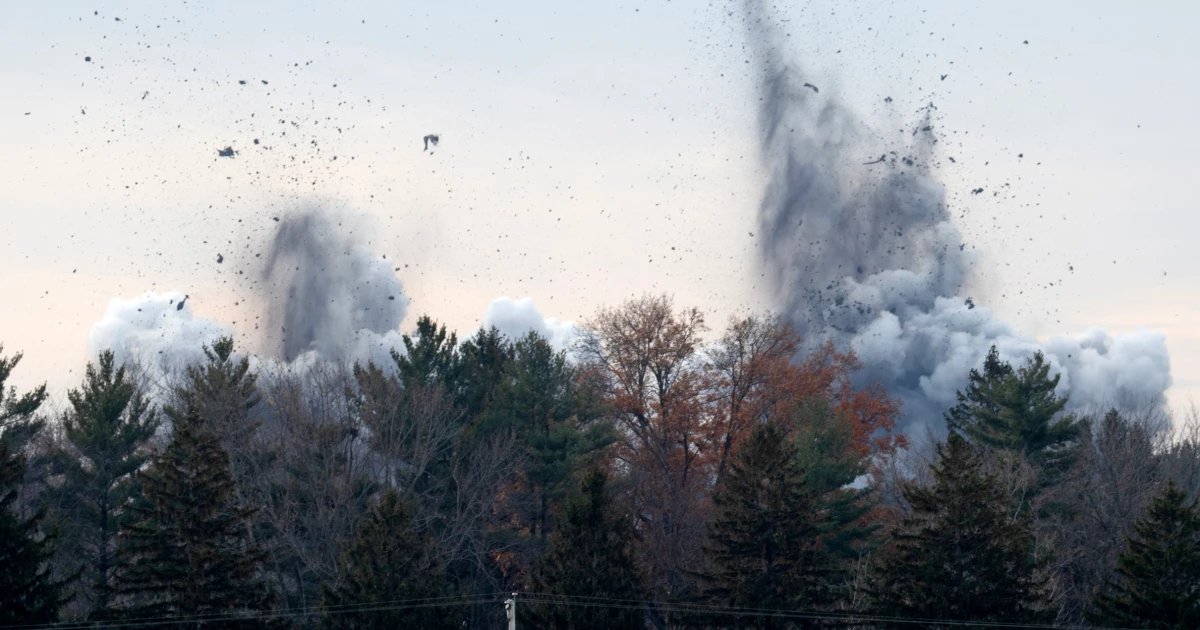
MIDDLETOWN, Iowa — A planned detonation of volatile bomb-making chemicals at the Iowa Army Ammunition Plant has left local residents in a state of anxiety and frustration, as a massive military operation aimed at neutralizing dangerous materials forces neighbors to brace for potential toxic fallout.
The controlled explosion, intended to dispose of unstable legacy explosives, prompted widespread alarm in the days leading up to the event. Many community members reported receiving insufficient warning, leaving those in the projected path of the resulting plume to scramble in a race against time. Residents spent the hours before the blast taping windows, covering gardens, stocking up on cleaning supplies, and, in many cases, fleeing the area entirely to escape the potential release of lead dust.
Jill Holler, who operates a family farm roughly 20 miles west of the facility, spent her Sunday night taking soil samples by flashlight, hoping to establish a baseline for future comparison. “I was down in the dark… and it’s just frustrating,” she said.
The Army has defended the operation, asserting that a controlled blast—backed by significant mitigation efforts—was a safer alternative to the risk of an unpredictable, spontaneous explosion. To contain the hazardous materials, the Army constructed two-story barriers of sand-filled modules around the site, supplemented by aqueous foam, gel blocks, and “water walls” composed of sixteen 16,000-gallon tanks designed to absorb the blast. Despite these efforts, documents submitted to the Environmental Protection Agency predicted the detonation would create a crater 38 feet wide and 5 feet deep.
Lead is a potent neurotoxin; there is no level of exposure considered safe, and children face the highest risk for lasting health complications, including learning disabilities and hearing loss. Because lead particles deposited on soil or surfaces remain indefinitely unless professionally removed, the long-term environmental impact is a primary concern for the community.
While the Army has promised to monitor the plume and perform cleanup at government expense if lead concentrations on residential properties exceed 200 parts per million, critics say the plan is dangerously vague.
“There is no plan for applying an evidence-based approach to determine if people’s homes, schools, and businesses are safe after the detonation,” said Andrew Whelton, a professor of engineering at Purdue University.
Independent scientists, including pulmonary toxicologist Peter Thorne of the University of Iowa, have deployed their own monitoring equipment to track the airborne lead. Thorne also raised pointed questions regarding why the stockpile—composed of lead azide, a substance phased out of use 15 years ago—was allowed to remain until it reached a state of crisis.
“Why wasn’t this dealt with long ago when they could have chemically degraded it?” Thorne asked. “It should have been dealt with in the past, and now it’s become a crisis with very few good options left.”
Disclaimer: This content is auto-generated for informational purposes only.
Source: Read Original News