







TURIN — The narrative surrounding Carlos Alcaraz heading into the final stretch of the 2026 season was one of transition, uncertainty, and, ultimately, absolute dominance. Following his straight-sets demolition of world No. 1 Alexander Zverev in the ATP Finals title match, the Spaniard has emphatically silenced any lingering questions about his trajectory. Having conquered the speedy indoor hardcourts of Turin, Alcaraz has proven that he doesn’t just adapt to surfaces; he conquers them—even when his most lethal weapons are still undergoing refinement.
Since returning to the tour in August following a wrist injury sustained in Barcelona this past April, Alcaraz has been nothing short of a wrecking ball. Competing in six tournaments, he has hoisted the trophy in four, bringing his total title count for the year to an impressive six. This late-season surge, which saw him compile a staggering 22-1 record, cements his status as the sport’s most compelling protagonist. Yet, perhaps the most terrifying prospect for his rivals is that this recent run of brilliance has been achieved with a serve that Alcaraz himself admits is still a “work in progress.”
The Evolution of a Weapon
Standing at 6 feet tall, Alcaraz faces a unique challenge in the modern era of tennis, where towering giants often dictate terms with explosive service games. As one of the shorter players in the ATP’s Top 10, the Spaniard has been forced to engineer ways to extract maximum efficiency from his serving motion.
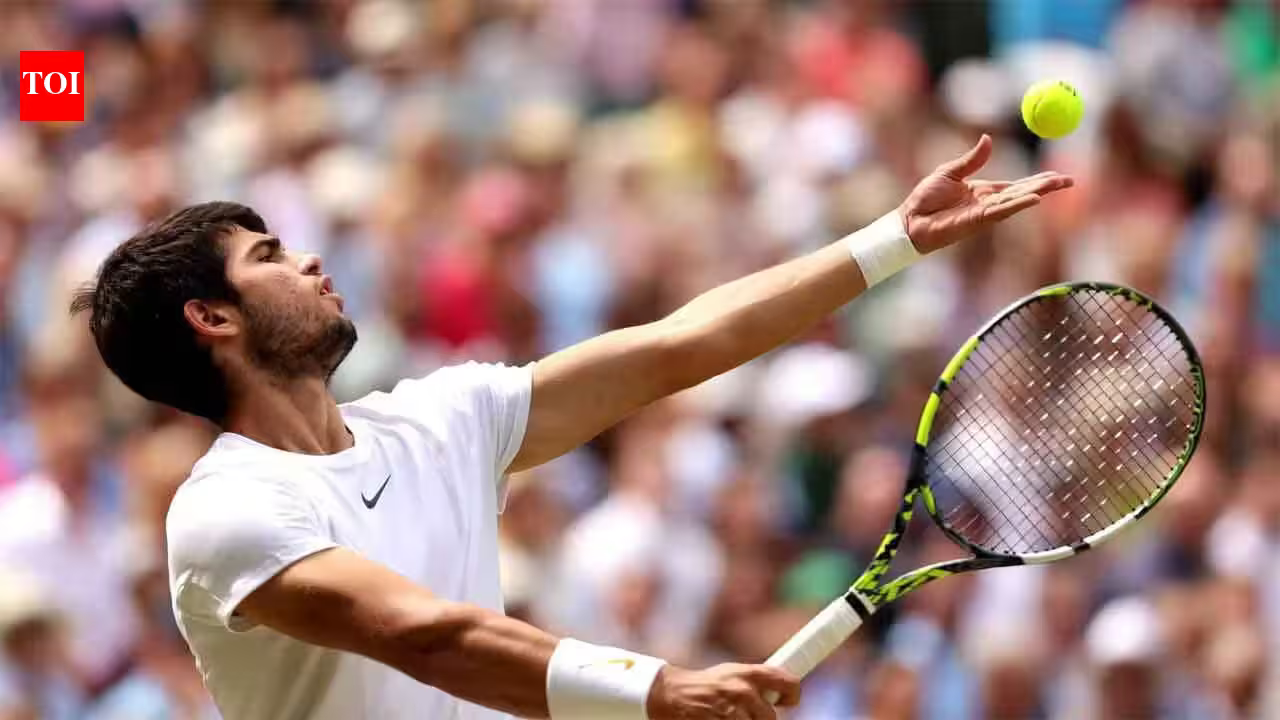
Observant fans and analysts alike have noted a deliberate shift in his mechanics since his August return. Alcaraz has implemented a subtle adjustment, featuring a pronounced lift of the front foot that shifts his weight onto the back, facilitating better loading and kinetic energy. Furthermore, he has lowered his ball toss and tightened his motion. These tweaks were particularly vital in the ultra-fast conditions of Turin.
“I understand how I should serve, and when I’m relaxed, I do a really smooth movement and I accelerate,” Alcaraz explained after his victory. “When I feel nervous, I want to do more than I should do. I’m not a server. I need to gain the point from the baseline, so I have to realize that and understand that. Once I got it, I think the serve goes much better.”
Statistically, the numbers are curious. In his championship victory over Zverev, his average first-serve speed was nearly 8 kmph slower than his performance against Jannik Sinner in last year’s final. Yet, by prioritizing placement and rhythm over raw velocity, Alcaraz proved that intelligence on the court often supersedes brute force.
Head, Heart, and Grit
Behind the physical adjustments lies a philosophy rooted in family tradition. Before stepping onto the court—whether for a high-stakes final or a solitary practice session—Alcaraz repeats the mantra taught to him by his grandfather.
“In Spanish it is ‘Cabeza, corazon, cajones’—in English, it is ‘head, heart, balls’,” Alcaraz said, echoing the grit that has defined his comeback. It is this psychological fortitude that allowed him to navigate a turbulent 2026. The year began with a media firestorm following his split with long-time coach Juan Carlos Ferrero, a move that sparked intense speculation regarding whether Alcaraz’s success was a product of Ferrero’s guidance or his own inherent genius.
His performance throughout this season has provided a definitive answer. While Ferrero has since moved on to coach world No. 4 Ben Shelton—creating a burgeoning rivalry that promises to be a centerpiece of the 2027 season—Alcaraz has thrived in his newfound independence. He has carved out his own territory, proving that he is not just a student of the game, but its primary architect.
The View Toward 2027
While Alexander Zverev finishes the 2026 season as the world No. 1, the momentum undoubtedly belongs to Alcaraz. The Spaniard has spent the autumn months systematically dismantling the field, proving he can triumph on his “weaker” surfaces—the fast indoor courts—by blending his baseline fluency with a serve that is growing more reliable by the match.
The implications for the rest of the tour are sobering. If Alcaraz can continue to refine his serve—integrating more power without sacrificing the precision that secured his Turin title—the rest of the ATP circuit may find themselves playing for second place next season.
The seven-time major champion has shown that even when he isn’t firing on all cylinders, he remains nearly impossible to beat. As he heads into the off-season, the “three C’s” are firmly in place. Should he marry these incremental technical gains with his trademark court coverage and forehand dominance, the 2027 version of Carlos Alcaraz could well be the most formidable iteration the sport has ever seen. The rest of the world, consider yourselves warned.
Disclaimer: This content is auto-generated for informational purposes only.
Source: Read Original News