








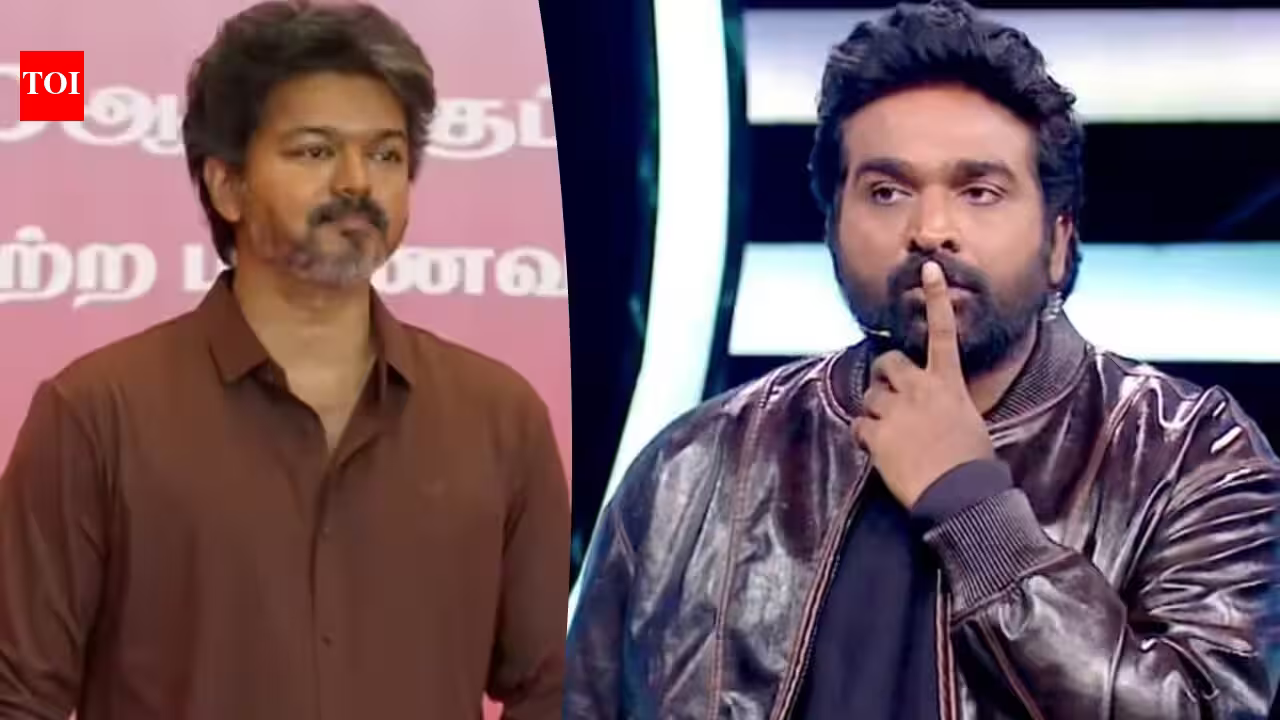
In the high-stakes, high-octane world of Kollywood, the line between celebrity and politician has become increasingly blurred. From the legendary MGR to the recent, seismic political entry of ‘Thalapathy’ Vijay, the Tamil film industry has long been a breeding ground for future leaders. Yet, amidst the fervent speculation about which star will next trade their script for a manifesto, one powerhouse performer is hitting the brakes. Vijay Sethupathi—affectionately known as “Makkal Selvan,” or the “People’s Treasure”—is making it crystal clear: his stage is the cinema, and his service is private.
In a candid, wide-ranging conversation during the promotions for his upcoming action-thriller Train, Sethupathi dismantled the inevitable questions about his political ambitions with the same grounded, unassuming demeanor that has made him a fan favorite. For an industry that often demands its stars take a stand on every legislative nuance, Sethupathi’s refusal to play the political pundit is as refreshing as it is firm.
The Misconception of the Political Stage
For years, the public has equated a high-profile platform with the obligation to opine on government policy. When asked about his thoughts on the recent political shift of his former co-star, Thalapathy Vijay, and whether he harbored similar aspirations, Sethupathi was quick to draw a line in the sand.
“Politics involves policies and several related matters,” Sethupathi noted. “It is not my job to keep analyzing all of that. Entering politics is not about having an ambition; it is about service.”
It is a subtle but potent distinction. In an era where “political ambition” is often synonymous with ego, power-grabbing, or long-term career planning, Sethupathi’s stance centers on the act of service rather than the title of politician. He isn’t dismissing the importance of civic duty; he is dismissing the necessity of a ballot box to fulfill it. By shifting the focus from rhetoric to result, he effectively argues that the noise of political commentary is a distraction from the quiet, tangible work that actually improves lives.
Redefining ‘Politics’ Through Action
Perhaps the most compelling part of Sethupathi’s defense is the sheer scale of the work he has done away from the cameras. While many stars use their social media feeds to broadcast their political leanings, Sethupathi has been quietly mobilizing his resources to create a measurable impact.
During the press junket, he revealed figures that would put many local manifestos to shame. Through his organization, the actor claims to have facilitated job opportunities for two lakh people. Beyond employment, his team has engaged in environmental restoration—specifically the cleaning of local ponds—and has provided educational support for countless individuals.
“This itself is politics,” he asserted. It is a powerful re-framing of the term. To Sethupathi, “politics” isn’t a speech at a rally or a fiery post on X (formerly Twitter); it is the logistical, gritty, and often unglamorous process of helping a neighbor find work or ensuring a child stays in school. By using his earnings to fund these initiatives, he is practicing a brand of politics that is inherently localized and impact-driven, rather than performative.
The Perils of the Digital Soapbox
Sethupathi didn’t shy away from addressing why he chooses to remain tight-lipped on government decisions—a stance that occasionally invites scrutiny from critics who feel he should be more vocal. His reasoning, however, is rooted in a pragmatic understanding of the modern digital landscape.
“We have no problem speaking about political views, but people do not take them in a sporting spirit, regardless of which government is in power,” he explained.
The actor highlighted the inherent “foolishness” of commenting on complex systems without deep, specialized understanding. Moreover, there is a protective instinct at play. Sethupathi is acutely aware of the “cancel culture” ecosystem, where a single misunderstood sentence can spiral into a public relations nightmare that shadows his professional output. He candidly admitted, “We do not want the criticism we receive on social media for our statements to affect our films.”
It’s a fair boundary to set. In an industry where a film’s box office success can be tied to the personal controversies of its lead, Sethupathi is choosing to keep his art and his politics in separate silos—not out of cowardice, but out of a desire to keep the focus on the craft.
Preparing for the ‘Train’
As the conversation pivoted from the ballot box to the silver screen, the atmosphere shifted to the anticipation surrounding his upcoming project. Directed by the enigmatic Mysskin, Train is set to be a significant addition to Sethupathi’s diverse filmography. Scheduled for a December 4, 2026, release, the film is already generating buzz for its claustrophobic setting—a thriller unfolding almost entirely within the confines of a train.
Featuring heavyweights like Nassar and the charismatic Shruti Haasan, Train looks to be a visceral, high-stakes outing for the actor. Following this, his pipeline remains packed with projects like Pocket Novel and Inji Vellam, proving that despite the political chatter, his primary commitment remains to the audience.
Ultimately, Vijay Sethupathi’s comments serve as a reminder that a public figure’s value isn’t defined by their willingness to enter the fray of political debate. In a world obsessed with binary choices—left or right, vocal or silent—Sethupathi is choosing a third path: the path of the benefactor. He is showing us that you don’t need a party symbol to leave a mark; sometimes, all you need is a steady hand, a clear objective, and the discipline to keep the noise of the political arena at arm’s length. As he boards his next Train, it’s clear that his destination is the cinema, and for his fans, that is more than enough.
Disclaimer: This content is auto-generated for informational purposes only.
Source: Read Original News