








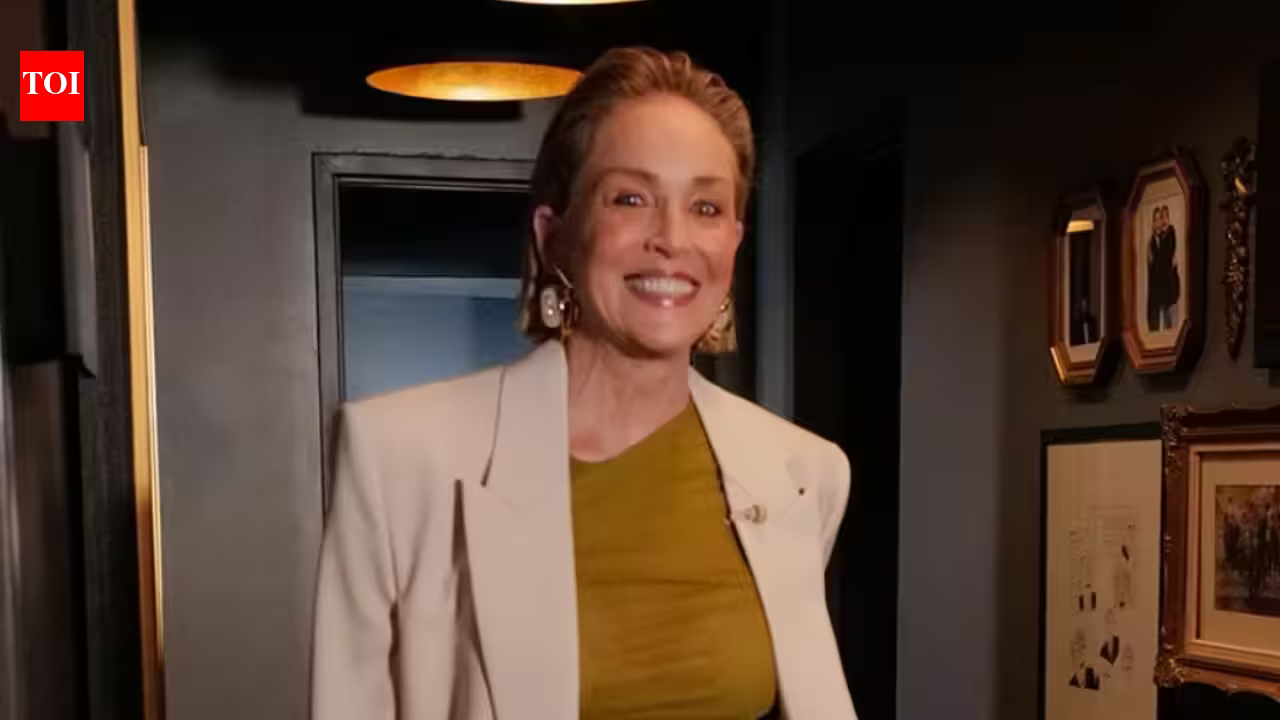
The neon lights of Hollywood are designed to burn bright, but for Sharon Stone, the glare of the spotlight once faded into the sterile, flickering hum of an intensive care unit. Long before she was the industry icon we know today—the woman who redefined the femme fatale in Basic Instinct and commanded the screen in Casino—she was a woman fighting for her life in a battle that nearly cost her everything.
While the public saw a star at the height of her powers in the late 90s, the turn of the millennium brought a silent, life-altering crisis. In 2001, at the age of 43, the narrative of Sharon Stone’s life shifted from celluloid glamour to a harrowing medical ordeal that serves as a sobering reminder of the fragility of even the brightest stars.
A 1% Chance at Life: The 2001 Medical Crisis
It began, as many silent killers do, with a headache—a sensation so searing and intrusive that it stopped the world in its tracks. For 72 hours, Stone pushed through the pain, battling the numbness in her leg and the mounting pressure behind her eyes. By the time she finally reached the emergency room, she wasn’t just a patient; she was a woman on the edge of a precipice.
She had suffered a subarachnoid brain hemorrhage. The medical team’s assessment was gut-wrenching: she had a 1% chance of survival. For nine long, grueling days, Stone lay in the ICU. The procedure to stop the bleeding was delicate and invasive—an endovascular coiling technique designed to bypass the need for open-brain surgery. While the physical trauma was immense, the psychological toll of that week in the balance remains one of the most defining chapters of her life.
The Invisible Battle: When Medical Systems Fail
Perhaps the most harrowing part of Stone’s story isn’t the hemorrhage itself, but the battle she fought to be heard. In a candid interview with Vogue, Stone peeled back the curtain on the dismissive nature of the medical establishment toward women’s health.
“What I learned through that experience is that in a medical setting, women often just aren’t heard, particularly when you don’t have a female doctor,” Stone reflected. She recounted being wheeled toward surgery without her knowledge or informed consent, a victim of a system that frequently underestimates the severity of female pain.
Even more shocking was the initial negligence. Doctors had performed an angiogram and, failing to see the rupture immediately, essentially dismissed her as “faking it.” Had it not been for her best friend’s insistence—a relentless demand for a second look—the medical team would have sent her home. It was that second scan that uncovered the truth: her vertebral artery had ruptured, and her subarachnoid pool was flooding. If they had sent her home, we wouldn’t be talking about a comeback today; we would be mourning a legend.
The Long Road to Recovery
The world moved on, but for Sharon Stone, time stopped for two years. The recovery was not merely a hiatus; it was a total recalibration of her existence. She didn’t just step away from scripts and cameras; she had to relearn how to be in her own skin.
The aftermath of a brain hemorrhage is rarely cinematic. Stone faced a grueling list of symptoms: severe stuttering, a total loss of steady gait, impaired vision, and significant memory gaps. She described the persistent, physical remnants of her trauma—”weird knuckle-like knots” on her head and the phantom sensation of being repeatedly punched.
For a long time, the public mask was firmly in place. “I wanted to pretend that I was just fine,” she admitted to PEOPLE years later. But pretending is exhausting, and eventually, the truth began to serve as a form of liberation. By shedding the performative perfectionism that Hollywood demands, Stone transformed her trauma into a platform for advocacy, forcing a conversation about medical gaslighting that resonates far beyond the red carpet.
The Second Act: Thriving in Her Own Terms
It is easy to view the trajectory of a star in terms of box-office receipts, but Sharon Stone’s real success lies in the resilience she displayed after the cameras stopped rolling. She did not return to the same industry she left; she returned as a different person—a woman who had walked through the fire and chosen to keep going.
In the years that followed, she moved away from the relentless churn of mainstream stardom, opting instead for roles that carry weight and depth. She isn’t playing the “ingénue” anymore; she is playing the survivor. As we look ahead to 2026, her schedule is a testament to her enduring relevance. Whether she is stepping into the intense, high-stakes world of Euphoria for its third season or starring in the upcoming feature Babies, Stone continues to choose work that defies expectations.
A Legacy Beyond the Screen
Today, Sharon Stone stands as a beacon of authenticity. She no longer hides the scars—physical or mental—of her 2001 ordeal. By speaking openly about her brush with death, she has given voice to countless women who have felt unheard in doctors’ offices and hospitals around the world.
She has proven that a career can survive a catastrophe, but more importantly, she has proven that a life is defined by how one navigates the “after.” Stone didn’t just recover from a brain hemorrhage; she reclaimed her agency. In an industry that thrives on youth and perfection, Sharon Stone’s most powerful performance has been her commitment to being unmistakably, undeniably real. She isn’t just a Hollywood star anymore—she is a survivor who decided to tell her truth, and in doing so, she became more powerful than she ever was in the spotlight of the 90s.
Disclaimer: This content is auto-generated for informational purposes only.
Source: Read Original News