








INDIA Bloc Mounts Unified Front Against Government’s Delimitation-Linked Women’s Quota Bill
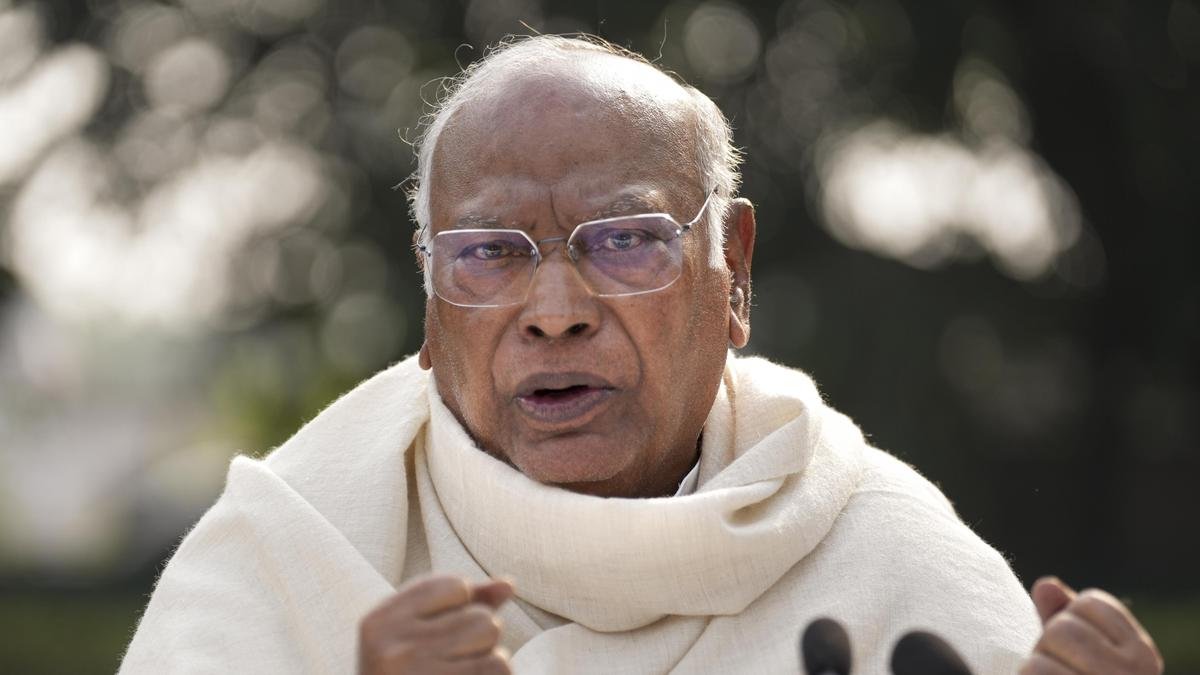
New Delhi: In a high-stakes move ahead of the upcoming special Parliament session, the INDIA bloc has resolved to jointly oppose the Union government’s proposed Constitution Amendment Bill, which seeks to link women’s reservation in legislative bodies with a fresh delimitation exercise. Opposition leaders, led by Congress President Mallikarjun Kharge, have decried the legislation as a strategic maneuver by the BJP-RSS to consolidate power indefinitely and undermine the democratic foundations of the country.
Following a two-hour strategy meeting at the residence of the Leader of the Opposition, Mr. Kharge addressed the media, labeling the bill a threat to the constitutional rights of Scheduled Castes (SC) and Scheduled Tribes (ST). He argued that the current proposal fails to adequately represent the rising population of these marginalized communities, suggesting that the government’s true objective is not women’s empowerment, but the pursuit of an “800-plus” seat majority to secure a permanent grip on governance.
Opposition Fears ‘Permanent’ BJP Rule
The opposition has voiced deep skepticism regarding the timing and design of the bill, which is scheduled for introduction in the Lok Sabha on November 30. Independent Rajya Sabha MP Kapil Sibal, who participated in the deliberations, emphasized that the government could easily implement women’s reservation within the existing 543-seat configuration of the Lok Sabha.
“Their real objective is to remain in power for the next 30 to 40 years,” Sibal remarked, warning that the bill empowers the ruling party to handpick members of the delimitation body—much like recent controversial appointments to the Election Commission—to redraw constituency boundaries in favor of their political strongholds.
Leaders from various parties, including TMC’s Abhishek Banerjee, RJD’s Manoj Jha, and representatives from the CPI and IUML, echoed these concerns, alleging that the move aims to centralize authority. The bloc has demanded that any move toward women’s reservation remain decoupled from the contentious task of redrawing district boundaries, proposing instead that the current seat allocation be frozen for another 25 years.
Parliament Braces for Contentious Session
The government’s proposal, titled the Constitution (132nd Amendment) Bill, 2026, intends to boost the maximum strength of the Lok Sabha to 850, with a corresponding increase in State Assembly capacities. Officials state that this 50% expansion is necessary to accommodate the gender-based quota while ensuring adequate representation.
However, the political arithmetic remains volatile. When a similar bill was introduced in April 2026, it failed to secure the necessary two-thirds majority by 54 votes. Since then, the landscape has shifted significantly: 20 MPs from the Trinamool Congress have moved toward the NDA-allied camp, and parties like the DMK have expressed support for the current version of the bill.
With the special session set to conclude on December 3, the BJP is banking on these new alliances to cross the legislative threshold. Conversely, the INDIA bloc remains firm in its refusal to support the amendment, warning that the bill’s passage would transform India’s parliamentary democracy into an executive-dominated system. As the nation watches, the debate over the future of the Lok Sabha has evolved into a fundamental clash over the structure of Indian governance.
Disclaimer: This content is auto-generated for informational purposes only.
Source: Read Original News