







Six years, and a lot of funding, later, the European Commission is still struggling to get a project to renew the Bauhaus design movement for a visionary and net-zero 21st century over the line.
Back in 2020, Ursula von der Leyen outlined her plans to reimagine the iconic modernist movement that revolutionised the last century – responsible for everything from large buildings to tubular chairs and chess boards – with clean lines and geometric shapes free of unnecessary fill or decoration.
The European Commission president hoped her New European Bauhaus (NEB) could create a new ethos, with significant financial support, to combine form and function for a modern age of climate-conscious design.
In real terms, the NEB offers EU cash to bring together architects, artists, designers, researchers, businesses and urban planners to create projects that are low-carbon, attractive, affordable and socially inclusive.
Von der Leyen once called the project the “soul” of the Green Deal suite of climate friendly policies. A Commission official described her as “heavily invested” in the new Bauhaus. The NEB is “one of her favourite things to talk about”, they added.
Capitalising on the wave of enthusiasm for the original Bauhaus school, which combined different disciplines to simplify design and architecture, the NEB has swallowed over €1.4 billion.
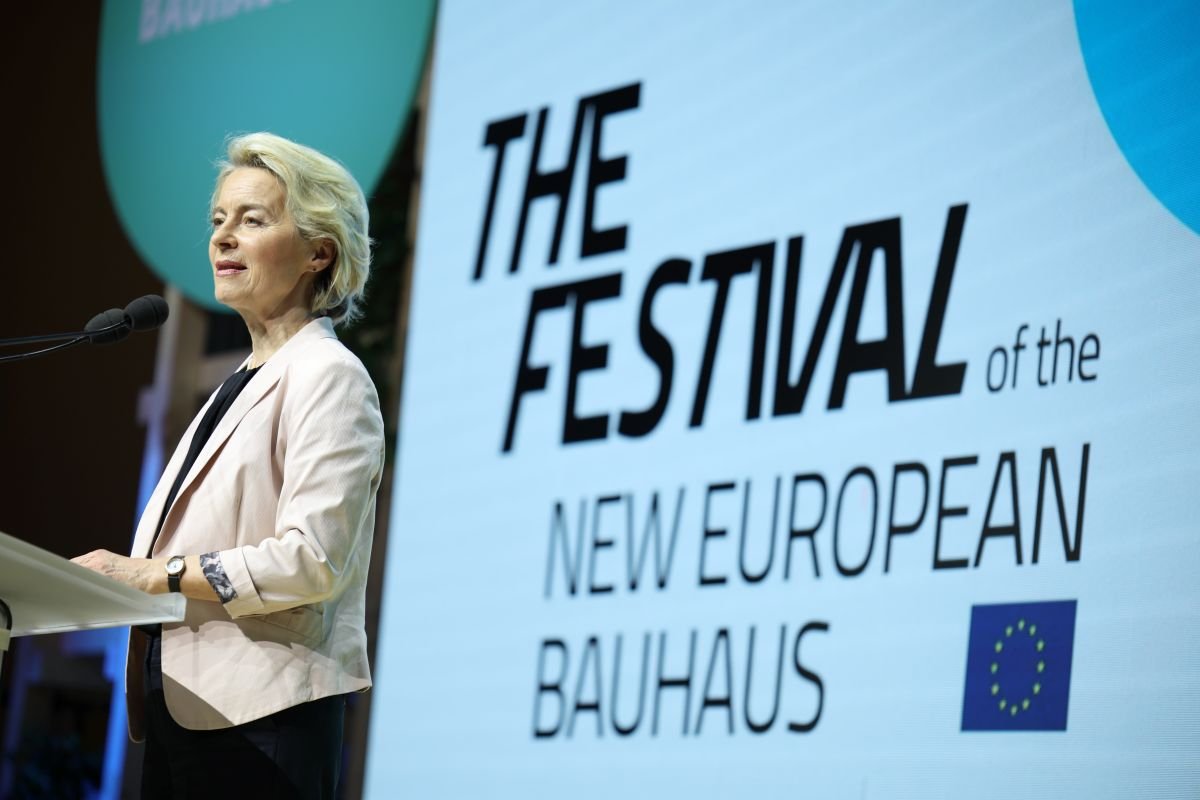
But as a festival aimed at celebrating it returns to Brussels this week, there is little to show for the early fanfare.
On Monday, the Parc du Cinquantenaire – the green heart of Brussels’ EU quarter – was on partial lockdown as construction workers hastily erected chipboard huts and a massive stage for the third biennial party to celebrate the NEB’s core values of “beautiful, together, and sustainable”.
Dozens of projects will be shown to thousands of expected attendees and curious passersby. A pair of Czech tourists eyed the site skeptically while strolling through the park. Had they ever heard of the New European Bauhaus? “No,” they said.
Old ideas
In reality, critics argue the lack of cultural impact the initiative has had since its launch comes by design.
“The NEB is a 20th century framing of a 21st century question,” argues Charles Esche, the former director of the Van Abbemuseum in Eindhoven and a long-time critic of the initiative.
Relying on the Bauhaus movement, which ran from 1919 to 1933 at schools in Weimar, Dessau and Berlin, as inspiration “points to Europe’s cultural stagnation and [attempts to recapture] the glory days,” Esche told Euractiv.
In that way, Brussels is no different to Germany’s far-right Alternative für Deutschland or the Dutch populist Geert Wilders, Esche added.
To date, the NEB ‘community’ claims some 2,000 members – which includes associations in Europe and beyond, like the China-based international bamboo lobby group INBAR – and covers a total of 700 projects.
Despite top billing for the oversized Hong Kong theatre mask exhibition “Happy Heads” that will be shown in the Parc du Cinquantenaire this week, the NEB has fallen far short of its original ambitions.
On YouTube the NEB has just 500 subscribers, slightly more than two for each video it has uploaded, along with 6,000 contacts on Facebook and 48,000 on Instagram.
That’s hardly a glowing endorsement of what von der Leyen originally said would be a “distinct aesthetic” to match Europe’s own “systemic change”.
In 2025, the first genuinely new Bauhaus initiative building began construction in Seville where Danish architects BIG will build a eye-catching headquarters under a solar panel gazebo to house some of the bloc’s researchers.
A ‘positive narrative’
Christian Ehler, a senior conservative MEP who like von der Leyen hails from Germany, has become a sort of patron for the initiative. His wife, Pernille Weiss-Ehler, also handles the NEB for the EU’s environment commissioner.
Ehler is confident that it will be a “positive narrative” for the EU’s green transformation.
In practice, however, much of the money goes to just three countries: Italy, Spain, and Portugal.
Each country has more EU-funded projects than Germany, Europe’s most populous state and the birthplace of Bauhaus. “Around 40% of all EU-based NEB projects are located in Southern Europe,” a Commission spokesperson said.
As examples, one programme saw €1.8 million allocated for an “AI-enhanced” website for NEB “knowledge gems”, another disbursed €1 million for a course on wood in Genoa, UTOPIZE spent €4 million for “urban citizen empowerment”.
What’s more, ‘Bauhaus Bites’ will spend €3 million on, among other things, “a hands-on cooking session led by chef Antonio Campo and social food entrepreneur Nicoletta Cosentino” in Palermo where participants were served “risotto agli agrumi”.
While citrus risotto might be delicious, that doesn’t amount to a revolution in architecture.
(bw, jp, rh)